
Pulp Fiction, 1927 · page 95 of 105
Amazing Stories, Vol. 2, No. 2 — page 95: what you’re looking at
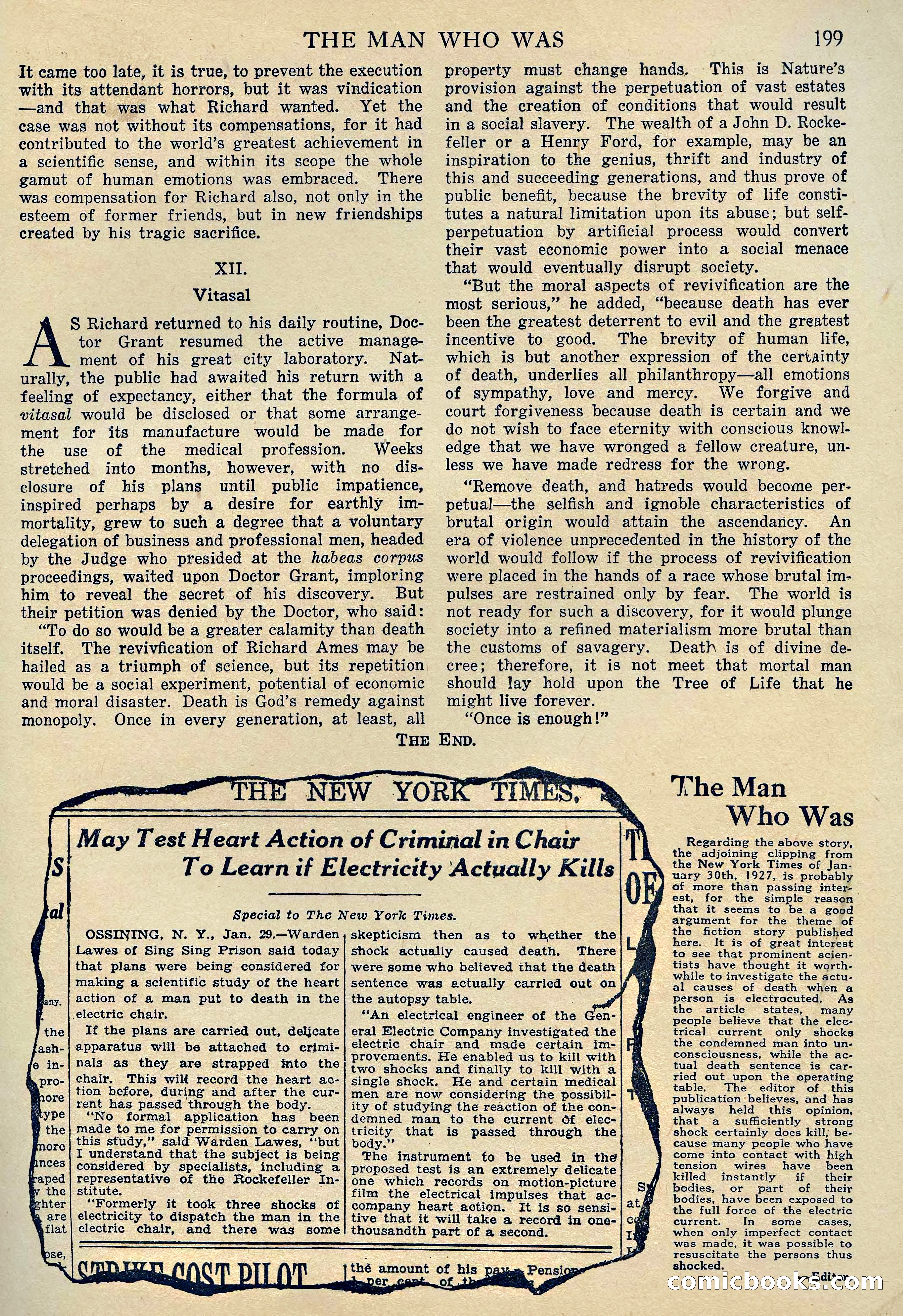
A restored page from Pulp Fiction, 1927. Page through the whole issue in the reader above.
📄 Transcribed text from this page (OCR, searchable)
Machine-transcribed from the original scan — historical spelling and the odd misread are preserved.
THE MAN WHO WAS 199 It came too late, it is true, to prevent the execution property must change hands. This is Nature’s with its attendant horrors, but it was vindication provision against the perpetuation of vast estates —and that was what Richard wanted. Yet the and the creation of conditions that would result case was not without its compensations, for it had ina social slavery. The wealth of a John D. Rocke- contributed to the world’s greatest achievement in feller or a Henry Ford, for example, may be an a scientific sense, and within its scope the whole inspiration to the genius, thrift and industry of gamut of human emotions was embraced. There this and succeeding generations, and thus prove of was compensation for Richard also, not only in the public benefit, because the brevity of life consti- esteem of former friends, but in new friendships tutes a natural limitation upon its abuse; but self- created by his tragic sacrifice. perpetuation by artificial process would convert their vast economic power into a social menace XII. that would eventually disrupt society. Vitasal “But the moral aspects of revivification are the most serious,” he added, “‘because death has ever S Richard returned to his daily routine, Doc- been the greatest deterrent to evil and the greatest tor Grant resumed the active manage- incentive to good. The brevity of human life, ment of his great city laboratory. Nat- which is but another expression of the certainty urally, the public had awaited his return with a of death, underlies all philanthropy—all emotions feeling of expectancy, either that the formula of of sympathy, love and mercy. We forgive and witasal would be disclosed or that some arrange- court forgiveness because death is certain and we ment for its manufacture would be made for do not wish to face eternity with conscious knowl- the use of the medical profession. Weeks edge that we have wronged a fellow creature, un- stretched into months, however, with no dis- less we have made redress for the wrong. closure of his plans until public impatience, “Remove death, and hatreds would become per- inspired perhaps by a desire for earthly im- _ petual—the selfish and ignoble characteristics of mortality, grew to such a degree that a voluntary brutal origin would attain the ascendancy. An delegation of business and professional men, headed era of violence unprecedented in the history of the by the Judge who presided at the habeas corpus world would follow if the process of revivification proceedings, waited upon Doctor Grant, imploring were placed in the hands of a race whose brutal im- him to reveal the secret of his discovery. But pulses are restrained only by fear. The world is their petition was denied by the Doctor, who said: not ready for such a discovery, for it would plunge “To do so would be a greater calamity than death society into a refined materialism more brutal than itself. The revivfication of Richard Ames may be the customs of savagery. Death is of divine de- hailed as a triumph of science, but its repetition cree; therefore, it is not meet that mortal man would be a social experiment, potential of economic should lay hold upon the Tree of Life that he and moral disaster. Death is God’s remedy against might live forever. monopoly. Once in every generation, at least, all “Once is enough!” THE END. Whe Man Who Was Regarding the above story, the adjoining clipping from the New York Times of Jan- uary 30th, 1927, is probably May T est Heart Action of Criminal in Chair To Learn if Electricity Actually Kills 5 est, for the simple reason that it seems to be a good argument for the theme of the fiction story published here. It is of great interest to see that prominent scien- tists have thought it worth- while to investigate the actu- al causes of death when a person is electrocuted. As the article states, many people believe that the elec- trical current only shocks the condemned man into un- consciousness, while the ac- tual death sentence is car- ried out upon the operating table. The editor of this publication ‘believes, and has always held this _ opinion, that a_ sufficiently strong shock certainly does kill; be- cause many people who have come into contact with high tension wires have been killed instantly if their bodies, or part of their bodies, have been exposed to the full force of the electric current. In some _ cases, when only imperfect contact was made, it was possible to resuscitate the persons thus shocked. Eomichbooks:.co al Special to The New York Times. OSSINING, N. Y., Jan. 29.—Warden, skepticism then as to whether the Lawes of Sing Sing Prison said today| shock actually caused death. ‘There that plans were being considered for] were some who believed that the death making a scientific study of the heart| sentence was actually carried out on | Any, | action of a man put to death in the] the autopsy table. Ser’, , electric chair. “An electrical engineer of the Gen- the| If the plans are carried out, deljcate| eral Electric Company investigated the ash-| apparatus will be attached to crimi-| electric chair and made certain im- a rovements. He enabled us to kill with] @ e in-| nals as they are strapped imto the ae shocks and finally to kill with aj & »pro-| Chair, This wilt record the heart ac-| single shock. He and certain medical} (a Wore | ion before, during and after the cur-|men are now considering the possibil- 2 rent has passed through the body. ity of studying the reaction of the con- ' eYPE| “No formal application has been} demned man to the current of elec- a 7 the} made to me for permission to carry on| tricity that is passed through the ore| this study,” said Warden Lawes, ‘‘but| body.” I understand that the subject is being| he instrument fo be used in the poses considered by specialists, including a] proposed test is an extremely delicate paped | representative of the Rockefeller In-| one which records on motion-picture fy the| stitute. film the electrical impulses that ac- sshter| ‘‘Formerly it took three shocks of| company heart aotion. It is so sensi- are| electricity to dispatch the man in the| tive that it will take a record in one- aflat| electric chair, and there was some! thousandth part of a second. ——— ED aaa (\ DTT thé amount of his payee Pensigg , ; E = Der Rot-8- (a) 3 ‘ of more than passing inter-_