
Pulp Fiction, 1927 · page 92 of 105
Amazing Stories, Vol. 2, No. 2 — page 92: what you’re looking at
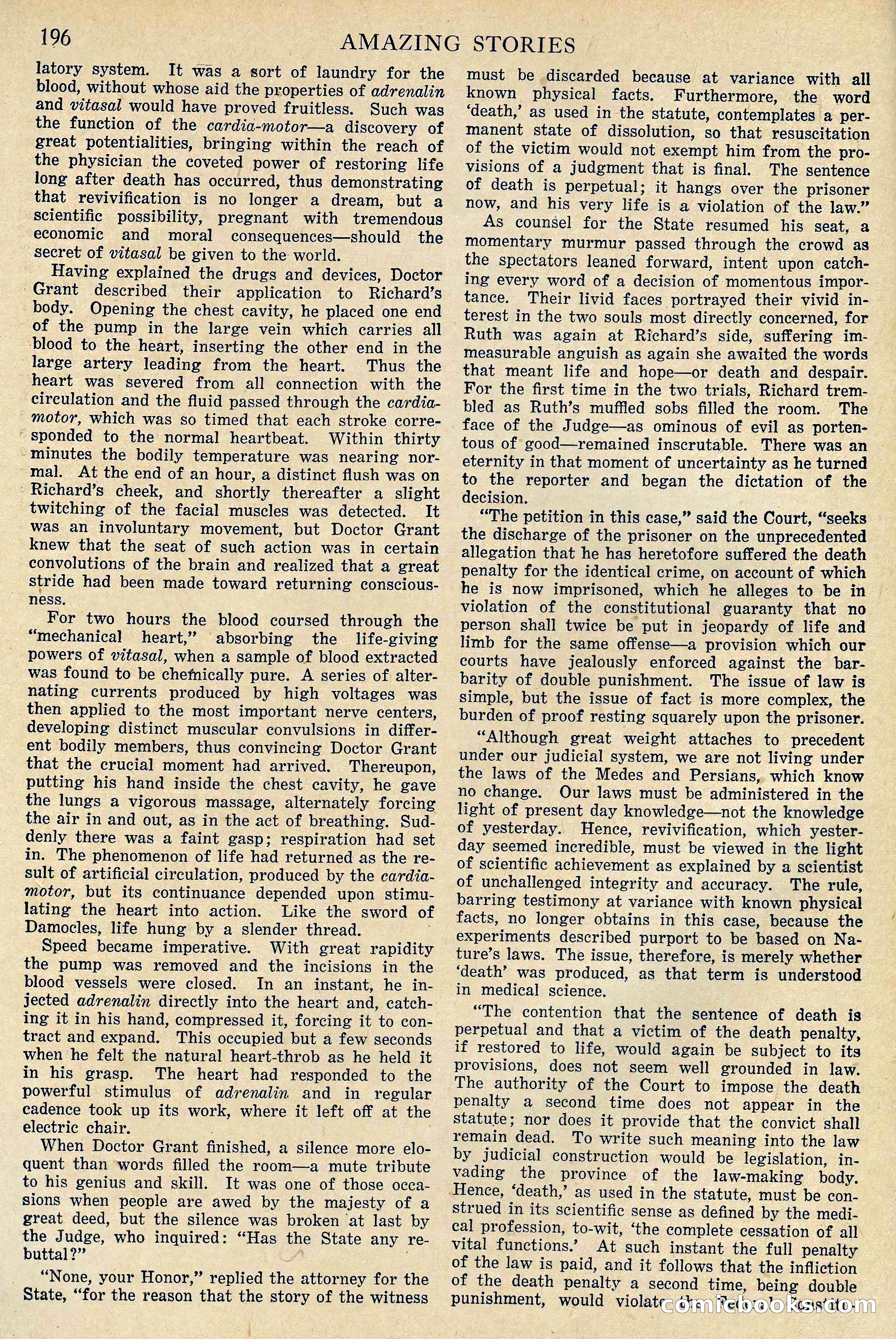
A restored page from Pulp Fiction, 1927. Page through the whole issue in the reader above.
📄 Transcribed text from this page (OCR, searchable)
Machine-transcribed from the original scan — historical spelling and the odd misread are preserved.
196 latory system. It was a sort of laundry for the blood, without whose aid the properties of adrenalin and vitasal would have proved fruitless. Such was the function of the cardia-motor—a discovery of great potentialities, bringing within the reach of the physician the coveted power of restoring life long after death has occurred, thus demonstrating that revivification is no longer a dream, but a scientific possibility, pregnant with tremendous economic and moral consequences—should the Secret of vitasal be given to the world. Having explained the drugs and devices, Doctor ~Grant described their application to Richard’s body. Opening the chest cavity, he placed one end of the pump in the large vein which carries all ‘blood to the heart, inserting the other end in the large artery leading from the heart. Thus the heart was severed from all connection with the circulation and the fluid passed through the cardia- motor, which was so timed that each stroke corre- * sponded to the normal heartbeat. Within thirty -minutes the bodily temperature was nearing nor- ~Mal. At the end of an hour, a distinct flush was on -Richard’s cheek, and shortly thereafter a slight twitching of the facial muscles was detected. It was an involuntary movement, but Doctor Grant knew that the seat of such action was in certain convolutions of the brain and realized that a great stride had been made toward returning conscious- ness. For two hours the blood coursed through the “mechanical heart,’ absorbing the life-giving powers of vitasal, when a sample of blood extracted was found to be chefnically pure. A series of alter- nating currents produced by high voltages was then applied to the most important nerve centers, developing distinct muscular convulsions in differ- ent bodily members, thus convincing Doctor Grant that the crucial moment had arrived. Thereupon, putting his hand inside the chest cavity, he gave the lungs a vigorous massage, alternately forcing the air in and out, as in the act of breathing. Sud- denly there was a faint gasp; respiration had set in. The phenomenon of life had returned as the re- sult of artificial circulation, produced by the cardia- motor, but its continuance depended upon stimu- lating the heart into action. Damocles, life hung by a slender thread. Speed became imperative. With great rapidity the pump was removed and the incisions in the blood vessels were closed. In an instant, he in- jected adrenalin directly into the heart and, catch- ing it in his hand, compressed it, forcing it to con- tract and expand. This occupied but a few seconds when he felt the natural heart-throb as he held it in his grasp. The heart had responded to the powerful stimulus of adrenalin and in regular cadence took up its work, where it left off at the electric chair. : When Doctor Grant finished, a silence more elo- quent than words filled the room—a mute tribute to his genius and skill. It was one of those occa- sions when people are awed by the majesty of a great deed, but the silence was broken ‘at last by the Judge, who inquired: “Has the State any re- buttal?” 3 “None, your Honor,” replied the attorney for the State, “for the reason that the story of the witness Like the sword of AMAZING STORIES must be discarded because at variance with all known physical facts. Furthermore, the word ‘death,’ as used in the statute, contemplates a per- manent state of dissolution, so that resuscitation of the victim would not exempt him from the pro- visions of a judgment that is final. The sentence of death is perpetual; it hangs over the prisoner now, and his very life is a violation of the law.” As counsel for the State resumed his seat, a momentary murmur passed through the crowd as the spectators leaned forward, intent upon catch- ing every word of a decision of momentous impor- tance. Their livid faces portrayed their vivid in- terest in the two souls most directly concerned, for Ruth was again at Richard’s side, suffering im- measurable anguish as again she awaited the words that meant life and hope—or death and despair. For the first time in the two trials, Richard trem- bled as Ruth’s muffled sobs filled the room. The face of the Judge—as ominous of evil as porten- tous of good—remained inscrutable. There was an eternity in that moment of uncertainty as he turned to the reporter and began the dictation of the decision. : “The petition in this case,” said the Court, “seeks the discharge of the prisoner on the unprecedented allegation that he has heretofore suffered the death penalty for the identical crime, on account of which he is now imprisoned, which he alleges to be in violation of the constitutional guaranty that no person shall twice be put in jeopardy of life and limb for the same offense—a provision which our courts have jealously enforced against the bar- barity of double punishment. The issue of law is simple, but the issue of fact is more complex, the burden of proof resting squarely upon the prisoner. “Although great weight attaches to precedent under our judicial system, we are not living under the laws of the Medes and Persians, which know no change. Our laws must be administered in the light of present day knowledge—not the knowledge of yesterday. Hence, revivification, which yester- day seemed incredible, must be viewed in the light of scientific achievement as explained by a scientist of unchallenged integrity and accuracy. The rule, barring testimony at variance with known physical facts, no longer obtains in this case, because the experiments described purport to be based on Na- ture’s laws. The issue, therefore, is merely whether ‘death’ was produced, as that term is understood in medical science. “The contention that the sentence of death is perpetual and that a victim of the death penalty, if restored to life, would again be subject to its provisions, does not seem well grounded in law. The authority of the Court to impose the death penalty a second time does not appear in the statute; nor does it provide that the convict shall remain dead. To write such meaning into the law by judicial construction would be legislation, in- vading the province of the law-making body. Hence, ‘death,’ as used in the statute, must be con- strued in its scientific sense as defined by the medi- cal profession, to-wit, ‘the complete cessation of all vital functions.’ At such instant the full penalty of the law is paid, and it follows that the infliction of the death penalty a second time, being double punishment, would violatecche) Te are lo) existatoy ny