
Pulp Fiction, 1927 · page 91 of 105
Amazing Stories, Vol. 2, No. 2 — page 91: what you’re looking at
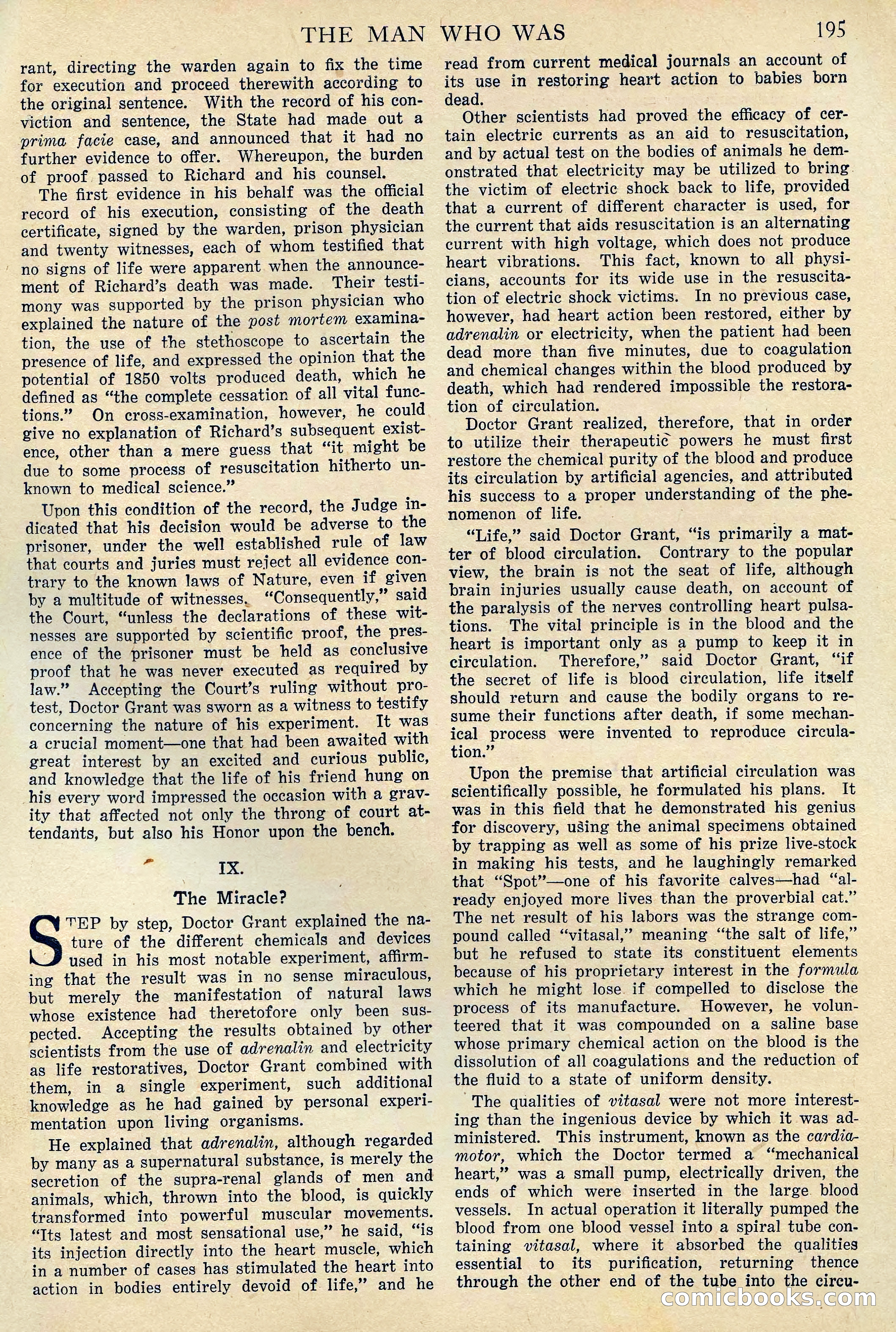
A restored page from Pulp Fiction, 1927. Page through the whole issue in the reader above.
📄 Transcribed text from this page (OCR, searchable)
Machine-transcribed from the original scan — historical spelling and the odd misread are preserved.
THE MAN rant, directing the warden again to fix the time for execution and proceed therewith according to the original sentence. With the record of his con- viction and sentence, the State had made out a prima facie case, and announced that it had no further evidence to offer. Whereupon, the burden of proof. passed to Richard and his counsel. The first evidence in his behalf was the official record of his execution, consisting of the death certificate, signed by the warden, prison physician and twenty witnesses, each of whom testified that ' no signs of life were apparent when the announce- ment of Richard’s death was made. Their testi- mony was supported by the prison physician who explained the nature of the post mortem examina- tion, the use of the stethoscope to ascertain the presence of life, and expressed the opinion that the potential of 1850 volts produced death, which he defined as “the complete cessation of all vital func- tions.’ On cross-examination, however, he could give no explanation of Richard’s subsequent exist- ence, other than a mere guess that “it might be due to some process of resuscitation hitherto un- known to medical science.” Upon this condition of the record, the Judge in- dicated that his decision would be adverse to the prisoner, under the well established rule of law that courts and juries must reject all evidence con- trary to the known laws of Nature, even if given by a multitude of witnesses. “Consequently,” said the Court, “unless the declarations of these wit- nesses are supported by scientific proof, the pres- ence of the prisoner must be held as conclusive proof that he was never executed as required by law.” Accepting the Court’s ruling without pro- test, Doctor Grant was sworn as a witness to testify concerning the nature of his experiment. It was a crucial moment—one that had been awaited with great interest by an excited and curious public, and knowledge that the life of his friend hung on his every word impressed the occasion with a grav- ity that affected not only the throng of court at- tendants, but also hig Honor upon the bench. = IX. The Miracle? TEP by step, Doctor Grant explained the na- ture of the different chemicals and devices J used in his most notable experiment, affirm- ing that the result was in no sense miraculous, but merely the manifestation of natural laws whose existence had theretofore only been sus- pected. Accepting the results obtained by other scientists from the use of adrenalin and electricity as life restoratives, Doctor Grant combined with them, in a single experiment, such additional knowledge as he had gained by personal experi- mentation upon living organisms. He explained that adrenalin, although regarded by many as a supernatural substance, is merely the secretion of the supra-renal glands of men and animals, which, thrown into the blood, is quickly transformed into powerful muscular movements. “Its latest and most sensational use,” he said, “is its injection directly into the heart muscle, which in a number of cases has stimulated the heart into action in bodies entirely devoid of life,” and he WHO WAS 195 read from current medical journals an account of its use in restoring heart action to babies born dead. . . Other scientists had proved the efficacy of cer- tain electric currents as an aid to resuscitation, and by actual test on the bodies of animals he dem- onstrated that electricity may be utilized to bring. the victim of electric shock back to life, provided that a current of different character is used, for the current that aids resuscitation is an alternating current with high voltage, which does not produce heart vibrations. This fact, known to all physi- cians, accounts for its wide use in the resuscita- tion of electric shock victims. In no previous case, however, had heart action been restored, either by adrenalin or electricity, when the patient had been dead more than five minutes, due to coagulation and chemical changes within the blood produced by death, which had rendered impossible the restora- tion of circulation. | Doctor Grant realized, therefore, that in order to utilize their therapeutic powers he must first restore the chemical purity of the blood and produce its circulation by artificial agencies, and attributed his success to a proper understanding of the phe- nomenon of life. “Life,” said Doctor Grant, “is primarily a mat- ter of blood circulation. Contrary to the popular view, the brain is not the seat of life, although brain injuries usually cause death, on account of the paralysis of the nerves controlling heart pulsa- tions. The vital principle is in the blood and the heart is important only as a pump to keep it in circulation. Therefore,’ said Doctor Grant, “if the secret of life is blood circulation, life itself should return and cause the bodily organs to re- sume their functions after death, if some mechan- ical process were invented to reproduce circula- tion.” | Upon the premise that artificial circulation was scientifically possible, he formulated his plans. It was in this field that he demonstrated his genius for discovery, uSing the animal specimens obtained by trapping as well as some of his prize live-stock in making his tests, and he laughingly remarked that “Spot”—one of his favorite calves—had “al- ready enjoyed more lives than the proverbial cat.” The net result of his labors was the strange com- pound called “vitasal,” meaning “the salt of life,” but he refused to state its constituent elements because of his proprietary interest in the formula which he might lose. if compelled to disclose the process of its manufacture. However, he volun- teered that it was compounded on a saline base whose primary chemical action on the blood is the dissolution of all coagulations and the reduction of the fluid to a state of uniform density. The qualities of vitasal were not more interest- ing than the ingenious device by which it was ad- ministered. This instrument, known as the cardia- motor, which the Doctor termed a “mechanical heart,” was a small pump, electrically driven, the ends of which were inserted in the large. blood vessels. In actual operation it literally pumped the blood from one blood vessel into a spiral tube con- taining vitasal, where it absorbed the qualities essential to its purification, returning thence through the other end of the tube into the circu- Eomicbooks:;¢com