
Pulp Fiction, 1927 · page 90 of 105
Amazing Stories, Vol. 2, No. 2 — page 90: what you’re looking at
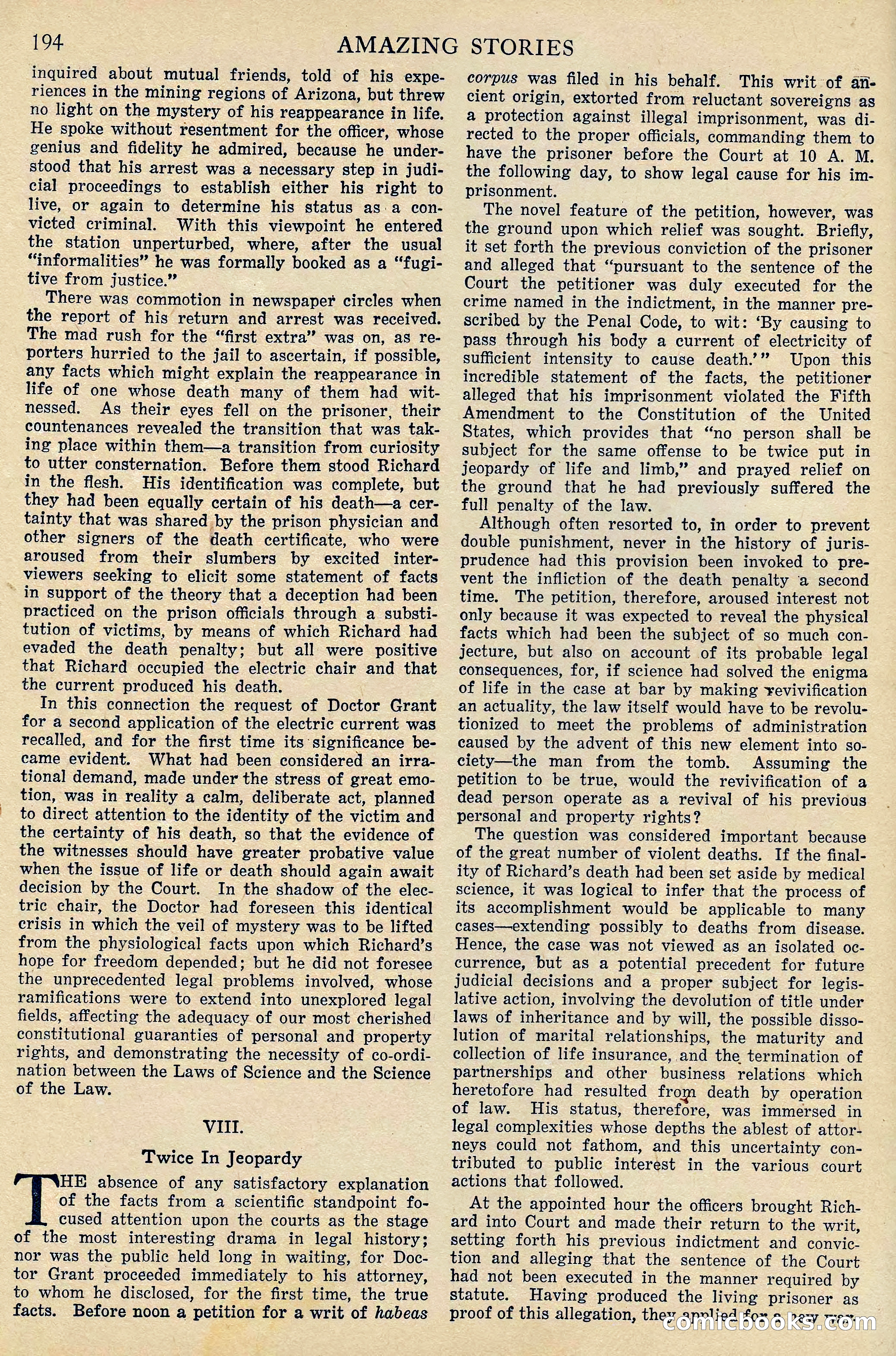
A restored page from Pulp Fiction, 1927. Page through the whole issue in the reader above.
📄 Transcribed text from this page (OCR, searchable)
Machine-transcribed from the original scan — historical spelling and the odd misread are preserved.
194. inquired about mutual friends, told of his expe- riences in the mining regions of Arizona, but threw no light on the mystery of his reappearance in life. He spoke without resentment for the officer, whose genius and fidelity he admired, because he under- stood that his arrest was a necessary step in judi- cial proceedings to establish either his right to live, or again to determine his status asa con- victed criminal. With this viewpoint he entered the station unperturbed, where, after the usual “informalities” he was formally booked as a “fugi- tive from justice.” : There was commotion in newspaper circles when the report of his return and arrest was received. The mad rush for the “first extra’? was on, as re- porters hurried to the jail to ascertain, if possible, any facts which might explain the reappearance in life of one whose death many of them had wit- nessed. As their eyes fell on the prisoner, their countenances revealed the transition that was tak- ing place within them—a transition from curiosity to utter consternation. Before them stood Richard in the flesh. His identification was complete, but they had been equally certain of his death—a cer- tainty that was shared by the prison physician and other signers of the death certificate, who were aroused from their slumbers by excited inter- viewers seeking to elicit some statement of facts ' In support of the theory that a deception had been practiced on the prison officials through a substi- tution of victims, by means of which Richard had evaded the death penalty; but all were positive that Richard occupied the electric chair and that the current produced his death. In this connection the request of Doctor Grant for a second application of the electric current was recalled, and for the first time its significance be- came evident. What had been considered an irra- tional demand, made under the stress of great emo- tion, was in reality a calm, deliberate act, planned to direct attention to the identity of the victim and the certainty of his death, so that the evidence of the witnesses should have greater probative value when the issue of life or death should again await decision by the Court. In the shadow of the elec- tric chair, the Doctor had foreseen this identical crisis in which the veil of mystery was to be lifted from the physiological facts upon which Richard’s hope for freedom depended: but he did not foresee the unprecedented legal problems involved, whose ramifications were to extend into unexplored legal fields, affecting the adequacy of our most cherished constitutional guaranties of personal and property rights, and demonstrating the necessity of co-ordi- nation between the Laws of Science and the Science of the Law. VIII. Twice In Jeopardy Te: absence of any satisfactory explanation of the facts from a scientific standpoint fo- cused attention upon the courts as the stage of the most interesting drama in legal history; nor was the public held long in waiting, for Doc- tor Grant proceeded immediately to his attorney, to whom he disclosed, for the first time, the true facts. Before noon a petition for a writ of habeas AMAZING STORIES corpus was filed in his behalf. This writ of ane cient origin, extorted from reluctant sovereigns as a protection against illegal imprisonment, was di- rected to the proper officials, commanding them to have the prisoner before the Court at 10 A. M. the following day, to show legal cause for his im- prisonment. : The novel feature of the petition, however, was the ground upon which relief was sought. Briefly, it set forth the previous conviction of the prisoner and alleged that “pursuant to the sentence of the Court the petitioner was duly executed for the crime named in the indictment, in the manner pre- scribed by the Penal Code, to wit: ‘By causing to pass through his body a current of electricity of sufficient intensity to cause death.’” Upon this incredible statement of the facts, the petitioner alleged that his imprisonment violated the Fifth Amendment to the Constitution of the United States, which provides that “no person shall be subject for the same offense to be twice put in jeopardy of life and limb,” and prayed relief on the ground that he had previously suffered the full penalty of the law. Although often resorted to, in order to prevent double punishment, never in the history of juris- prudence had this provision been invoked to pre- vent the infliction of the death penalty a second time. The petition, therefore, aroused interest not only because it was expected to reveal the physical facts which had been the subject of so much con- jecture, but also on account of its probable legal consequences, for, if science had solved the enigma of life in the case at bar by making ¥evivification an actuality, the law itself would have to be revolu- tionized to meet the problems of administration caused by the advent of this new element into so- ciety—the man from the tomb. Assuming the petition to be true, would the revivification of a dead person operate as a revival of his previous personal and property rights? The question was considered important because of the great number of violent deaths. If the final- ity of Richard’s death had been set aside by medical science, it was logical to infer that the process of its accomplishment would be applicable to many cases—extending possibly to deaths from disease. Hence, the case was not viewed as an isolated oc- currence, but as a potential precedent for future judicial decisions and a proper subject for legis- lative action, involving the devolution of title under laws of inheritance and by will, the possible disso- lution of marital relationships, the maturity and collection of life insurance, and the termination of partnerships and other business relations which heretofore had resulted from death by operation of law. His status, therefore, was immersed in legal complexities whose depths the ablest of attor- neys could not fathom, and this uncertainty con- tributed to public interest in the various court actions that followed. At the appointed hour the officers brought Rich- ard into Court and made their return to the writ, setting forth his previous indictment and convic- tion and alleging that the sentence of the Court had not been executed in the manner required by statute. Having produced the living prisoner as proof of this allegation, UMMC DOOIKS! COM