
Pulp Fiction, 1927 · page 89 of 105
Amazing Stories, Vol. 2, No. 2 — page 89: what you’re looking at
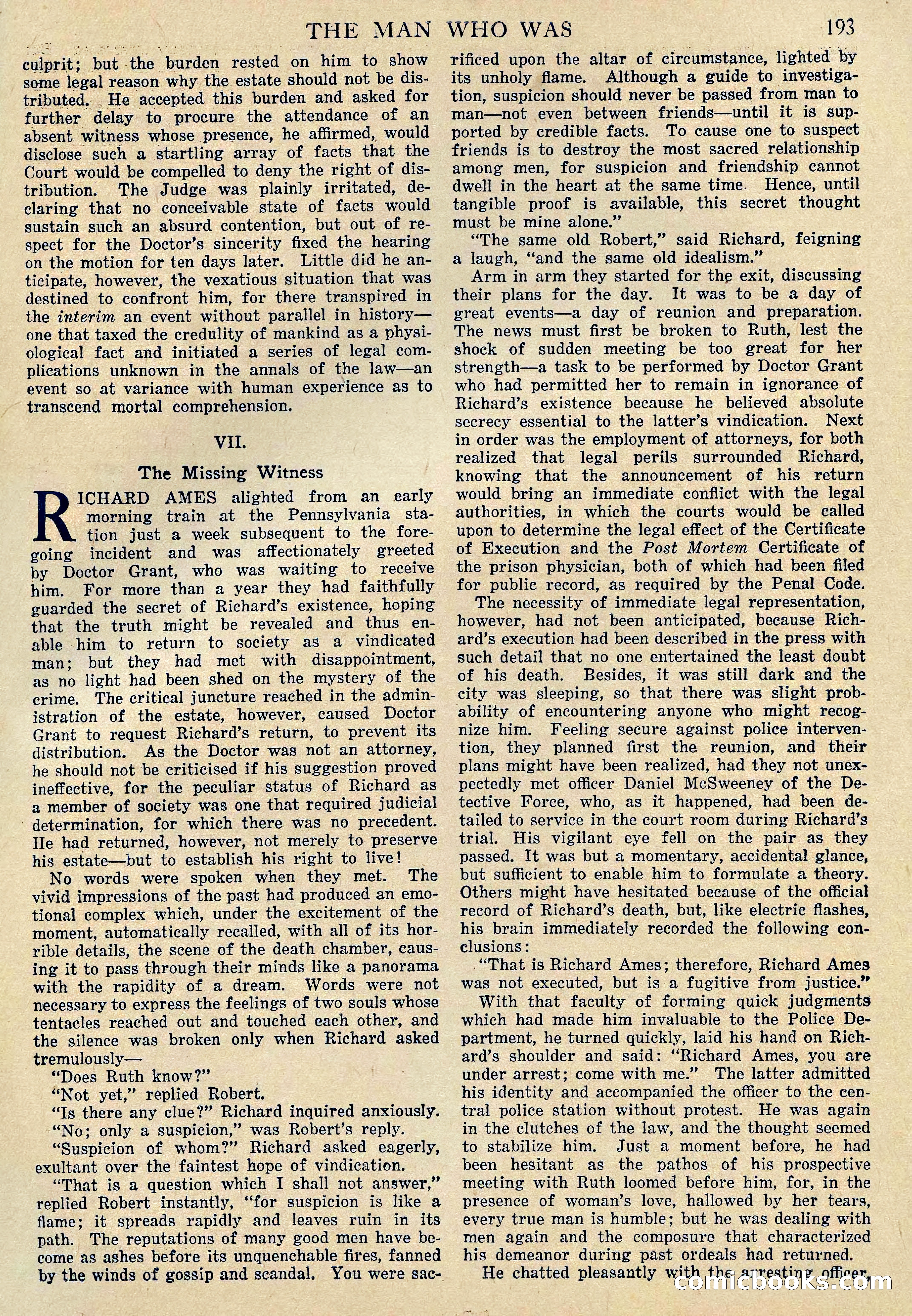
A restored page from Pulp Fiction, 1927. Page through the whole issue in the reader above.
📄 Transcribed text from this page (OCR, searchable)
Machine-transcribed from the original scan — historical spelling and the odd misread are preserved.
THE MAN culprit; but the burden rested on him to show some legal reason why the estate should not be dis- tributed. He accepted this burden and asked for further delay to procure the attendance of an absent witness whose presence, he affirmed, would disclose such a startling array of facts that the Court would be compelled to deny the right of dis- tribution. The Judge was plainly irritated, de- claring that no conceivable state of facts would sustain such an absurd contention, but out of re- spect for the Doctor’s sincerity fixed the hearing on the motion for ten days later. Little did he an- ticipate, however, the vexatious situation that was destined to confront him, for there transpired in the interim an event without parallel in history— one that taxed the credulity of mankind as a physi- ological fact and initiated a series of legal com- plications unknown in the annals of the law—an event so at variance with human experience as to transcend mortal comprehension. Vil. The Missing Witness | ICHARD AMES alighted from an early R morning train at the Pennsylvania sta- tion just a week subsequent to the fore- going incident and was affectionately greeted by Doctor Grant, who was waiting to receive him. For more than a year they had faithfully guarded the secret of Richard’s existence, hoping that the truth might be revealed and thus en- able him to return to society as a vindicated man; but they had met with disappointment, as no light had been shed on the mystery of the erime. The critical juncture reached in the admin- istration of the estate, however, caused Doctor Grant to request Richard’s return, to prevent its distribution. As the Doctor was not an attorney, he should not be criticised if his suggestion proved ineffective, for the peculiar status of Richard as a member of society was one that required judicial - determination, for which there was no precedent. He had returned, however, not merely to preserve his estate—but to establish his right to live! No words were spoken when they met. The vivid impressions of the past had produced an emo- tional complex which, under the excitement of the moment, automatically recalled, with all of its hor- rible details, the scene of the death chamber, caus- ing it to pass through their minds like a panorama with the rapidity of a dream. Words were not necessary to express the feelings of two souls whose tentacles reached out and touched each other, and the silence was broken only when Richard asked tremulously— “Does Ruth know?” , “Not yet,’ replied Robert. “Ts there any clue?” Richard inquired anxiously. “No: only a suspicion,” was Robert’s reply. “Suspicion of whom?” Richard asked eagerly, exultant over the faintest hope of vindication. “That is a question which I shall not answer,” replied Robert instantly, “for suspicion is like a flame: it spreads rapidly and leaves ruin in its path. The reputations of many good men have be- come as ashes before its unquenchable fires, fanned by the winds of gossip and scandal. You were sac- WHO WAS 193 rificed upon the altar of circumstance, lighted by its unholy flame. Although a guide to investiga- tion, suspicion should never be passed from man to man—not even between friends—until it is sup- ported by credible facts. To cause one to suspect friends is to destroy the most sacred relationship among men, for suspicion and friendship cannot dwell in the heart at the same time. Hence, until tangible proof is available, this secret thought must be mine alone.” “The same old Robert,” said Richard, feigning a laugh, “and the same old idealism.” Arm in arm they started for the exit, discussing their plans for the day. It was to be a day of great events—a day of reunion and preparation. The news must first be broken to Ruth, lest the shock of sudden meeting be too great for her strength—a task to be performed by Doctor Grant who had permitted her to remain in ignorance of Richard’s existence because he believed absolute secrecy essential to the latter’s vindication. Next in order was the employment of attorneys, for both realized that legal perils surrounded Richard, knowing that the announcement of his return would bring an immediate conflict with the legal authorities, in which the courts would be called upon to determine the legal effect of the Certificate of Execution and the Post Mortem Certificate of the prison physician, both of which had been filed for public record, as required by the Penal Code. The necessity of immediate legal representation, however, had not been anticipated, because Rich- ard’s execution had been described in the press with such detail that no one entertained the least doubt of his death. Besides, it was still dark and the city was sleeping, so that there was slight prob- ability of encountering anyone who might recog- nize him. Feeling secure against police interven- tion, they planned first the reunion, and their plans might have been realized, had they not unex- pectedly met officer Daniel McSweeney of the De- tective Force, who, as it happened, had been de- tailed to service in the court room during Richard’s trial. His vigilant eye fell on the pair as they passed. It was but a momentary, accidental glance, but sufficient to enable him to formulate a theory. Others might have hesitated because of the official record of Richard’s death, but, like electric flashes, his brain immediately recorded the following con- clusions: “That is Richard Ames; therefore, Richard Ames was not executed, but is a fugitive from justice.” With that faculty of forming quick judgments which had made him invaluable to the Police De- partment, he turned quickly, laid his hand on Rich- ard’s shoulder and said: ‘“‘Richard Ames, you are under arrest; come with me.” The latter admitted his identity and accompanied the officer to the cen- tral police station without protest. He was again in the clutches of the law, and the thought seemed to stabilize him. Just a moment before, he had been hesitant as the pathos of his prospective meeting with Ruth loomed before him, for, in the presence of woman’s love, hallowed by her tears, every true man is humble; but he was dealing with men again and the composure that characterized his demeanor during past ordeals had returned. He chatted pleasantly wil the arresting officer,