
Pulp Fiction, 1927 · page 9 of 105
Amazing Stories, Vol. 2, No. 2 — page 9: what you’re looking at
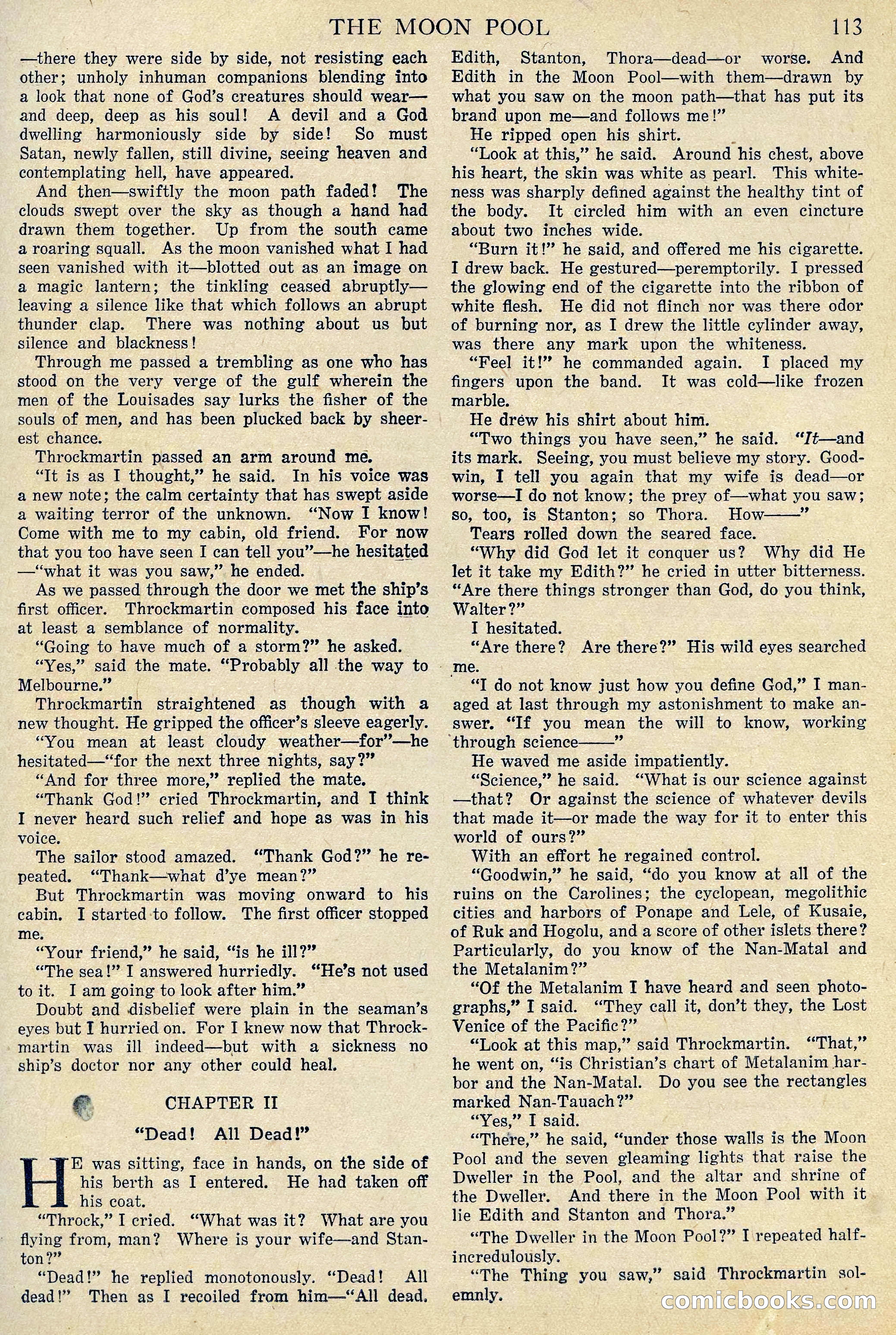
A restored page from Pulp Fiction, 1927. Page through the whole issue in the reader above.
📄 Transcribed text from this page (OCR, searchable)
Machine-transcribed from the original scan — historical spelling and the odd misread are preserved.
THE MOON POOL —there they were side by side, not resisting each other; unholy inhuman companions blending into a look that none of God’s creatures should wear— and deep, deep as his soul! A devil and a God dwelling harmoniously side by side! So must Satan, newly fallen, still divine, seeing heaven and contemplating hell, have appeared. And then—swiftly the moon path faded! The clouds swept over the sky as though a hand had drawn them together. Up from the south came a roaring squall. As the moon vanished what I had seen vanished with it—blotted out as an image on a magic lantern; the tinkling ceased abruptly— leaving a silence like that which follows an abrupt thunder clap. There was nothing about us but silence and blackness! Through me passed a trembling as one who has stood on the very verge of the gulf wherein the men of the Louisades say lurks the fisher of the souls of men, and has been plucked back by sheer- est chance. Throckmartin passed an arm around me. “It is as I thought,” he said. In his voice was a new note; the calm certainty that has swept aside a waiting terror of the unknown. ‘Now I know! Come with me to my cabin, old friend. For now that you too have seen I ean tell you”’—he hesitated —‘what it was you saw,” he ended. As we passed through the door we met the ship’s first officer. Throckmartin composed his face into at least a semblance of normality. “Going to have much of a storm?” he asked. “Yes,” said the mate. “Probably all the way to - Melbourne.” Throckmartin straightened as though with a new thought. He gripped the officer’s sleeve eagerly. “You mean at least cloudy weather—for’”—he hesitated—“for the next three nights, say?” “And for three more,” replied the mate. “Thank God!” eried Throckmartin, and I think I never heard such relief and hope as was in his voice. The sailor stood amazed. “Thank God?” he re- peated. “Thank—what d’ye mean?” But Throckmartin was moving onward to his cabin. I started-to follow. The first officer stopped me. “Your friend,” he said, “is he ill?” “The sea!’? I answered hurriedly. ‘“He’s not used to it. I am going to look after him.” Doubt and disbelief were plain in the seaman’s eyes but I hurried on. For I knew now that Throck- martin was ill indeed—but with a sickness no ship’s doctor nor any other could heal. &. CHAPTER II “Dead! All Dead!” : E was sitting, face in hands, on the side of H his berth as I entered. He had taken off his coat. “Throck,” I cried. “What was it? What are you flying from, man? Where is your wife—and Stan- ton?” “Dead!” he replied monotonously. ‘Dead! All dead!” Then as I recoiled from him—‘“All dead. ‘through science 113 Edith, Stanton, Thora—dead—or worse. And Edith in the Moon Pool—with them—drawn by what you saw on the moon path—that has put its brand upon me—and follows me!” He ripped open his shirt. ‘ “Look at this,’’ he said. Around his chest, above his heart, the skin was white as pearl. This white- ness was sharply defined against the healthy tint of the body. It circled him with an even cincture about two inches wide. “Burn it!” he said, and offered me his cigarette. I drew back. He gestured—peremptorily. I pressed the glowing end of the cigarette into the ribbon of white flesh. He did not flinch nor was there odor of burning nor, as I drew the little cylinder away, was there any mark upon the whiteness. “Feel it!” he commanded again. I placed my fingers upon the band. It was cold—like frozen marble. He dréw his shirt about him. “Two things you have seen,” he said. “Jé—and its mark. Seeing, you must believe my story. Good- win, I tell you again that my wife is dead—or worse—I do not know; the prey of—what you saw; so, too, is Stanton; so Thora. How " Tears rolled down the seared face. 3 “Why did God let it conquer us? Why did He let it take my Edith?” he cried in utter bitterness. “Are there things stronger than God, do you think, Walter?” I hesitated. “Are there? Are there?” His wild eyes searched me. “T do not know just how you define God,” I man- aged at last through my astonishment to make an- swer. “If you mean the will to know, working 99 He waved me aside impatiently. “Science,” he said. “What is our science against —that? Or against the science of whatever devils that made it—or made the way for it to enter this world of ours?” With an effort he regained control. “Goodwin,” he said, “do you know at all of the ruins on the Carolines; the cyclopean, megolithic cities and harbors of Ponape and Lele, of Kusaie, of Ruk and Hogolu, and a score of other islets there? Particularly, do you know of the Nan-Matal and the Metalanim?”’ “Of the Metalanim I have heard and seen photo- graphs,” I said. “They call it, don’t they, the Lost Venice of the Pacific?” “Took at this map,” said Throckmartin. ‘That,’ he went on, “is Christian’s chart of Metalanim har- bor and the Nan-Matal. Do you see the rectangles marked Nan-Tauach?” “Yes,’”’ I said. “There,” he said, “under those walls is the Moon Pool and the seven gleaming lights that raise the Dweller in the Pool, and the altar and shrine of the Dweller. And there in the Moon Pool with it lie Edith and Stanton and Thora.” “The Dweller in the Moon Pool?” I repeated half- incredulously. “The Thing you saw,” said Throckmartin sol-