
Pulp Fiction, 1927 · page 10 of 105
Amazing Stories, Vol. 2, No. 2 — page 10: what you’re looking at
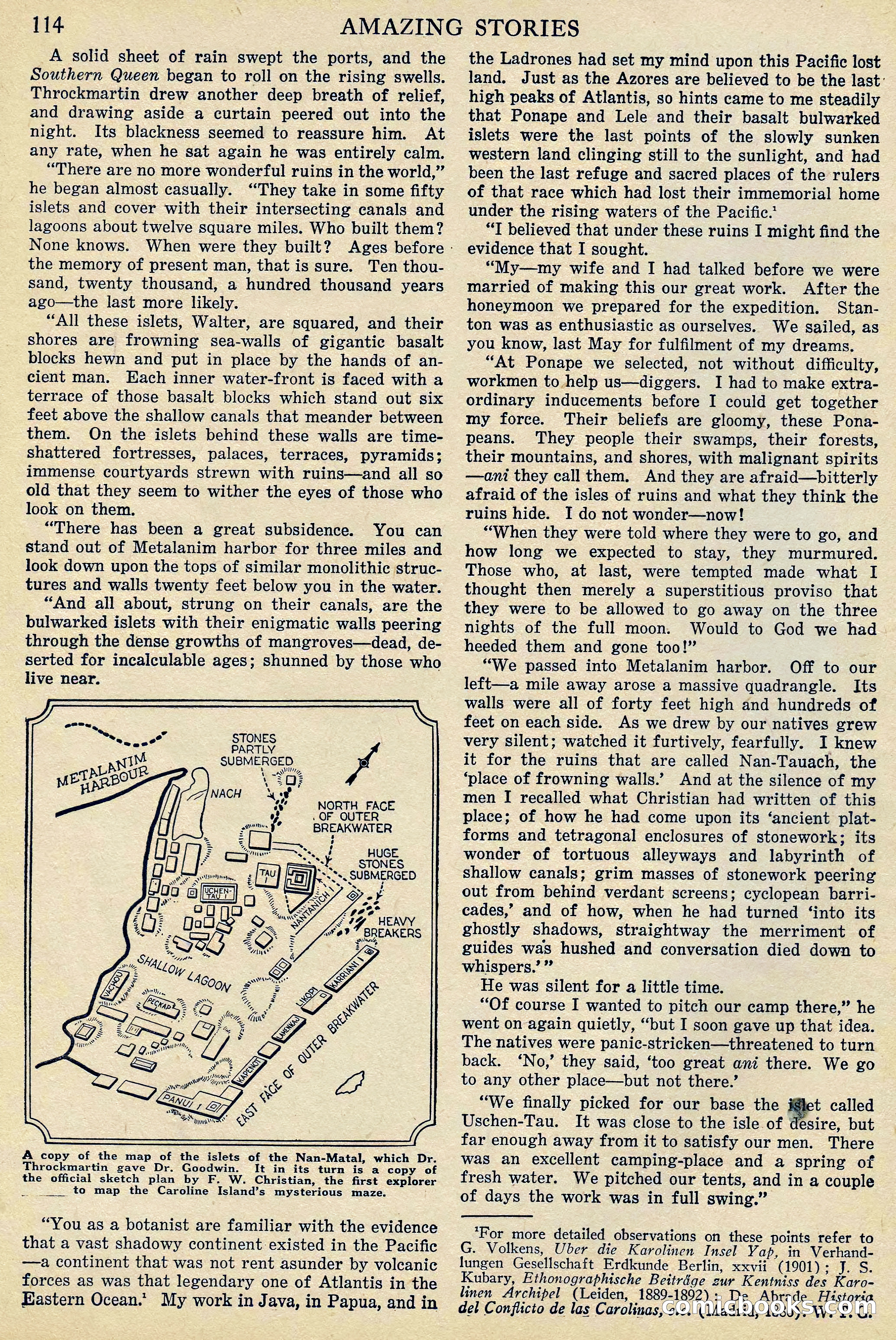
A restored page from Pulp Fiction, 1927. Page through the whole issue in the reader above.
📄 Transcribed text from this page (OCR, searchable)
Machine-transcribed from the original scan — historical spelling and the odd misread are preserved.
114 A solid sheet of rain swept the ports, and the Southern Queen began to roll on the rising swells. Throckmartin drew another deep breath of relief, and drawing aside a curtain peered out into the night. Its blackness seemed to reassure him. At any rate, when he sat again he was entirely calm. “There are no more wonderful ruins in the world,” he began almost casually. ‘They take in some fifty islets and cover with their intersecting canals and lagoons about twelve square miles. Who built them? None knows. When were they built? the memory of present man, that is sure. Ten thou- sand, twenty thousand, a hundred thousand years ago—the last more likely. “All these islets, Walter, are squared, and their shores are frowning sea-walls of gigantic basalt blocks hewn and put in place by the hands of an- cient man. Each inner water-front is faced with a terrace of those basalt blocks which stand out six feet above the shallow canals that meander between them. On the islets behind these walls are time- Shattered fortresses, palaces, terraces, pyramids; immense courtyards strewn with ruins—and all so old that they seem to wither the eyes of those who look on them. “There has been a great subsidence. You can stand out of Metalanim harbor for three miles and look down upon the tops of similar monolithic struc- tures and walls twenty feet below you in the water. “And all about, strung on their canals, are the bulwarked islets with their enigmatic walls peering through the dense growths of mangroves—dead, de- serted for incalculable ages; shunned by those who live near. NORTH FACE . OF OUTER BREAKWATER = ere - HUGE F --F STONES STONES PARTLY SUBMERGED : UG: te55 = e QU, g = ats S k 98 3 0 = = = ‘s = Z » wo vis = = ve ol Oo “is ROM ; Nyy) at ee: Ney, FE = ies ANN, > 2 vee ee an ATS SS ; ieee PS any PA, CP ‘ 4 ” 4 Y A copy of the map of the islets of the Nan-Matal, which Dr. Throckmartin gave Dr. Goodwin. It in its turn is a copy of the official sketch plan by F. W. Christian, the first explorer _to map the Caroline Island’s mysterious maze. “You as a botanist are familiar with the evidence that a vast shadowy continent: existed in the Pacific —a continent that was not rent asunder by volcanic forces as was that legendary one of Atlantis in the Eastern Ocean.” My work in Java, in Papua, and in Ages before - AMAZING STORIES the Ladrones had set my mind upon this Pacific lost land. Just as the Azores are believed to be the last: high peaks of Atlantis, so hints came to me steadily that Ponape and Lele and their basalt bulwarked islets were the last points of the slowly sunken western land clinging still to the sunlight, and had been the last refuge and sacred places of the rulers of that race which had lost their immemorial home under the rising waters of the Pacific.’ “TI believed that under these ruins I might find the evidence that I sought. “My—my wife and I had talked before we were married of making this our great work. After the honeymoon we prepared for the expedition. Stan- ton was as enthusiastic as ourselves. We sailed, as you know, last May for fulfilment of my dreams. “At Ponape we selected, not without difficulty, workmen to help us—diggers. I had to make extra- ordinary inducements before I could get together my force. Their beliefs are gloomy, these Pona- peans. They people their swamps, their forests, their mountains, and shores, with malignant spirits —ani they call them. And they are afraid—bitterly afraid of the isles of ruins and what they think the ruins hide. I do not wonder—now! “When they were told where they were to go, and how long we expected to stay, they murmured. Those who, at last, were tempted made what I thought then merely a superstitious proviso that they were to be allowed to go away on the three nights of the full moon. Would to God we had heeded them and gone too!” “We passed into Metalanim harbor. Off to our left—a mile away arose a massive quadrangle. Its walls were all of forty feet high and hundreds of feet on each side. As we drew by our natives grew very silent; watched it furtively, fearfully. I knew it for the ruins that are called Nan-Tauach, the ‘place of frowning walls.’ And at the silence of my men I recalled what Christian had written of this place; of how he had come upon its ‘ancient plat- forms and tetragonal enclosures of stonework; its wonder of tortuous alleyways and labyrinth of shallow canals; grim masses of stonework peering out from behind verdant screens; cyclopean barri- cades,’ and of how, when he had turned ‘into its ghostly shadows, straightway the merriment of guides was hushed and conversation died down to whispers.’ ” ‘He was silent for a little time. “Of course I wanted to pitch our camp there,” he went on again quietly, “but I soon gave up that idea. The natives were panic-stricken—threatened to turn back. ‘No,’ they said, ‘too great ani there. We go to any other place—but not there.’ “We finally picked for our base the i@let called Uschen-Tau. It was close to the isle of desire, but far enough away from it to satisfy our men. There was an excellent camping-place and a spring of fresh water. We pitched our tents, and in a couple of days the work was in full swing.” ‘For more detailed observations on these points refer to G. Volkens, Uber die Karolinen Insel V ap, in Verhand- lungen Gesellschaft Erdkunde Berlin, xxvii (1901); J. S. Kubary, Ethonographische Beitrége zur Kentniss des Karo- linen Archipel (Leiden, 1889-1892): De Ab istora del Conflicto de las Carolinas,2.°. mich Oks.com