
Pulp Fiction, 1927 · page 8 of 105
Amazing Stories, Vol. 2, No. 2 — page 8: what you’re looking at
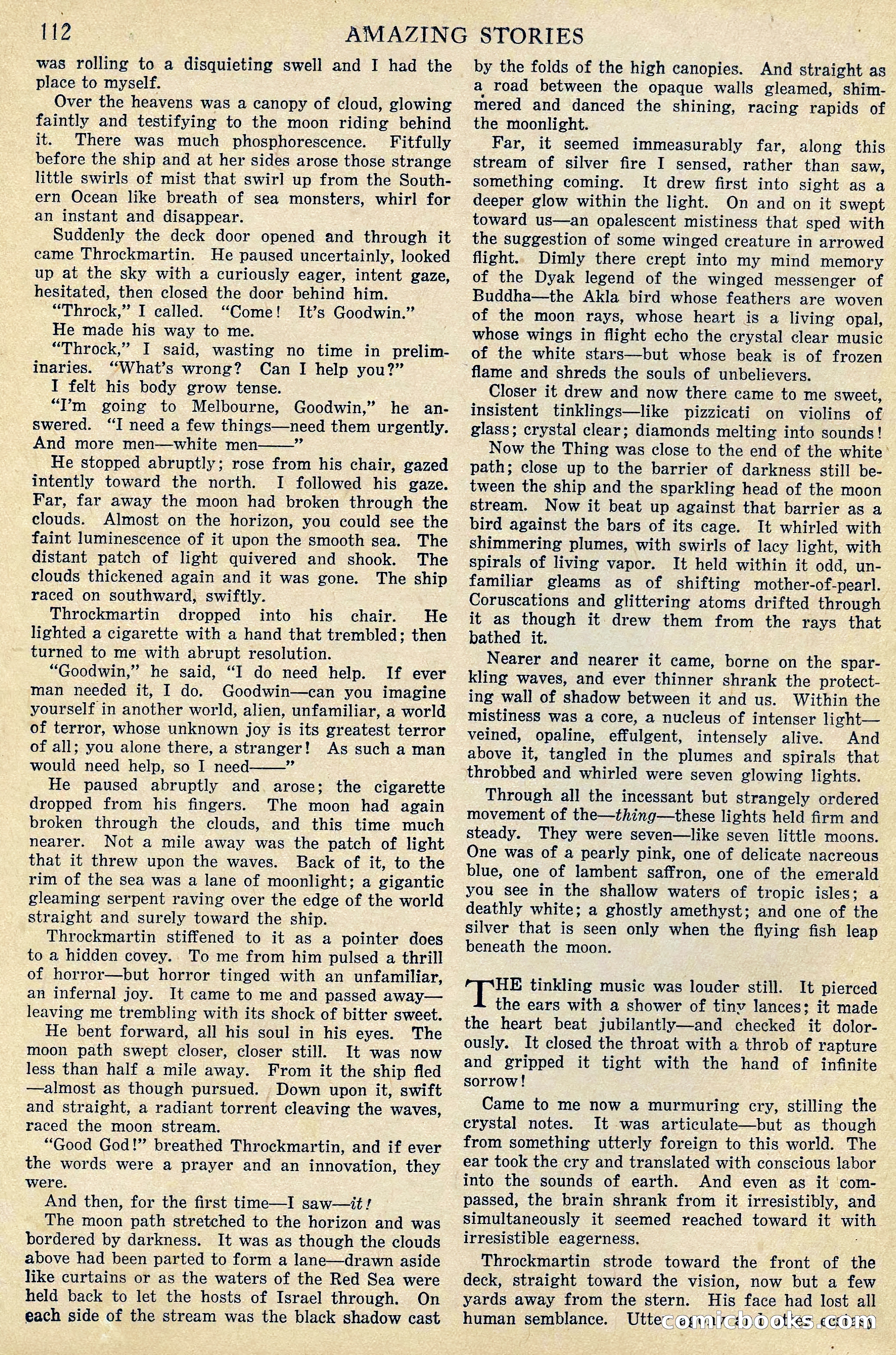
A restored page from Pulp Fiction, 1927. Page through the whole issue in the reader above.
📄 Transcribed text from this page (OCR, searchable)
Machine-transcribed from the original scan — historical spelling and the odd misread are preserved.
112 was rolling to a disquieting swell and I had the place to myself. Over the heavens was a canopy of cloud, glowing faintly and testifying to the moon riding behind it. There was much phosphorescence. Fitfully before the ship and at her sides arose those strange little swirls of mist that swirl up from the South- ern Ocean like breath of sea monsters, whirl for an instant and disappear. Suddenly the deck door opened and through it came Throckmartin. He paused uncertainly, looked up at the sky with a curiously eager, intent gaze, hesitated, then closed the door behind him. “Throck,” I called. “Come! It’s Goodwin.” He made his way to me. “Throck,” I said, wasting no time in prelim- inaries. “What’s wrong? Can I help you?” I felt his body grow tense. “Tm going to Melbourne, Goodwin,” he an- swered. “I need a few things—need them urgently. And more men—white men i He stopped abruptly; rose from his chair, gazed intently toward the north. I followed his gaze. Far, far away the moon had broken through the clouds. Almost on the horizon, you could see the faint luminescence of it upon the smooth sea. The distant patch of light quivered and shook. The clouds thickened again and it was gone. The ship raced on southward, swiftly. Throckmartin dropped into his chair. He lighted a cigarette with a hand that trembled; then turned to me with abrupt resolution. “Goodwin,” he said, “I do need help. If ever man needed it, I do. Goodwin—can you imagine yourself in another world, alien, unfamiliar, a world of terror, whose unknown joy is its greatest terror of all; you alone there, a stranger! As such a man would need help, so I need. ee He paused abruptly and arose; the cigarette dropped from his fingers. The moon had again broken through the clouds, and this time much nearer. Not a mile away was the patch of light that it threw upon the waves. Back of it, to the rim of the sea was a lane of moonlight; a gigantic gleaming serpent raving over the edge of the world straight and surely toward the ship. Throckmartin stiffened to it as a pointer does to a hidden covey. To me from him pulsed a thrill of horror—but horror tinged with an unfamiliar, an infernal joy. It came to me and passed away— leaving me trembling with its shock of bitter sweet. He bent forward, all his soul in his eyes. The moon path swept closer, closer still. It was now less than half a mile away. From it the ship fled —almost as though pursued. Down upon it, swift and straight, a radiant torrent cleaving the waves, raced the moon stream. “Good God!” breathed Throckmartin, and if ever the words were a prayer and an innovation, they were. And then, for the first time—I saw—it! The moon path stretched to the horizon and was bordered by darkness. It was as though the clouds above had been parted to form a lane—drawn aside like curtains or as the waters of the Red Sea were held back to let the hosts of Israel through. On each side of the stream was the black shadow cast AMAZING STORIES by the folds of the high canopies. And straight as a road between the opaque walls gleamed, shim- mered and danced the shining, racing rapids of the moonlight. Far, it seemed immeasurably far, along this stream of silver fire I sensed, rather than saw, something coming. It drew first into sight as a deeper glow within the light. On and on it Swept toward us—an opalescent mistiness that sped with the suggestion of some winged creature in arrowed flight. Dimly there crept into my mind memory of the Dyak legend of the winged messenger of Buddha—the Akla bird whose feathers are woven of the moon rays, whose heart is a living opal, whose wings in flight echo the crystal clear music of the white stars—but whose beak is of frozen flame and shreds the souls of unbelievers. Closer it drew and now there came to me sweet, insistent tinklings—like pizzicati on violins of glass; crystal clear; diamonds melting into sounds! Now the Thing was close to the end of the white’ path; close up to the barrier of darkness still be- tween the ship and the sparkling head of the moon stream. Now it beat up against that barrier as a bird against the bars of its cage. It whirled with shimmering plumes, with swirls of lacy light, with Spirals of living vapor. It held within it odd, un- familiar gleams as of shifting mother-of-pearl. Coruscations and glittering atoms drifted through it as though it drew them from the rays that bathed it. Nearer and nearer it came, borne on the spar- kling waves, and ever thinner shrank the protect- ing wall of shadow between it and us. Within the mistiness was a core, a nucleus of intenser light— veined, opaline, effulgent, intensely alive. And above it, tangled in the plumes and spirals that throbbed and whirled were seven glowing lights. Through all the incessant but strangely ordered movement of the—thing—these lights held firm and steady. They were seven—like seven little moons. One was of a pearly pink, one of delicate nacreous blue, one of lambent saffron, one of the emerald you see in the shallow waters of tropic isles: a deathly white; a ghostly amethyst: and one of the silver that is seen only when the flying fish leap beneath the moon. SRLS tinkling music was louder still. It pierced the ears with a shower of tinv lances: it made the heart beat jubilantly—and checked it dolor- ously. It closed the throat with a throb of rapture and gripped it tight with the hand of infinite sorrow ! Came to me now a murmuring cry, stilling the crystal notes. It was articulate—but as though from something utterly foreign to this world. The ear took the cry and translated with conscious labor into the sounds of earth. And even as it ‘com- passed, the brain shrank from it irresistibly, and simultaneously it seemed reached toward it mae irresistible eagerness. Throckmartin strode toward the front of the deck, straight toward the vision, now but a few yards away from the stern. His face had lost all human semblance. Uttecepviyraamot'e ccarss)