
Pulp Fiction, 1927 · page 88 of 105
Amazing Stories, Vol. 2, No. 2 — page 88: what you’re looking at
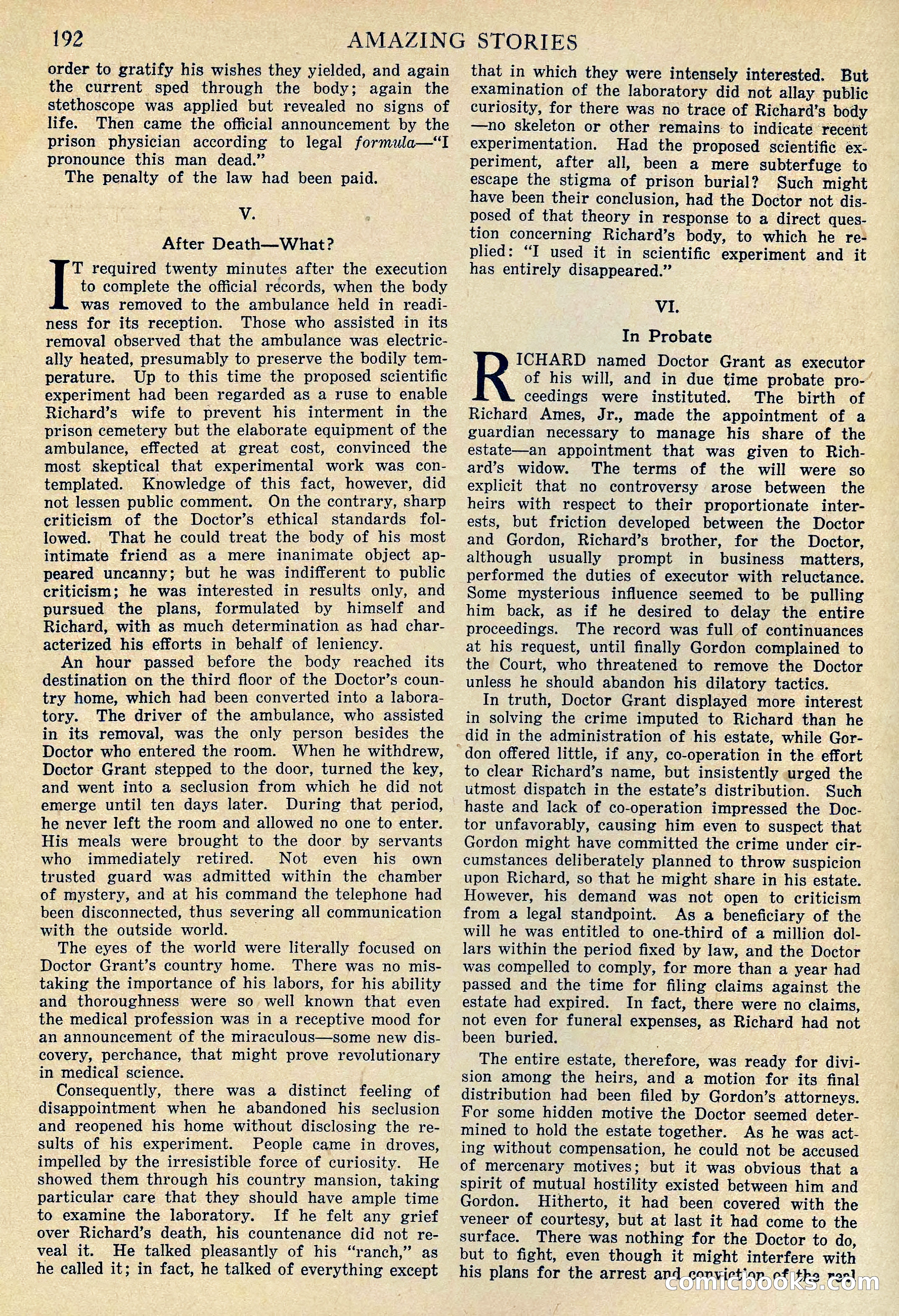
A restored page from Pulp Fiction, 1927. Page through the whole issue in the reader above.
📄 Transcribed text from this page (OCR, searchable)
Machine-transcribed from the original scan — historical spelling and the odd misread are preserved.
192 order to gratify his wishes they yielded, and again the current sped through the body; again the stethoscope was applied but revealed no signs of life. Then came the official announcement by the prison physician according to legal formula—“I pronounce this man dead.” The penalty of the law had been paid. V. After Death—What? T required twenty minutes after the execution | to complete the official records, when the body was removed to the ambulance held in readi- ness for its reception. Those who assisted in its removal observed that the ambulance was electric- ally heated, presumably to preserve the bodily tem- perature. Up to this time the proposed scientific experiment had been regarded as a ruse to enable Richard’s wife to prevent his interment in the prison cemetery but the elaborate equipment of the ambulance, effected at great cost, convinced the most skeptical that experimental work was con- templated. Knowledge of this fact, however, did not lessen public comment. On the contrary, sharp criticism of the Doctor’s ethical standards fol- lowed. That he could treat the body of his most intimate friend as a mere inanimate object ap- peared uncanny; but he was indifferent to public criticism; he was interested in results only, and pursued the plans, formulated by himself and Richard, with as much determination as had char- acterized his efforts in behalf of leniency. An hour passed before the body reached its destination on the third floor of the Doctor’s coun- try home, which had been converted into a labora- tory. The driver of the ambulance, who assisted in its removal, was the only person besides the Doctor who entered the room. When he withdrew, Doctor Grant stepped to the door, turned the key, and went into a seclusion from which he did not emerge until ten days later. During that period, he never left the room and allowed no one to enter. His meals were brought to the door by servants who immediately retired. Not even his own trusted guard was admitted within the chamber of mystery, and at his command the telephone had been disconnected, thus severing all communication with the outside world. _ The eyes of the world were literally focused on Doctor Grant’s country home. There was no mis- taking the importance of his labors, for his ability and thoroughness were so well known that even the medical profession was in a receptive mood for an announcement of the miraculous—some new dis- covery, perchance, that might prove revolutionary in medical science. | Consequently, there was a distinct feeling of disappointment when he abandoned his seclusion and reopened his home without disclosing the re- sults of his experiment. People came in droves, impelled by the irresistible force of curiosity. He showed them through his country mansion, taking particular care that they should have ample time to examine the laboratory. If he felt any grief over Richard’s death, his countenance did not re- veal it. He talked pleasantly of his “ranch,” as he called it; in fact, he talked of everything except AMAZING STORIES that in which they were intensely interested. But examination of the laboratory did not allay public curiosity, for there was no trace of Richard's body —no skeleton or other remains to indicate ‘recent experimentation. Had the proposed scientific ex: periment, after all, been a mere subterfuge to escape the stigma of prison burial? Such might have been their conclusion, had the Doctor not dis- posed of that theory in response to a direct ques- tion concerning Richard’s body, to which he re- plied: “I used it in scientific experiment and it has entirely disappeared.” VI. In Probate of his will, and in due time probate pro- ceedings were instituted. The birth of Richard Ames, Jr., made the appointment of a guardian necessary to manage his share of the estate—an appointment that was given to Rich- ard’s widow. The terms of the will were so explicit that no controversy arose between the heirs with respect to their proportionate inter- ests, but friction developed between the Doctor and Gordon, Richard’s brother, for the Doctor, although usually prompt in business matters, performed the duties of executor with reluctance. Some mysterious influence seemed to be pulling him back, as if he desired to delay the entire proceedings. The record was full of continuances at his request, until finally Gordon complained to the Court, who threatened to remove the Doctor unless he should abandon his dilatory tactics. In truth, Doctor Grant displayed more interest in solving the crime imputed to Richard than he did in the administration of his estate, while Gor- R eens: named Doctor Grant as executor don offered little, if any, co-operation in the effort to clear Richard’s name, but insistently urged the utmost dispatch in the estate’s distribution. Such haste and lack of co-operation impressed the Doc- tor unfavorably, causing him even to suspect that Gordon might have committed the crime under cir- cumstances deliberately planned to throw suspicion upon Richard, so that he might Share in his estate. However, his demand was not open to criticism from a legal standpoint. As a beneficiary of the will he was entitled to one-third of a million dol- lars within the period fixed by Iaw, and the Doctor was compelled to comply, for more than a year had passed and the time for filing claims against the estate had expired. In fact, there were no claims, not even for funeral expenses, as Richard had not been buried. The entire estate, therefore, was ready for divi- sion among the heirs, and a motion for its final distribution had been filed by Gordon’s attorneys. For some hidden motive the Doctor seemed deter- mined to hold the estate together. As he was act- ing without compensation, he could not be accused of mercenary motives; but it was obvious that a spirit of mutual hostility existed between him and Gordon. Hitherto, it had been covered with the veneer of courtesy, but at last it had come to the surface. There was nothing for the Doctor to do, but to fight, even though it might interfere with his plans for the arrest apd covvictiop..nf the ral im