
Pulp Fiction, 1927 · page 87 of 105
Amazing Stories, Vol. 2, No. 2 — page 87: what you’re looking at
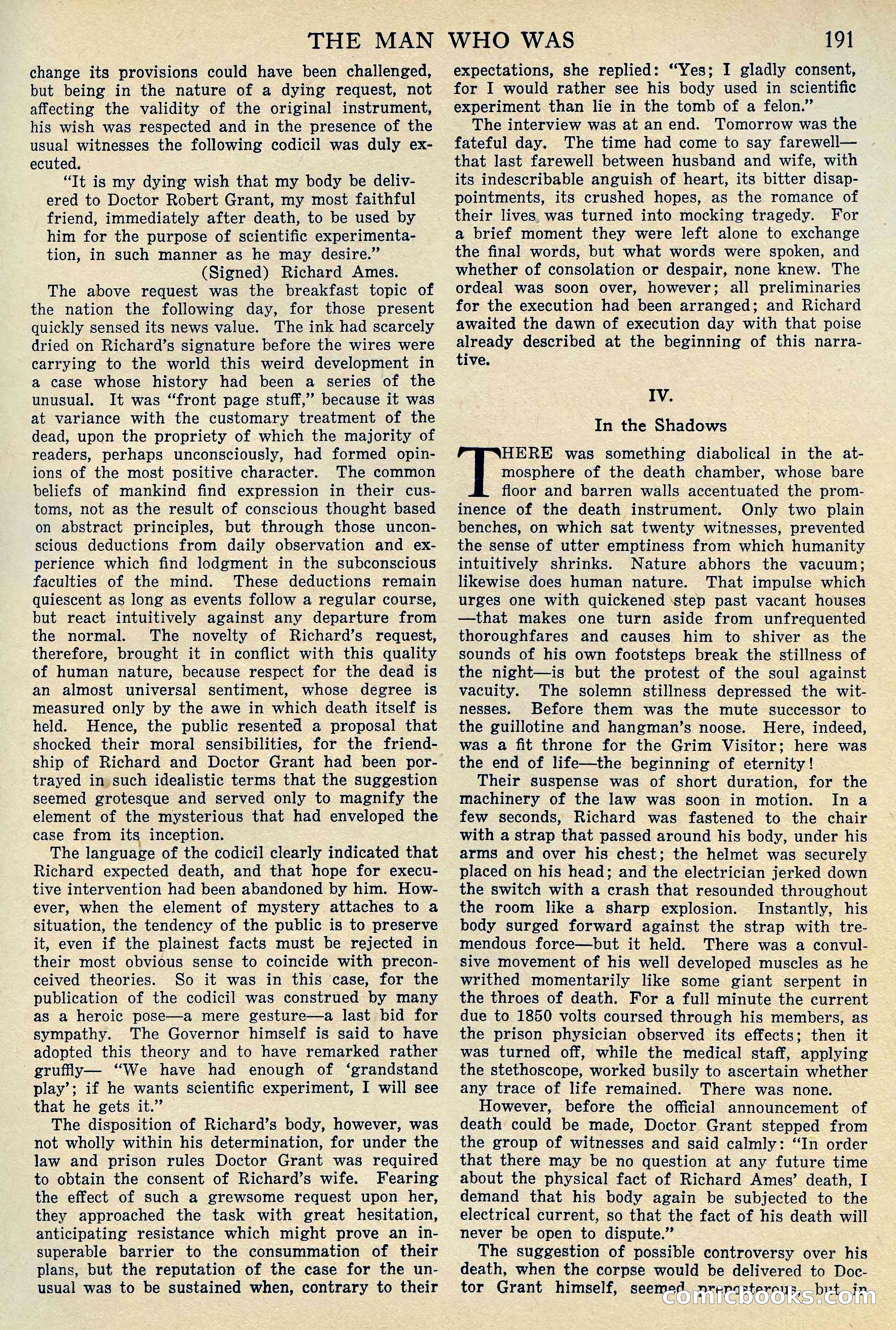
A restored page from Pulp Fiction, 1927. Page through the whole issue in the reader above.
📄 Transcribed text from this page (OCR, searchable)
Machine-transcribed from the original scan — historical spelling and the odd misread are preserved.
THE MAN change its provisions could have been challenged, but being in the nature of a dying request, not affecting the validity of the original instrument, his wish was respected and in the presence of the usual witnesses the following codicil was duly ex- ecuted. | “It ig my dying wish that my body be deliv- ered to Doctor Robert Grant, my most faithful friend, immediately after death, to be used by him for the purpose of scientific experimenta- tion, in such manner as he may desire.” (Signed) Richard Ames. The above request was the breakfast topic of the nation the following day, for those present quickly sensed its news value. The ink had scarcely dried on Richard’s signature before the wires were carrying to the world this weird development in a case whose history had been a series of the unusual. It was “front page stuff,’ because it was at variance with the customary treatment of the dead, upon the propriety of which the majority of readers, perhaps unconsciously, had formed opin- ions of the most positive character. The common beliefs of mankind find expression in their cus- toms, not as the result of conscious thought based on abstract principles, but through those uncon- scious deductions from daily observation and ex- perience which find lodgment in the subconscious faculties of the mind. These deductions remain quiescent as long as events follow a regular course, but react intuitively against any departure from the normal. The novelty of Richard’s request, therefore, brought it in conflict with this quality of human nature, because respect for the dead is an almost universal sentiment, whose degree is measured only by the awe in which death itself is held. Hence, the public resented a proposal that shocked their moral sensibilities, for the friend- ship of Richard and Doctor Grant had been por- trayed in such idealistic terms that the suggestion seemed grotesque and served only to magnify the element of the mysterious that had enveloped the case from its inception. The language of the codicil clearly indicated that Richard expected death, and that hope for execu- tive intervention had been abandoned by him. How- ever, when the element of mystery attaches to a situation, the tendency of the public is to preserve it, even if the plainest facts must be rejected in their most obvious sense to coincide with precon- ceived theories. So it was in this case, for the publication of the codicil was construed by many as a heroic pose—a mere gesture—a last bid for sympathy. The Governor himself is said to have adopted this theory and to have remarked rather gruffly— “We have had enough of ‘grandstand play’; if he wants scientific experiment, I will see that he gets it.” The disposition of Richard’s body, however, was not wholly within his determination, for under the law and prison rules Doctor Grant was required to obtain the consent of Richard’s wife. Fearing the effect of such a grewsome request upon her, they approached the task with great hesitation, anticipating resistance which might prove an in- superable barrier to the consummation of their plans, but the reputation of the case for the un- usual was to be sustained when, contrary to their WHO WAS 191 expectations, she replied: “Yes; I gladly consent, for I would rather see his body used in scientific experiment than lie in the tomb of a felon.” The interview was at an end. Tomorrow was the fateful day. The time had come to say farewell— that last farewell between husband and wife, with its indescribable anguish of heart, its bitter disap- pointments, its crushed hopes, as the romance of their lives. was turned into mocking tragedy. For a brief moment they were left alone to exchange the final words, but what words were spoken, and whether of consolation or despair, none knew. The ordeal was soon over, however; all preliminaries for the execution had been arranged; and Richard awaited the dawn of execution day with that poise already described at the beginning of this narra- tive. IV. In the Shadows HERE was something diabolical in the at- mosphere of the death chamber, whose bare floor and barren walls accentuated the prom- inence of the death instrument. Only two plain benches, on which sat twenty witnesses, prevented the sense of utter emptiness from which humanity intuitively shrinks. Nature abhors the vacuum; likewise does human nature. That impulse which urges one with quickened ‘step past vacant houses —that makes one turn aside from unfrequented thoroughfares and causes him to shiver as the sounds of his own footsteps break the stillness of the night—is but the protest of the soul against vacuity. The solemn stillness depressed the wit- nesses. Before them was the mute successor to the guillotine and hangman’s noose. Here, indeed, was a fit throne for the Grim Visitor; here was the end of life—the beginning of eternity! Their suspense was of short duration, for the machinery of the law was soon in motion. In a few seconds, Richard was fastened to the chair with a strap that passed around his body, under his arms and over his chest; the helmet was securely placed on his head; and the electrician jerked down the switch with a crash that resounded throughout the room like a sharp explosion. Instantly, his body surged forward against the strap with tre- mendous force—but it held. There was a convul- sive movement of his well developed muscles as he writhed momentarily like some giant serpent in the throes of death. For a full minute the current due to 1850 volts coursed through his members, as the prison physician observed its effects: then it was turned off, while the medical staff, applying the stethoscope, worked busily to ascertain whether any trace of life remained. There was none. However, before the official announcement of death could be made, Doctor Grant stepped from the group of witnesses and said calmly: “In order that there may be no question at any future time about the physical fact of Richard Ames’ death, I demand that his body again be subjected to the electrical current, so that the fact of his death will never be open to dispute.” The suggestion of possible controversy over his death, when the corpse would be delivered to Doc- tor Grant himself, So OCD OOKS Goll