
Pulp Fiction, 1927 · page 7 of 105
Amazing Stories, Vol. 2, No. 2 — page 7: what you’re looking at
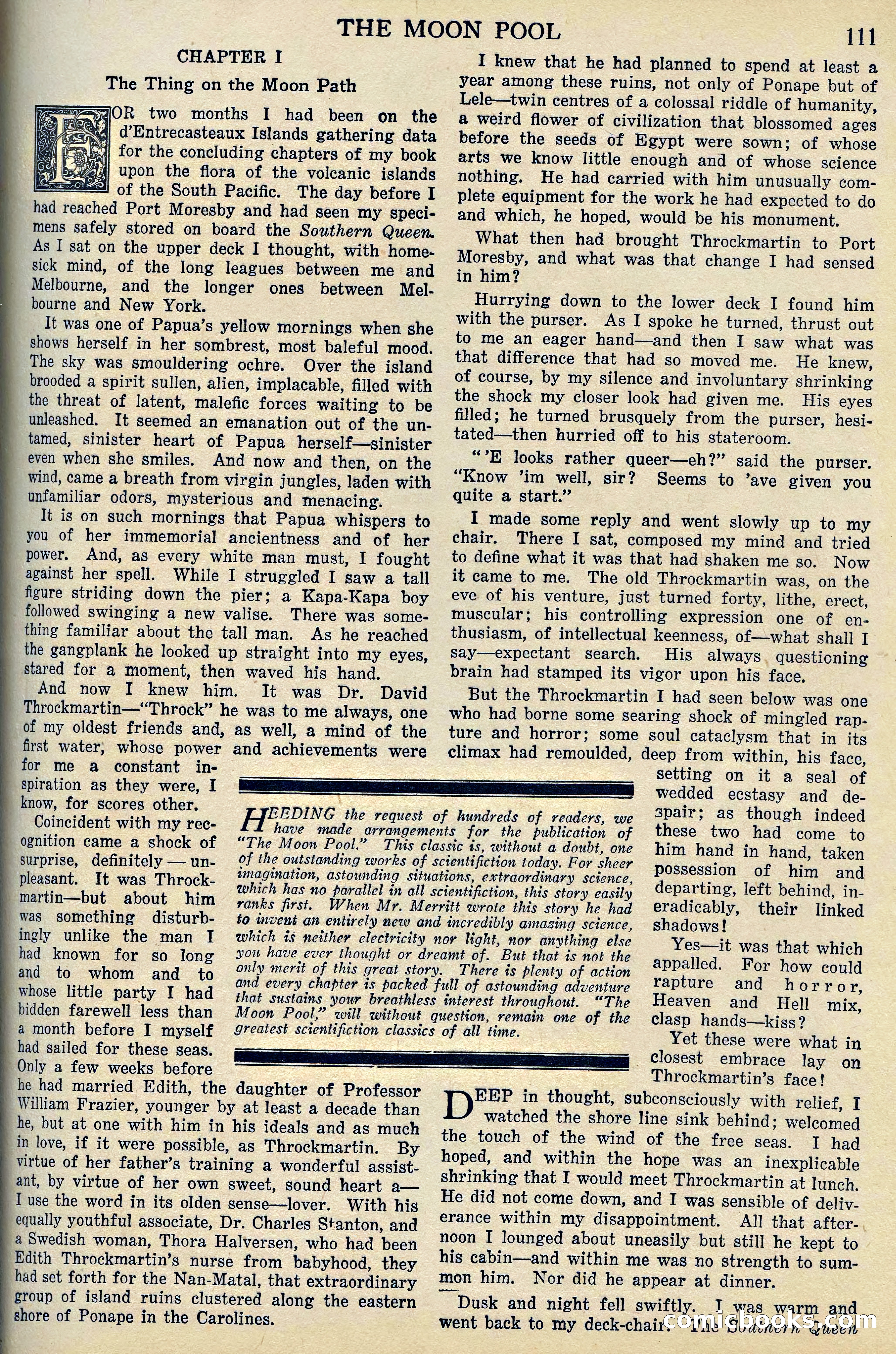
A restored page from Pulp Fiction, 1927. Page through the whole issue in the reader above.
📄 Transcribed text from this page (OCR, searchable)
Machine-transcribed from the original scan — historical spelling and the odd misread are preserved.
THE MOON POOL CHAPTER I The Thing on the Moon Path ay==R two months I had been on the €4| d’Entrecasteaux Islands gathering data sia4| for the concluding chapters of my book ) Es Zel4| upon the flora of the volcanic islands ao of the South Pacific. The day before I had reached Port Moresby and had seen my speci- mens safely stored on board the Southern Queen. As I sat on the upper deck I thought, with home- sick mind, of the long leagues between me and Melbourne, and the longer ones between Mel- bourne and New York. It was one of Papua’s yellow mornings when she shows herself in her sombrest, most baleful mood. The sky was smouldering ochre. Over the island brooded a spirit sullen, alien, implacable, filled with the threat of latent, malefic forces waiting to be unleashed. It seemed an emanation out of the un- tamed, sinister heart of Papua herself—sinister even when she smiles. And now and then, on the wind, came a breath from virgin j ungles, laden with unfamiliar odors, mysterious and menacing. It is on such mornings that Papua whispers to you of her immemorial ancientness and of her power, And, as every white man must, I fought against her spell. While I struggled I saw a tall figure striding down the pier: a Kapa-Kapa boy followed swinging a new valise. There was some- thing familiar about the tall man. As he reached the gangplank he looked up straight into my eyes, stared for a moment, then waved his hand. And now I knew him. It was Dr. David Throckmartin—“Throck” he was to me always, one of my oldest friends and, as well, a mind of the first water, whose power and achievements were 'for me a constant in- spiration as they were, I _ know, for scores other. Coincident with my rec- ognition came a shock of surprise, definitely — un- _ pleasant. It was Throck- _ martin—but about him Was something disturb- ingly unlike the man I _had known for so long 'and to whom and to _ whose little party I had '_ bidden farewell less than _amonth before I myself _had sailed for these seas. | Only a few weeks before _ he had married Edith, the daughter of Professor | Wiliam Frazier, younger by at least a decade than he, but at one with him in his ideals and as much in love, if it were possible, as Throckmartin. By virtue of her father’s training a wonderful assist- ant, by virtue of her own sweet, sound heart a— I use the word in its olden sense—lover. With hig equally youthful associate, Dr. Charles Stanton, and 4 Swedish woman, Thora Halversen, who had been Edith Throckmartin’s nurse from babyhood, they had set forth for the Nan-Matal, that extraordinary group of island ruins clustered along the eastern shore of Ponape in the Carolines. “The Moon Pool.” vanks first. |S Sees G } the request of hundreds of readers, we have made arrangements for the publication of This classic is, without a doubt, one of the outstanding works of scientifiction today. For sheer imagination, astounding situations, extraordinary science, which has no parallel in all scientifiction, this story easily When Mr. Merritt wrote this story he had to invent an entirely new and wcredibly amazing science, which is neither electricity nor light, nor anything else you have ever thought or dreamt of. But that is not the only merit of this great story. There is plenty of action and every chapter 1s packed full of astounding adventure that sustains your breathless interest throughout. “The Moon Pool,” will without question, remain one of the greatest scientifiction classics of all time. {11 I knew that he had planned to spend at least a year among these ruins, not only of Ponape but of Lele—twin centres of a colossal riddle of humanity, a weird flower of civilization that blossomed ages before the seeds of Egypt were Sown; of whose arts we know little enough and of whose science nothing. He had carried with him unusually com- plete equipment for the work he had expected to do and which, he hoped, would be his monument, What then had brought Throckmartin to Port Moresby, and what was that change I had sensed in him? Hurrying down to the lower deck I found him with the purser. As I spoke he turned, thrust out to me an eager hand—and then I saw what was that difference that had so moved me. He knew, of course, by my silence and involuntary shrinking the shock my closer look had given me. His eyes filled; he turned brusquely from the purser, hesi- tated—then hurried off to his stateroom. “"E looks rather queer—eh?” said the purser. “Know ’im well, sir? Seems to ’ave given you quite a start.” I made some reply and went slowly up to my chair. There I sat, composed my mind and tried to define what it was that had shaken me so. Now it came to me. The old Throckmartin was, on the eve of his venture, just turned forty, lithe, erect, muscular; his controlling expression one of en- thusiasm, of intellectual keenness, of—what shall I Say—expectant search. His always. questioning brain had stamped its vigor upon his face. But the Throckmartin I had seen below was one who had borne some searing shock of mingled rap- ture and horror; some soul cataclysm that in its climax had remoulded, deep from within, his face, Setting on it a seal of wedded ecstasy and de- Spair; as though indeed these two had come to him hand in hand, taken possession of him and departing, left behind, in- eradicably, their linked shadows! Yes—it was that which appalled. For how could rapture and horro Y: Heaven and Hell mix, clasp hands—kiss? Yet these were what in _ Closest embrace lay on Throckmartin’s face! KEP in thought, subconsciously with relief, I watched the shore line sink behind; weleomed the touch of the wind of the free seas. I had hoped, and within the hope was an inexplicable shrinking that I would meet Throckmartin at lunch. He did not come down, and I was sensible of deliv- erance within my disappointment. All that after- noon I lounged about uneasily but still he kept to his cabin—and within me wag no strength to sum- mon him. Nor did he appear at dinner. Dusk and night fell swiftly. icbe yoksscom went back to my deck-chairo©