
Pulp Fiction, 1927 · page 79 of 105
Amazing Stories, Vol. 2, No. 2 — page 79: what you’re looking at
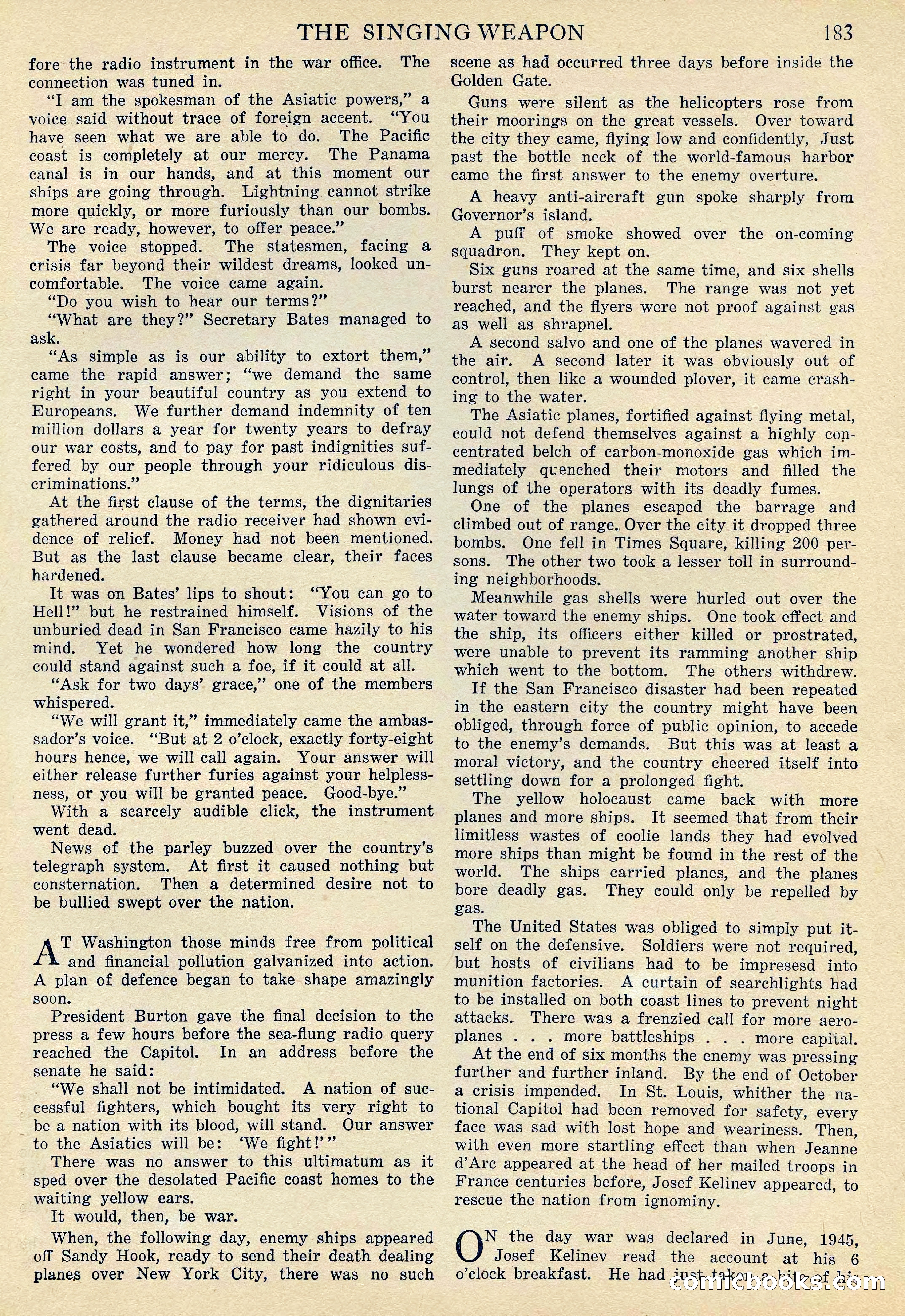
A restored page from Pulp Fiction, 1927. Page through the whole issue in the reader above.
📄 Transcribed text from this page (OCR, searchable)
Machine-transcribed from the original scan — historical spelling and the odd misread are preserved.
THE SINGING WEAPON fore the radio instrument in the war office. The connection was tuned in. “T am the spokesman of the Asiatic powers,” a voice said without trace of foreign accent. “You have seen what we are able to do. The Pacific coast is completely at our mercy. The Panama canal is in our hands, and at this moment our ships are going through. Lightning cannot strike more quickly, or more furiously than our bombs. We are ready, however, to offer peace.” The voice stopped. The statesmen, facing a crisis far beyond their wildest dreams, looked un- comfortable. The voice came again. “Do you wish to hear our terms?” “What are they?” Secretary Bates managed to ask. “As simple as is our ability to extort them,” came the rapid answer; “we demand the same right in your beautiful country as you extend to Europeans. We further demand indemnity of ten million dollars a year for twenty years to defray our war costs, and to pay for past indignities suf- fered by our people through your ridiculous dis- criminations.” At the first clause of the terms, the dignitaries gathered around the radio receiver had shown evi- dence of relief. Money had not been mentioned. But as the last clause became clear, their faces hardened. It was on Bates’ lips to shout: ‘You can go to Hell!” but he restrained himself. Visions of the unburied dead in San Francisco came hazily to his mind. Yet he wondered how long the country could stand against such a foe, if it could at all. “Ask for two days’ grace,’ one of the members whispered. “We will grant it,” immediately came the ambas- sador’s voice. ‘“‘But at 2 o’clock, exactly forty-eight hours hence, we will call again. Your answer will either release further furies against your helpless- ness, or you will be granted peace. Good-bye.” With a scarcely audible click, the instrument went dead. News of the parley buzzed over the country’s telegraph system. At first it caused nothing but consternation. be bullied swept over the nation. T Washington those minds free from political and financial pollution galvanized into action. A plan of defence began to take shape amazingly soon. President Burton gave the final decision to the press a few hours before the sea-flung radio query reached the Capitol. In an address before the senate he said: “We shall not be intimidated. A nation of suc- cessful fighters, which bought its very right to be a nation with its blood, will stand. Our answer _ to the Asiatics will be: ‘We fight!” There was no answer to this ultimatum as it sped over the desolated Pacific coast homes to the waiting yellow ears. It would, then, be war. When, the following day, enemy ships appeared off Sandy Hook, ready to send their death dealing planes over New York City, there was no such Then a determined desire not to. 183 scene as had occurred three days before inside the Golden Gate. Guns were silent as the helicopters rose from their moorings on the great vessels. Over toward the city they came, flying low and confidently, Just past the bottle neck of the world-famous harbor came the first answer to the enemy overture. A heavy anti-aircraft gun spoke sharply from Governor’s island. A puff of smoke showed over the on-coming squadron. They kept on. Six guns roared at the same time, and six shells burst nearer the planes. The range was not yet reached, and the flyers were not proof against gas as well as shrapnel. A second salvo and one of the planes wavered in the air. A second later it was obviously out of control, then like a wounded plover, it came crash- ing to the water. The Asiatic planes, fortified against flying metal, could not defend themselves against a highly con- centrated belch of carbon-monoxide gas which im- mediately quenched their motors and filled the lungs of the operators with its deadly fumes. One of the planes escaped the barrage and climbed out of range. Over the city it dropped three bombs. One fell in Times Square, killing 200 per- sons. The other two took a lesser toll in surround- ing neighborhoods. Meanwhile gas shells were hurled out over the water toward the enemy ships. One took effect and the ship, its officers either killed or prostrated, were unable to prevent its ramming another ship which went to the bottom. The others withdrew. If the San Francisco disaster had been repeated in the eastern city the country might have been obliged, through force of public opinion, to accede to the enemy’s demands. But this was at least a moral victory, and the country cheered itself into settling down for a prolonged fight. The yellow holocaust came back with more planes and more ships. It seemed that from their limitless wastes of coolie lands they had evolved more ships than might be found in the rest of the world. The ships carried planes, and the planes bore deadly gas. They could only be repelled by gas. The United States was obliged to simply put it- self on the defensive. Soldiers were not required, but hosts of civilians had to be impresesd into munition factories. A curtain of searchlights had to be installed on both coast lines to prevent night attacks. There was a frenzied call for more aero- planes . . more battleships . . more capital. At the end of six months the enemy was pressing further and further inland. By the end of October a crisis impended. In St. Louis, whither the na- tional Capitol had been removed for safety, every face was sad with lost hope and weariness. Then, with even more startling effect than when Jeanne d’Arc appeared at the head of her mailed troops in France centuries before, Josef Kelinev appeared, to rescue the nation from ignominy. N the day war was declared in June, 1945, Josef Kelinev read the account at his 6 o’clock breakfast. He had Comicbool (até) KN se