
Pulp Fiction, 1927 · page 80 of 105
Amazing Stories, Vol. 2, No. 2 — page 80: what you’re looking at
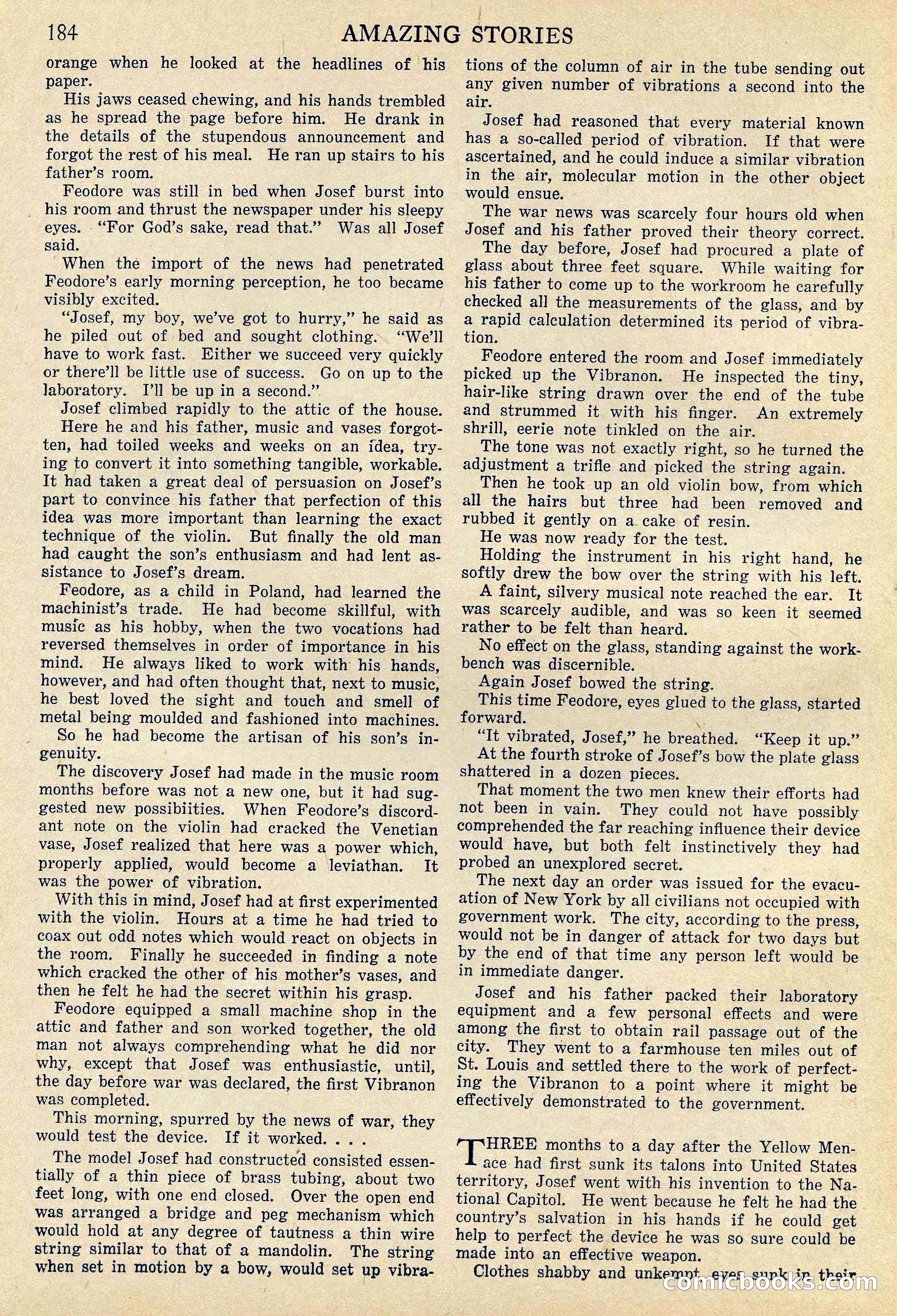
A restored page from Pulp Fiction, 1927. Page through the whole issue in the reader above.
📄 Transcribed text from this page (OCR, searchable)
Machine-transcribed from the original scan — historical spelling and the odd misread are preserved.
184 orange when he looked at the headlines of his paper. His jaws ceased chewing, and his hands trembled as he spread the page before him. He drank in the details of the stupendous announcement and forgot the rest of his meal. He ran up stairs to his father’s room. Feodore was still in bed when Josef burst into his room and thrust the newspaper under his sleepy eyes. - “For God’s sake, read that.’ Was all Josef said. When the import of the news had penetrated Feodore’s early morning perception, he too became visibly excited. “Josef, my boy, we’ve got to hurry,” he said as he piled out of bed and sought clothing. ‘“We’ll have to work fast. Either we succeed very quickly or there’ll be little use of success. Go on up to the laboratory. I'll be up in a second.” Josef climbed rapidly to the attic of the house. Here he and his father, music and vases forgot- ten, had toiled weeks and weeks on an idea, try- ing to convert it into something tangible, workable. It had taken a great deal of persuasion on Josef’s part to convince his father that perfection of this idea was more important than learning the exact technique of the violin. But finally the old man had caught the son’s enthusiasm and had lent as- sistance to Josef’s dream. Feodore, as a child in Poland, had learned the machinist’s trade. He had become skillful, with music as his hobby, when the two vocations had reversed themselves in order of importance in his mind. He always liked to work with his hands, however, and had often thought that, next to music, he best loved the sight and touch and smell of metal being moulded and fashioned into machines. So he had become the artisan of his son’s in- genuity. The discovery Josef had made in the music room months before was not a new one, but it had sug- gested new possibiities. When Feodore’s discord- ant note on the violin had cracked the Venetian vase, Josef realized that here was a power which, properly applied, would become a leviathan. It was the power of vibration. With this in mind, Josef had at first experimented with the violin. Hours at a time he had tried to coax out odd notes which would react on objects in the room. Finally he succeeded in finding a note which cracked the other of his mother’s vases, and then he felt he had the secret within his grasp. Feodore equipped a small machine shop in the attic and father and son worked together, the old man not always comprehending what he did nor why, except that Josef was enthusiastic, until, the day before war was declared, the first Vibranon was completed. This morning, spurred by the news of war, they would test the device. If it worked. ... The model Josef had constructed consisted essen- tially of a thin piece of brass tubing, about two feet long, with one end closed. Over the open end was arranged a bridge and peg mechanism which would hold at any degree of tautness a thin wire string similar to that of a mandolin. The string when set in motion by a bow, would set up vibra- AMAZING STORIES tions of the column of air in the tube sending out any given number of vibrations a second into the air. Josef had reasoned that every material known has a so-called period of vibration. If that were ascertained, and he could induce a similar vibration in the air, molecular motion in the other object would ensue. The war news was scarcely four hours old when Josef and his father proved their theory correct. The day before, Josef had procured a plate of glass about three feet square. While waiting for his father to come up to the workroom he carefully checked all the measurements of the glass, and by a rapid calculation determined its period of vibra- tion. | Feodore entered the room and Josef immediately picked up the Vibranon. He inspected the tiny, hair-like string drawn over the end of the tube and strummed it with his finger. An extremely shrill, eerie note tinkled on the air. The tone was not exactly right, so he turned the adjustment a trifle and picked the string again. Then he took up an old violin bow, from which all the hairs but three had been removed and rubbed it gently on a. cake of resin. He was now ready for the test. Holding the instrument in his right hand, he softly drew the bow over the string with his left. A faint, silvery musical note reached the ear. It was scarcely audible, and was so keen it seemed rather to be felt than heard. No effect on the glass, standing against the work- bench was discernible. Again Josef bowed the string. This time Feodore, eyes glued to the glass, started forward. i ; “Tt vibrated, Josef,” he breathed. “Keep it up.” At the fourth stroke of Josef’s bow the plate glass shattered in a dozen pieces. That moment the two men knew their efforts had not been in vain. They could not have possibly comprehended the far reaching influence their device would have, but both felt instinctively they had probed an unexplored secret. The next day an order was issued for the evacu- ation of New York by all civilians not occupied with government work. The city, according to the press, would not be in danger of attack for two days but by the end of that time any person left would be in immediate danger. Josef and his father packed their laboratory equipment and a few personal effects and were among the first to obtain rail passage out of the city. They went to a farmhouse ten miles out of St. Louis and settled there to the work of perfect- ing the Vibranon to a point where it might be effectively demonstrated to the government. 6 Ree months to a day after the Yellow Men- ace had first sunk its talons into United States territory, Josef went with his invention to the Na- tional Capitol. He went because he felt he had the country’s salvation in his hands if he could get help to perfect the device he was so sure could be made into an effective weapon. Clothes shabby and unkemnt ever supk ke thein