
Pulp Fiction, 1927 · page 78 of 105
Amazing Stories, Vol. 2, No. 2 — page 78: what you’re looking at
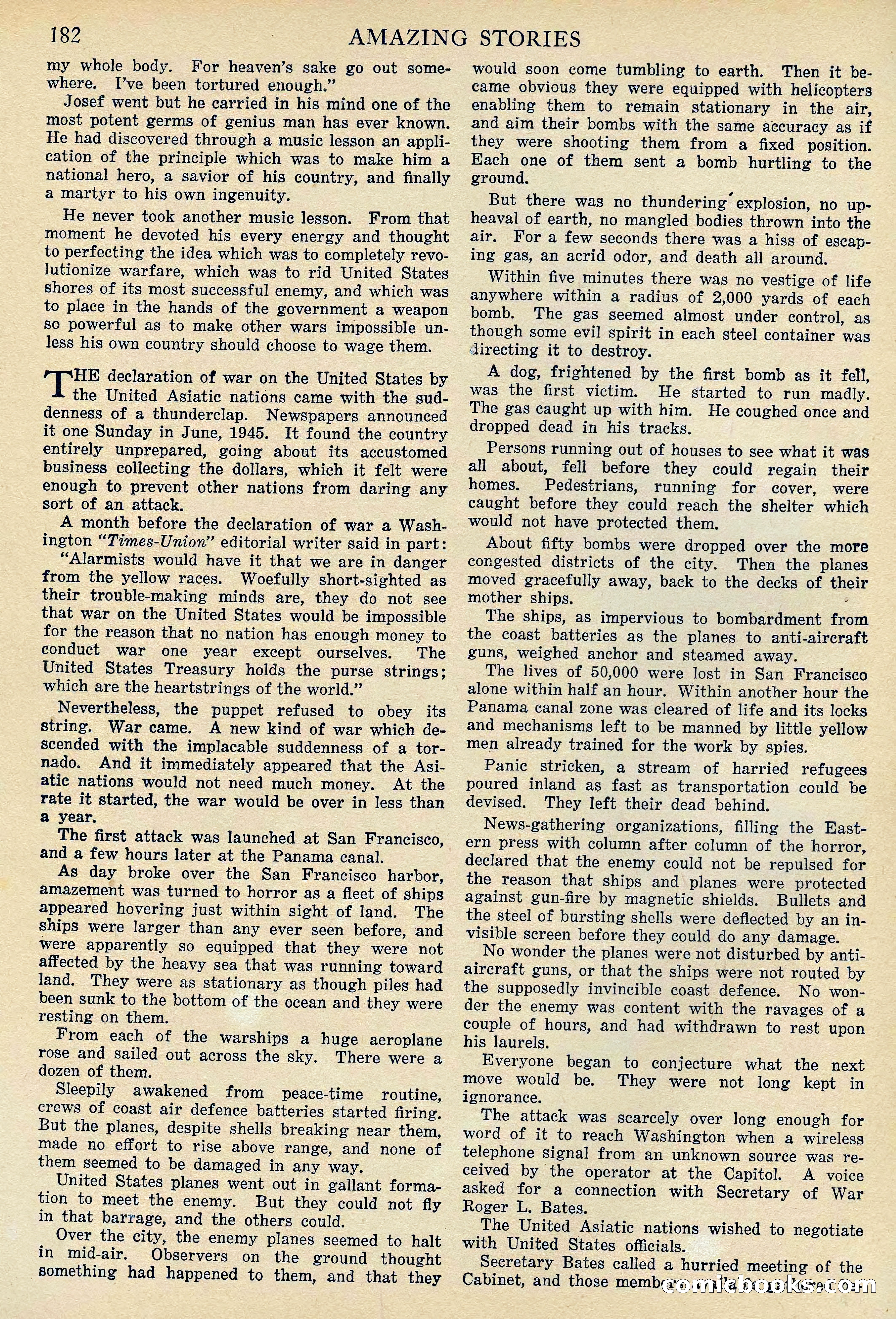
A restored page from Pulp Fiction, 1927. Page through the whole issue in the reader above.
📄 Transcribed text from this page (OCR, searchable)
Machine-transcribed from the original scan — historical spelling and the odd misread are preserved.
182 my whole body. For heaven’s sake go out some- where. I’ve been tortured enough.” Josef went but he carried in his mind one of the most potent germs of genius man has ever known. He had discovered through a music lesson an appli- cation of the principle which was to make him a national hero, a savior of his country, and finally a martyr to his own ingenuity. He never took another music lesson. From that moment he devoted his every energy and thought to perfecting the idea which was to completely revo- lutionize warfare, which was to rid United States Shores of its most successful enemy, and which was to place in the hands of the government a weapon So powerful as to make other wars impossible un- less his own country should choose to wage them. HE declaration of war on the United States by the United Asiatic nations came with the sud- denness of a thunderclap. Newspapers announced it one Sunday in June, 1945. It found the country entirely unprepared, going about its accustomed business collecting the dollars, which it felt were enough to prevent other nations from daring any sort of an attack. A month before the declaration of war 2 Wash- ington “Times-Union” editorial writer said in part: “Alarmists would have it that we are in danger from the yellow races. Woefully short-sighted as their trouble-making minds are, they do not see that war on the United States would be impossible for the reason that no nation has enough money to conduct war one year except ourselves. The United States Treasury holds the purse strings; which are the heartstrings of the world.” Nevertheless, the puppet refused to obey its string. War came. A new kind of war which de- Scended with the implacable suddenness of a tor- nado. And it immediately appeared that the Asi- atic nations would not need much money. At the rate it started, the war would be over in less than a year. The first attack was launched at San Francisco, and a few hours later at the Panama canal. As day broke over the San Francisco harbor, amazement was turned to horror as a fleet of ships appeared hovering just within sight of land. The ships were larger than any ever seen before, and were apparently so equipped that they were not affected by the heavy sea that was running toward land. They were as stationary as though piles had been sunk to the bottom of the ocean and they were resting on them. From each of the warships a huge aeroplane rose and sailed out across the sky. There were a dozen of them. Sleepily awakened from peace-time routine, crews of coast air defence batteries started firing. But the planes, despite shells breaking near them, made no effort to rise above range, and none of them seemed to be damaged in any way. United States planes went out in gallant forma- tion to meet the enemy. But they could not fly in that barrage, and the others could. Over the city, the enemy planes seemed to halt In mid-air. Observers on the ground thought something had happened to them, and that they AMAZING STORIES would soon come tumbling to earth. Then it be- came obvious they were equipped with helicopters enabling them to remain stationary in the air, and aim their bombs with the same accuracy as if they were shooting them from a fixed position. Each one of them sent a bomb hurtling to the ground. But there was no thundering explosion, no up- heaval of earth, no mangled bodies thrown into the air. For a few seconds there was a hiss of escap- ing gas, an acrid odor, and death all around. Within five minutes there was no vestige of life anywhere within a radius of 2,000 yards of each bomb. The gas seemed almost under control, as though some evil spirit in each steel container was directing it to destroy. A dog, frightened by the first bomb as it fell, was the first victim. He started to run madly. The gas caught up with him. He coughed once and dropped dead in his tracks. Persons running out of houses to see what it was all about, fell before they could regain their homes. Pedestrians, running for cover, were caught before they could reach the shelter which would not have protected them. About fifty bombs were dropped over the more congested districts of the city. Then the planes moved gracefully away, back to the decks of their mother ships. ‘ The ships, as impervious to bombardment from the coast batteries as the planes to anti-aircraft guns, weighed anchor and steamed away. The lives of 50,000 were lost in San Francisco alone within half an hour. Within another hour the Panama canal zone was cleared of life and its locks and mechanisms left to be manned by little yellow men already trained for the work by spies. Panic stricken, a stream of harried refugees poured inland as fast as transportation could be devised. They left their dead behind. News-gathering organizations, filling the East- ern press with column after column of the horror, declared that the enemy could not be repulsed for the reason that ships and planes were protected against gun-fire by magnetic shields. Bullets and the steel of bursting shells were deflected by an in- visible screen before they could do any damage. No wonder the planes were not disturbed by anti- aircraft guns, or that the ships were not routed by the supposedly invincible coast defence. No won- der the enemy was content with the ravages of a couple of hours, and had withdrawn to rest upon his laurels. Everyone began to conjecture what the next move would be. They were not long kept in ignorance. The attack was scarcely over long enough for word of it to reach Washington when a wireless telephone signal from an unknown source was re- ceived by the operator at the Capitol. A voice asked for a connection with Secretary of War Roger L. Bates. The United Asiatic nations wished to negotiate with United States officials. Secretary Bates called a hurried meeting of the Cabinet, and those membrays i yil’a oroxe) Ac OxA)