
Pulp Fiction, 1927 · page 77 of 105
Amazing Stories, Vol. 2, No. 2 — page 77: what you’re looking at
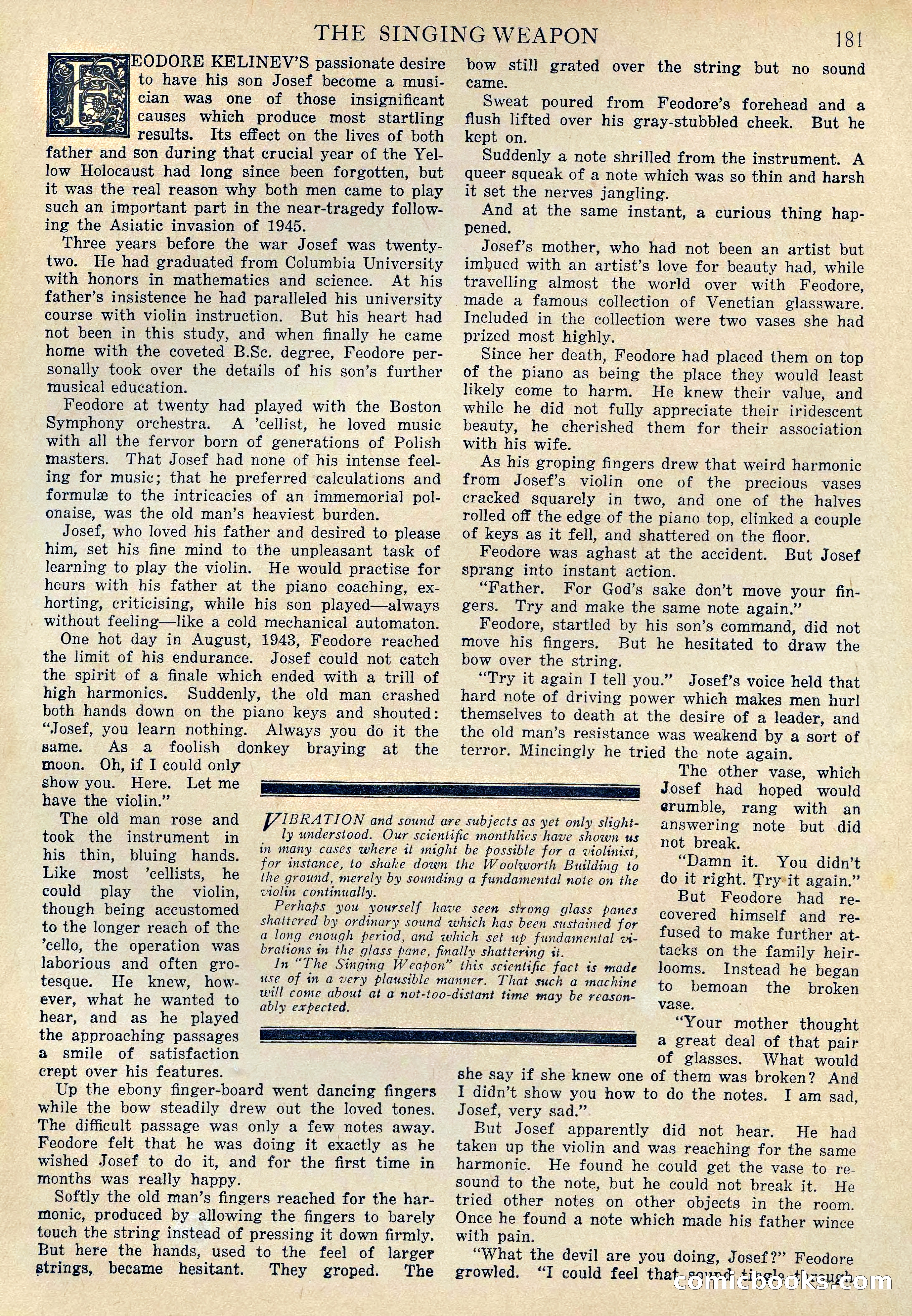
A restored page from Pulp Fiction, 1927. Page through the whole issue in the reader above.
📄 Transcribed text from this page (OCR, searchable)
Machine-transcribed from the original scan — historical spelling and the odd misread are preserved.
THE SINGING WEAPON ex iil cian was one of those insignificant el causes which produce most startling results. Its effect on the lives of both father and son during that crucial year of the Yel- low Holocaust had long since been forgotten, but it was the real reason why both men came to play such an important part in the near-tragedy follow- ing the Asiatic invasion of 1945. Three years before the war Josef was twenty- two. He had graduated from Columbia University with honors in mathematics and science. At his father’s insistence he had paralleled his university course with violin instruction. But his heart had not been in this study, and when finally he came home with the coveted B.Sc. degree, Feodore per- sonally took over the details of his son’s further musical education. Feodore at twenty had played with the Boston Symphony orchestra. <A ’cellist, he loved music with all the fervor born of generations of Polish masters. That Josef had none of his intense feel- ing for music; that he preferred calculations and formulz to the intricacies of an immemorial pol- onaise, was the old man’s heaviest burden. Josef, who loved his father and desired to please him, set his fine mind to the unpleasant task of learning to play the violin. He would practise for hcurs with his father at the piano coaching, ex- horting, criticising, while his son played—always . without feeling—like a cold mechanical automaton. One hot day in August, 1943, Feodore reached the limit of his endurance. Josef could not catch the spirit of a finale which ended with a trill of high harmonics. Suddenly, the old man crashed both hands down on the piano keys and shouted: “Josef, you learn nothing. Always you do it the same. As a foolish donkey braying at the moon. Oh, if I could only show you. Here. Let me have the violin.” The old man rose and took the instrument in his thin, bluing hands. Like most cellists, he could play the violin, though being accustomed to the longer reach of the ‘cello, the operation was laborious and often gro- tesque. He knew, how- ever, what he wanted to hear, and as he played the approaching passages a smile of satisfaction crept over his features. Up the ebony finger-board went dancing fingers while the bow steadily drew out the loved tones. The difficult passage was only a few notes away. Feodore felt that he was doing it exactly as he wished Josef to do it, and for the first time in months was really happy. Softly the old man’s fingers reached for the har- monic, produced by allowing the fingers to barely touch the string instead of pressing it down firmly. But here the hands, used to the feel of larger strings, became hesitant. They groped. The violin continually. ably expected. ee ee een ee ee Ee | IBRATION and sound are subjects as yet only slight- ly understood. Our scientific monthlies have shown us m many cases where it might be possible for a violinist, for instance, to shake down the Woolworth Building to the ground, merely by sounding a fundamental note on the Perhaps you yourself have seen strong glass panes shattered by ordinary sound which has been sustained for a long enough period, and which set up fundamental w- brations in the glass pane, finally shattering it. In “The Singing Weapon” this scientific fact is made use of in a very plausible manner. That such a machine will come about at @ not-too-distant time may be reason- ee ne ee eas 18] bow still grated over the string but no sound came. Sweat poured from Feodore’s forehead and a flush lifted over his gray-stubbled cheek. But he kept on. Suddenly a note shrilled from the instrument. A queer squeak of a note which was so thin and harsh it set the nerves jangling. And at the same instant, a curious thing hap- pened. Josef’s mother, who had not been an artist but imbued with an artist’s love for beauty had, while travelling almost the world over with Feodore, made a famous collection of Venetian glassware. Included in the collection were two vases she had prized most highly. Since her death, Feodore had placed them on top of the piano as being the place they would least likely come to harm. He knew their value, and while he did not fully appreciate their iridescent beauty, he cherished them for their association with his wife. As his groping fingers drew that weird harmonic from Josef’s violin one of the precious vases cracked squarely in two, and one of the halves rolled off the edge of the piano top, clinked a couple of keys as it fell, and shattered on the floor. Feodore was aghast at the accident. But Josef sprang into instant action. “Father. For God’s sake don’t move your fin- gers. Try and make the same note again.” Feodore, startled by his son’s command, did not move his fingers. But he hesitated to draw the bow over the string. “Try it again I tell you.” Josef’s voice held that hard note of driving power which makeg men hurl themselves to death at the desire of a leader, and the old man’s resistance was weakend by a sort of terror. Mincingly he tried the note again. The other vase, which Josef had hoped would erumble, rang with an answering note but did not break. “Damn it. You didn’t do it right. Try*it again.” But Feodore had re- covered himself and re- fused to make further at- tacks on the family heir- looms. Instead he began to bemoan the broken vase. “Your mother thought a great deal of that pair of glasses. What would she say if she knew one of them was broken? And I didn’t show you how to do the notes. I am sad, Josef, very sad.” But Josef apparently did not hear. He had taken up the violin and was reaching for the same harmonic. He found he could get the vase to re- sound to the note, but he could not break it. He tried other notes on other objects in the room. Once he found a note which made his father wince with pain. “What the devil are you doing, Josef?” Feodore growled. “I could feel thatarqued Ai pesy ot zcugao)