
Pulp Fiction, 1927 · page 66 of 105
Amazing Stories, Vol. 2, No. 2 — page 66: what you’re looking at
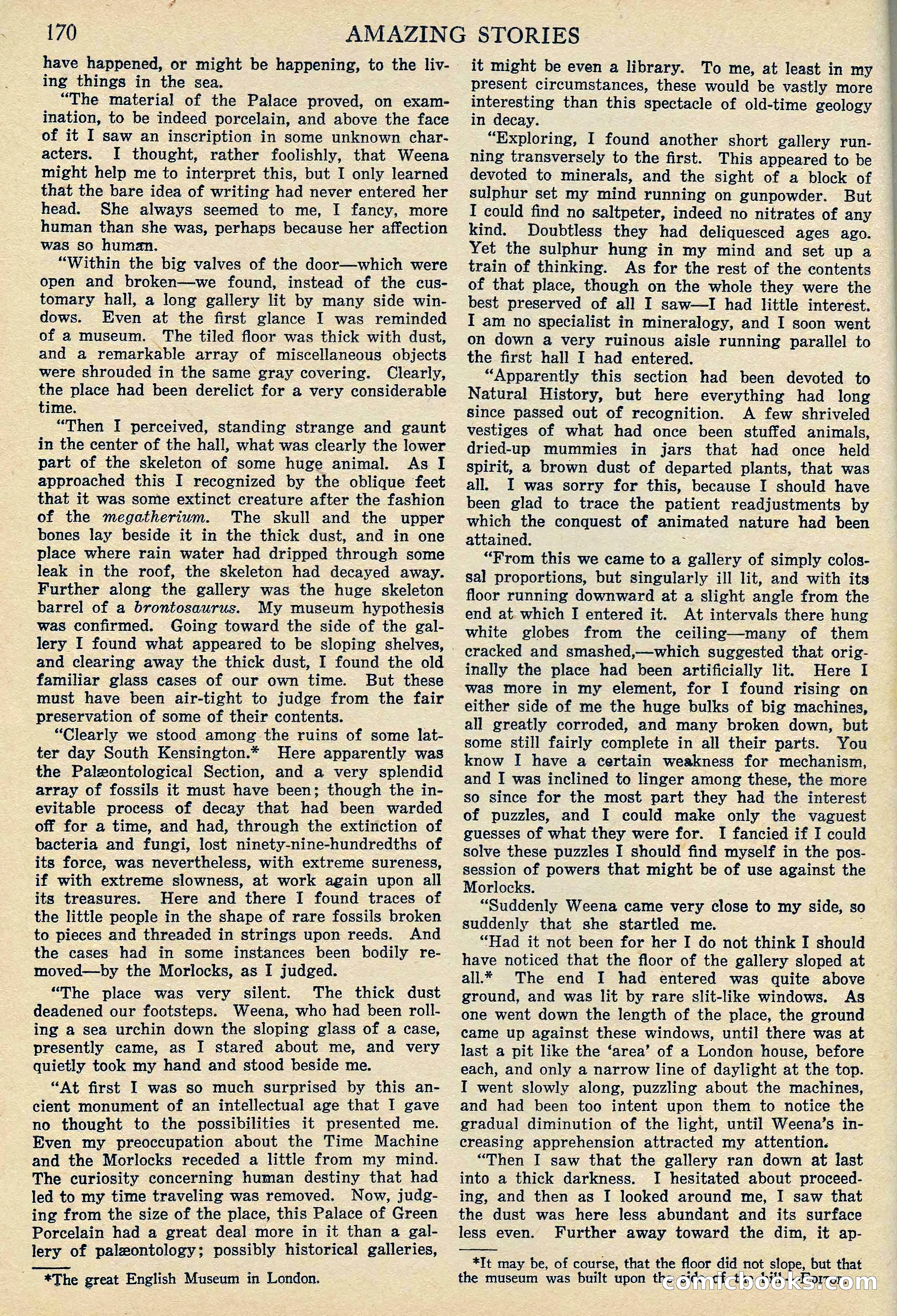
A restored page from Pulp Fiction, 1927. Page through the whole issue in the reader above.
📄 Transcribed text from this page (OCR, searchable)
Machine-transcribed from the original scan — historical spelling and the odd misread are preserved.
170 have happened, or might be happening, to the liv- ing things in the sea. “The material of the Palace proved, on exam- ination, to be indeed porcelain, and above the face of it I saw an inscription in some unknown char- acters. I thought, rather foolishly, that Weena might help me to interpret this, but I only learned that the bare idea of writing had never entered her head. She always seemed to me, I fancy, more human than she was, perhaps because her affection was so human. “Within the big valves of the door—which were open and broken—we found, instead of the cus- tomary hall, a long gallery lit by many side win- dows. Even at the first glance I was reminded of a museum. The tiled floor was thick with dust, and a remarkable array of miscellaneous objects were shrouded in the same gray covering. Clearly, the place had been derelict for a very considerable time. “Then I perceived, standing strange and gaunt in the center of the hall, what was clearly the lower part of the skeleton of some huge animal. As I approached this I recognized by the oblique feet that it was some extinct creature after the fashion of the megatherium. The skull and the upper bones lay beside it in the thick dust, and in one place where rain water had dripped through some leak in the roof, the skeleton had decayed away. Further along the gallery was the huge skeleton barrel of a brontosaurus. My museum hypothesis was confirmed. Going toward the side of the gal- lery I found what appeared to be sloping shelves, and clearing away the thick dust, I found the old familiar glass cases of our own time. But these must have been air-tight to judge from the fair preservation of some of their contents. “Clearly we stood among the ruins of some lat- ter day South Kensington.* Here apparently was the Paleontological Section, and a very splendid array of fossils it must have been; though the in- evitable process of decay that had been warded off for a time, and had, through the extinction of bacteria and fungi, lost ninety-nine-hundredths of its force, was nevertheless, with extreme sureness, if with extreme slowness, at work again upon all its treasures. Here and there I found traces of the little people in the shape of rare fossils broken to pieces and threaded in strings upon reeds. And the cases had in some instances been bodily re- moved—by the Morlocks, as I judged. “The place was very silent. The thick dust deadened our footsteps. Weena, who had been roll- ing a sea urchin down the sloping glass of a case, presently came, as I stared about me, and very quietly took my hand and stood beside me. “At first I was so much surprised by this an- ecient monument of an intellectual age that I gave no thought to the possibilities it presented me. Even my preoccupation about the Time Machine and the Morlocks receded a little from my mind. The curiosity concerning human destiny that had led to my time traveling was removed. Now, judg- ing from the size of the place, this Palace of Green Porcelain had a great deal more in it than a gal- lery of paleontology; possibly historical galleries, *The great English Museum in London. AMAZING STORIES it might be even a library. To me, at least in my present circumstances, these would be vastly more interesting than this spectacle of old-time geology in decay. “Exploring, I found another short gallery run- ning transversely to the first. This appeared to be devoted to minerals, and the sight of a block of sulphur set my mind running on gunpowder. But I could find no saltpeter, indeed no nitrates of any kind. Doubtless they had deliquesced ages ago. Yet the sulphur hung in my mind and set up a train of thinking. As for the rest of the contents of that place, though on the whole they were the best preserved of all I saw—I had little interest. I am no specialist in mineralogy, and I soon went on down a very ruinous aisle running parallel to the first hall I had entered. “Apparently this section had been devoted to Natural History, but here everything had long Since passed out of recognition. A few shriveled vestiges of what had once been stuffed animals, dried-up mummies in jars that had once held spirit, a brown dust of departed plants, that was all. I was sorry for this, because I should have been glad to trace the patient readjustments by which the conquest of animated nature had been attained. “From this we came to a gallery of simply colos- sal proportions, but singularly ill lit, and with its floor running downward at a slight angle from the end at which I entered it. At intervals there hung white globes from the ceiling—many of them eracked and smashed,—which suggested that orig- inally the place had been artificially lit. Here I was more in my element, for I found rising on either side of me the huge bulks of big machines, all greatly corroded, and many broken down, but some still fairly complete in all their parts. You know I have a certain weakness for mechanism, and I was inclined to linger among these, the more so since for the most part they had the interest of puzzles, and I could make only the vaguest guesses of what they were for. I fancied if I could solve these puzzles I should find myself in the pos- session of powers that might be of use against the Morlocks. “Suddenly Weena came very close to my side, SO suddenly that she startled me. “Had it not been for her I do not think I should have noticed that the floor of the gallery sloped at all.* The end I had entered was quite above ground, and was lit by rare slit-like windows. As one went down the length of the place, the ground came up against these windows, until there was at last a pit like the ‘area’ of a London house, before each, and only a narrow line of daylight at the top. I went slowly along, puzzling about the machines, and had been too intent upon them to notice the gradual diminution of the light, until Weena’s in- ereasing apprehension attracted my attention. “Then I saw that the gallery ran down at last into a thick darkness. I hesitated about proceed- ing, and then as I looked around me, I saw that the dust was here less abundant and its surface less even. Further away toward the dim, it ap- +1 may be, of course, that the floor did not slope, but that the museum was built upon thoes och syevey -Eairere) 79)