
Pulp Fiction, 1927 · page 67 of 105
Amazing Stories, Vol. 2, No. 2 — page 67: what you’re looking at
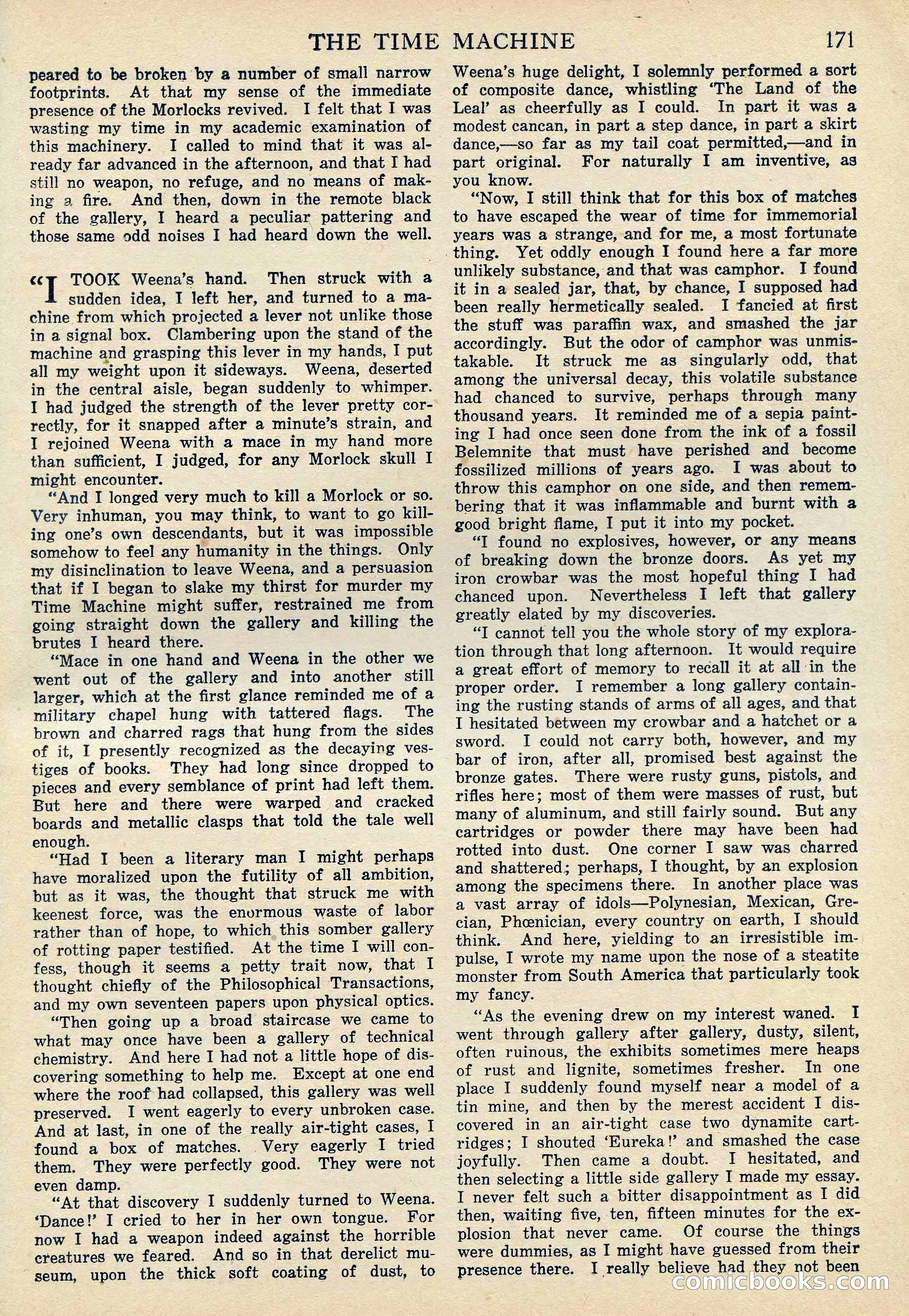
A restored page from Pulp Fiction, 1927. Page through the whole issue in the reader above.
📄 Transcribed text from this page (OCR, searchable)
Machine-transcribed from the original scan — historical spelling and the odd misread are preserved.
THE TIME peared to be broken by a number of small narrow footprints. At that my sense of the immediate presence of the Morlocks revived. I felt that I was wasting my time in my academic examination of this machinery. I called to mind that it was al- ready far advanced in the afternoon, and that I had still no weapon, no refuge, and no means of mak- ing a fire. And then, down in the remote black of the gallery, I heard a peculiar pattering and those same odd noises I had heard down the well. a | TOOK Weena’s hand. Then struck with a sudden idea, I left her, and turned to a ma- chine from which projected a lever not unlike those in a signal box. Clambering upon the stand of the machine and grasping this lever in my hands, I put all my weight upon it sideways. Weena, deserted in the central aisle, began suddenly to whimper. I had judged the strength of the lever pretty cor- rectly, for it snapped after a minute’s strain, and I rejoined Weena with a mace in my hand more than sufficient, I judged, for any Morlock skull I might encounter. “And I longed very much to kill a Morlock or so. Very inhuman, you may think, to want to go kill- ing one’s own descendants, but it was impossible somehow to feel any humanity in the things. Only my disinclination to leave Weena, and a persuasion that if I began to slake my thirst for murder my Time Machine might suffer, restrained me from going straight down the gallery and killing the brutes I heard there. “Wace in one hand and Weena in the other we went out of the gallery and into another still larger, which at the first glance reminded me of a military chapel hung with tattered flags. The brown and charred rags that hung from the sides of it, I presently recognized as the decaying ves- tiges of books. They had long since dropped to pieces and every semblance of print had left them. But here and there were warped and cracked boards and metallic clasps that told the tale well enough. “Had I been a literary man I might perhaps have moralized upon the futility of all ambition, but as it was, the thought that struck me with keenest force, was the enormous waste of labor rather than of hope, to which this somber gallery of rotting paper testified. At the time I will con- fess, though it seems a petty trait now, that I thought chiefly of the Philosophical ‘Transactions, and my own seventeen papers upon physical optics. “Then going up a broad staircase we came to what may once have been a gallery of technical chemistry. And here I had not a little hope of dis- covering something to help me. Except at one end where the roof had collapsed, this gallery was well preserved. I went eagerly to every unbroken case. And at last, in one of the really air-tight cases, 1 found a box of matches. Very eagerly I tried them. They were perfectly good. They were not even damp. “At that discovery I suddenly turned to Weena. ‘Dance!’ I cried to her in her own tongue. For now I had a weapon indeed against the horrible creatures we feared. And so in that derelict mu- seum, upon the thick soft coating of dust, to thing. MACHINE 171 Weena’s huge delight, I solemnly performed a sort of composite dance, whistling ‘The Land of the Leal’ as cheerfully as I could. In part it was a modest cancan, in part a step dance, in part a skirt dance,—so far as my tail coat permitted,—and in part original. For naturally I am inventive, as you know. . “Now, I still think that for this box of matches to have escaped the wear of time for immemorial years was a strange, and for me, a most fortunate Yet oddly enough I found here a far more unlikely substance, and that was camphor. I found it in a sealed jar, that, by chance, I supposed had been really hermetically sealed. I fancied at first the stuff was paraffin wax, and smashed the jar accordingly. But the odor of camphor was unmis- takable. It struck me as singularly odd, that among the universal decay, this volatile substance had chanced to survive, perhaps through many thousand years. It reminded me of a sepia paint- ing I had once seen done from the ink of a fossil Belemnite that must have perished and become fossilized millions of years ago. I was about to throw this camphor on one side, and then remem- bering that it was inflammable and burnt with a good bright flame, I put it into my pocket. “T found no explosives, however, or any means of breaking down the bronze doors. As yet my iron crowbar was the most hopeful thing I had chanced upon. Nevertheless I left that gallery greatly elated by my discoveries. “T cannot tell you the whole story of my explora- tion through that long afternoon. It would require a great effort of memory to recall it at all in the proper order. I remember a long gallery contain- ing the rusting stands of arms of all ages, and that I hesitated between my crowbar and a hatchet or a sword. I could not carry both, however, and my bar of iron, after all, promised best against the bronze gates. There were rusty guns, pistols, and rifles here; most of them were masses of rust, but many of aluminum, and still fairly sound. But any cartridges or powder there may have been had rotted into dust. One corner I saw was charred and shattered; perhaps, I thought, by an explosion among the specimens there. In another place was a vast array of idols—Polynesian, Mexican, Gre- cian, Phenician, every country on earth, I should think. And here, yielding to an irresistible im- pulse, I wrote my name upon the nose of a steatite monster from South America that particularly took my fancy. “As the evening drew on my interest waned. I went through gallery after gallery, dusty, silent, often ruinous, the exhibits sometimes mere heaps of rust and lignite, sometimes fresher. In one place I suddenly found myself near a model of a tin mine, and then by the merest accident I dis- covered in an air-tight case two dynamite cart- ridges; I shouted ‘Eureka!’ and smashed the case joyfully. Then came a doubt. I hesitated, and then selecting a little side gallery I made my essay. I never felt such a bitter disappointment as I did then, waiting five, ten, fifteen minutes for the ex- plosion that never came. Of course the things were dummies, as I might have guessed from their presence there. I really believe had they not been EOomichbooksico