
Pulp Fiction, 1927 · page 65 of 105
Amazing Stories, Vol. 2, No. 2 — page 65: what you’re looking at
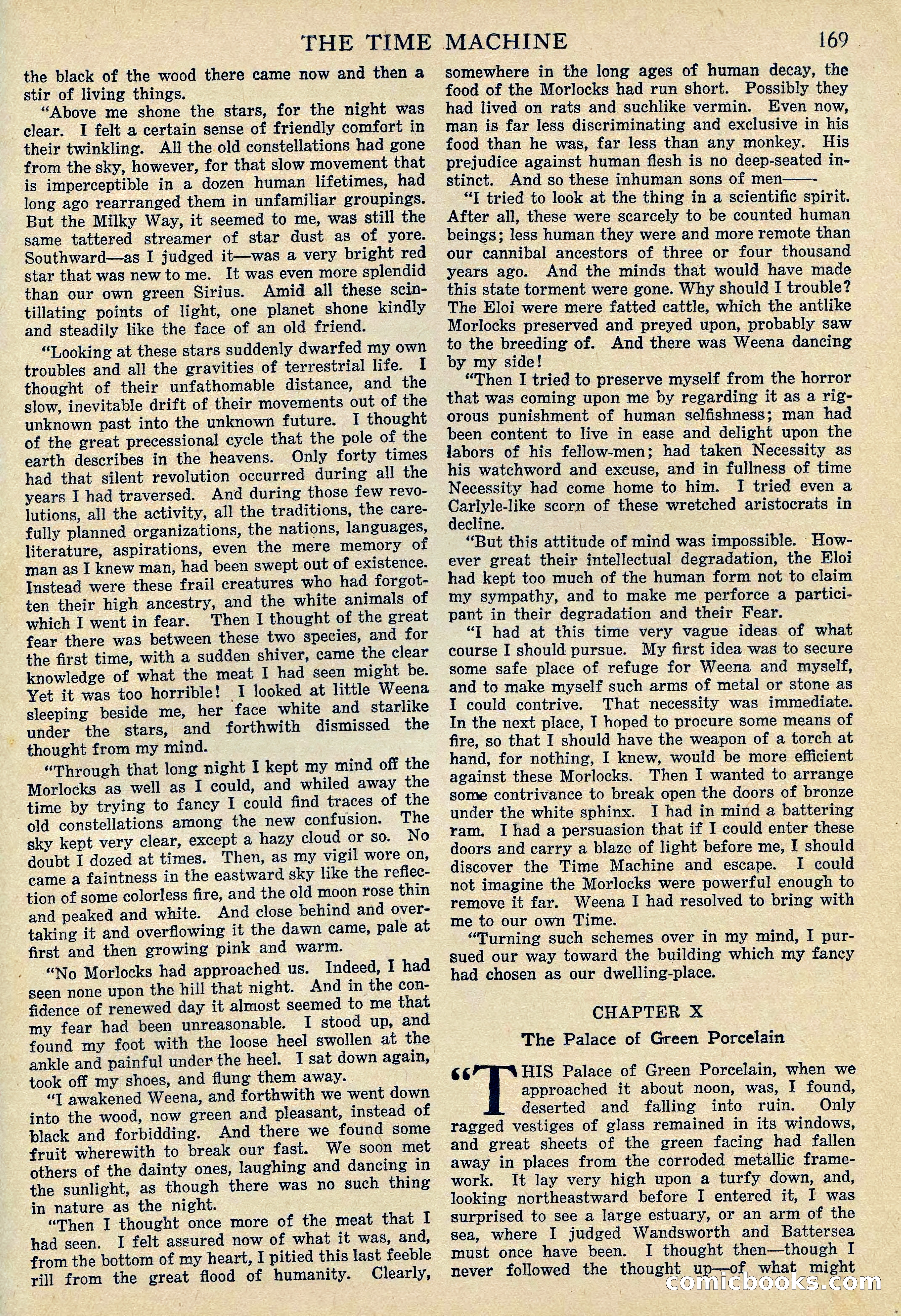
A restored page from Pulp Fiction, 1927. Page through the whole issue in the reader above.
📄 Transcribed text from this page (OCR, searchable)
Machine-transcribed from the original scan — historical spelling and the odd misread are preserved.
THE TIME MACHINE the black of the wood there came now and then a stir of living things. “Above me shone the stars, for the night was clear. I felt a certain sense of friendly comfort in their twinkling. All the old constellations had gone from the sky, however, for that slow movement that is imperceptible in a dozen human lifetimes, had long ago rearranged them in unfamiliar groupings. But the Milky Way, it seemed to me, was still the same tattered streamer of star dust as of yore. Southward—as I judged it—was a very bright red star that was new to me. It was even more splendid than our own green Sirius. Amid all these scin- tillating points of light, one planet shone kindly and steadily like the face of an old friend. “T ooking at these stars suddenly dwarfed my own troubles and all the gravities of terrestrial life. I thought of their unfathomable distance, and the slow, inevitable drift of their movements out of the unknown past into the unknown future. I thought of the great precessional cycle that the pole of the earth describes in the heavens. Only forty times had that silent revolution occurred during all the years I had traversed. And during those few revo- lutions, all the activity, all the traditions, the care- fully planned organizations, the nations, languages, literature, aspirations, even the mere memory of man as I knew man, had been swept out of existence. Instead were these frail creatures who had forgot- ten their high ancestry, and the white animals of which I went in fear. Then I thought of the great fear there was between these two species, and for the first time, with a sudden shiver, came the clear knowledge of what the meat I had seen might be. Yet it was too horrible! I looked at little Weena sleeping beside me, her face white and starlike under the stars, and forthwith dismissed the ~ thought from my mind. “Through that long night I kept my mind off the Morlocks as well as I could, and whiled away the time by trying to fancy I could find traces of the old constellations among the new eonfusion. The sky kept very clear, except a hazy cloud or so. No doubt I dozed at times. Then, as my vigil wore on, came a faintness in the eastward sky like the reflec- tion of some colorless fire, and the old moon rose thin and peaked and white. And close behind and over- taking it and overflowing it the dawn came, pale at first and then growing pink and warm. “No Morlocks had approached us. Indeed, I had seen none upon the hill that night. And in the con- fidence of renewed day it almost seemed to me that my fear had been unreasonable. I stood up, and found my foot with the loose heel swollen at the ankle and painful under the heel. I sat down again, - took off my shoes, and flung them away. “T awakened Weena, and forthwith we went down into the wood, now green and pleasant, instead of black and forbidding. And there we found some fruit wherewith to break our fast. We soon met others of the dainty ones, laughing and dancing in the sunlight, as though there was no such thing in nature as the night. “Then I thought once more of the meat that I had seen. I felt assured now of what it was, and, from the bottom of my heart, I pitied this last feeble rill from the great flood of humanity. Clearly, somewhere in the long ages of human decay, the food of the Morlocks had run short. Possibly they had lived on rats and suchlike vermin. Even now, man is far less discriminating and exclusive in his food than he was, far less than any monkey. His prejudice against human flesh is no deep-seated in- stinct. And so these inhuman sons of men—— “T tried to look at the thing in a scientific spirit. After all, these were scarcely to be counted human beings; less human they were and more remote than our cannibal ancestors of three or four thousand years ago. And the minds that would have made this state torment were gone. Why should I trouble? The Eloi were mere fatted cattle, which the antlike Morlocks preserved and preyed upon, probably saw to the breeding of. And there was Weena dancing by my side! “Then I tried to preserve myself from the horror that was coming upon me by regarding it as a rig- orous punishment of human selfishness; man had been content to live in ease and delight upon the Jabors of his fellow-men; had taken Necessity as his watchword and excuse, and in fullness of time Necessity had come home to him. I tried even a Carlyle-like scorn of these wretched aristocrats in decline. “But this attitude of mind was impossible. How- ever great their intellectual degradation, the Eloi had kept too much of the human form not to claim my sympathy, and to make me perforce a partici- pant in their degradation and their Fear. “T had at this time very vague ideas of what course I should pursue. My first idea was to secure some safe place of refuge for Weena and myself, and to make myself such arms of metal or stone as I eould contrive. That necessity was immediate. In the next place, I hoped to procure some means of fire, so that I should have the weapon of a torch at hand, for nothing, I knew, would be more efficient against these Morlocks. Then I wanted to arrange some contrivance to break open the doors of bronze under the white sphinx. I had in mind a battering ram. I had a persuasion that if I could enter these doors and carry a blaze of light before me, I should discover the Time Machine and escape. I could not imagine the Morlocks were powerful enough to remove it far. Weena I had resolved to bring with me to our own Time. “Turning such schemes over in my mind, I pur- sued our way toward the building which my fancy had chosen as our dwelling-place. CHAPTER X The Palace of Green Porcelain 66 HIS Palace of Green Porcelain, when we approached it about noon, was, I found, deserted and falling into ruin. Only ragged vestiges of glass remained in its windows, and great sheets of the green facing had fallen away in places from the corroded metallic frame- work. It lay very high upon a turfy down, and, looking northeastward before I entered it, I was surprised to see a large estuary, or an arm of the sea, where I judged Wandsworth and Battersea must once have been. I thought then—though I 169 . never followed the thought up-—o mea might ; Gor ( TOK OOS (@(@) m |