
Pulp Fiction, 1927 · page 9 of 108
Amazing Stories, Vol. 2, No. 1 — page 9: what you’re looking at
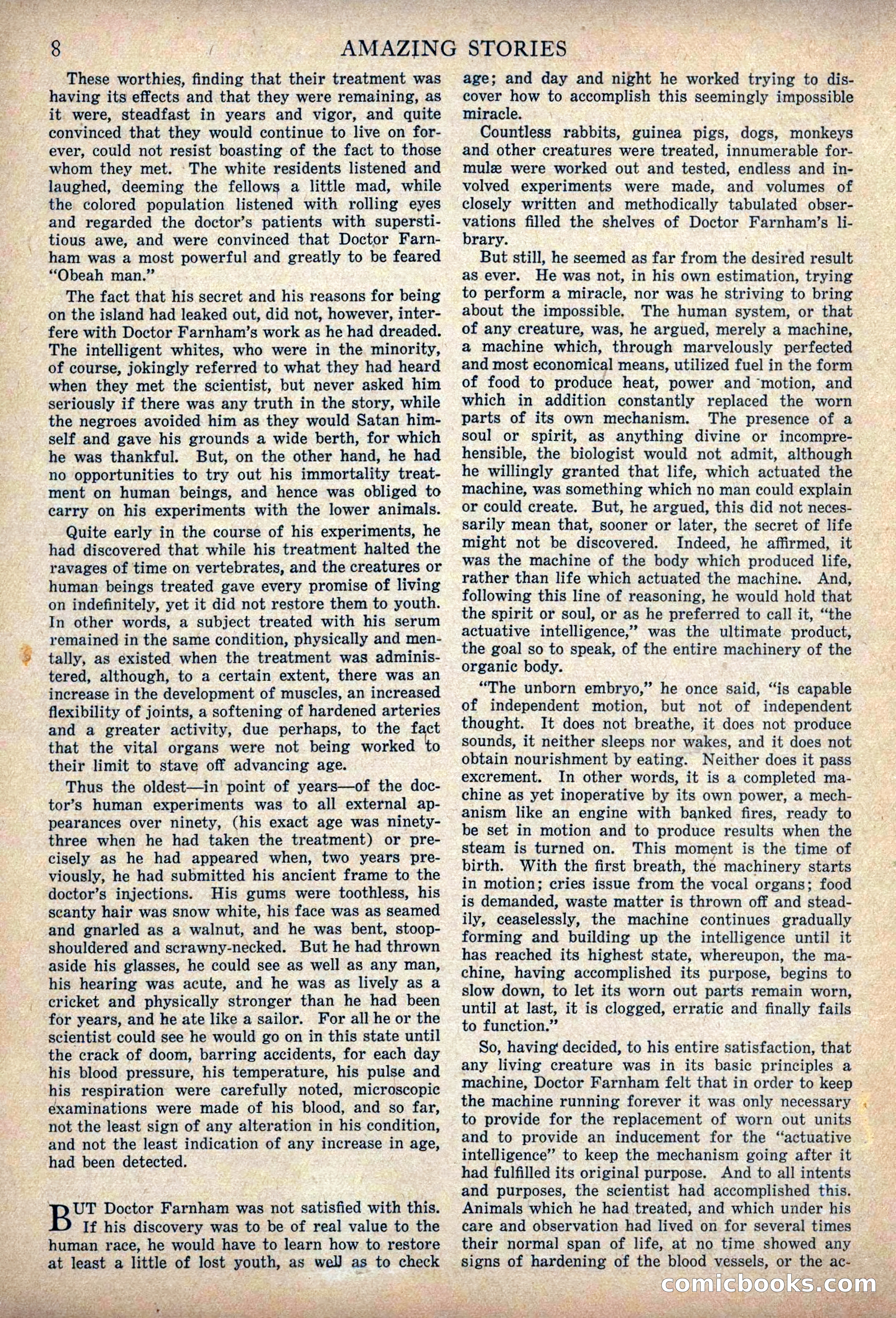
A restored page from Pulp Fiction, 1927. Page through the whole issue in the reader above.
📄 Transcribed text from this page (OCR, searchable)
Machine-transcribed from the original scan — historical spelling and the odd misread are preserved.
8 These worthies, finding that their treatment was having its effects and that they were remaining, as it were, steadfast in years and vigor, and quite convinced that they would continue to live on for- ever, could not resist boasting of the fact to those whom they met. -The white residents listened and laughed, deeming the fellows a little mad, while the colored population listened with rolling eyes and regarded the doctor’s patients with supersti- tious awe, and were convinced that Doctor Farn- ham was a most powerful and greatly to be feared “Obeah man.” The fact that his secret and his reasons for being on the island had leaked out, did not, however, inter- fere with Doctor Farnham’s work as he had dreaded. The intelligent whites, who were in the minority, of course, jokingly referred to what they had heard when they met the scientist, but never asked him seriously if there was any truth in the story, while the negroes avoided him as they would Satan him- self and gave his grounds a wide berth, for which he was thankful. But, on the other hand, he had no opportunities to try out his immortality treat- ment on human beings, and hence was obliged to earry on his experiments with the lower animals. Quite early in the course of his experiments, he had discovered that while his treatment halted the ravages of time on vertebrates, and the creatures or human beings treated gave every promise of living on indefinitely, yet it did not restore them to youth. In other words, a subject treated with his serum remained in the same condition, physically and men- tally, as existed when the treatment was adminis- tered, although, to a certain extent, there was an increase in the development of muscles, an increased flexibility of joints, a softening of hardened arteries and a greater activity, due perhaps, to the fact that the vital organs were not being worked to their limit to stave off advancing age. Thus the oldest—in point of years—of the doc- tor’s human experiments was to all external ap- pearances over ninety, (his exact age was ninety- three when he had taken the treatment) or pre- cisely as he had appeared when, two years pre- viously, he had submitted his ancient frame to the doctor’s injections. His gums were toothless, his scanty hair was snow white, his face was as seamed and gnarled as a walnut, and he was bent, stoop- shouldered and scrawny-necked. But he had thrown aside his glasses, he could see as well as any man, his hearing was acute, and he was as lively as a cricket and physically stronger than he had been for years, and he ate like a sailor. For all he or the scientist could see he would go on in this state until the crack of doom, barring accidents, for each day his blood pressure, his temperature, his pulse and his respiration were carefully noted, microscopic examinations were made of his blood, and so far, not the least sign of any alteration in his condition, and not the least indication of any increase in age, had been detected. UT Doctor Farnham was not satisfied with this. If his discovery was to be of real value to the human race, he would have to learn how to restore at least a little of lost youth, as wel as to check ; does ; 4a, - et. 3 Feet? - * \ ete e” - oe . > tes ere BAN, 4 yas os eee 4° -% he - wh & ot he : oe a ee £ . 5 Se AS a Be ~> <4 ~ vy Wes Se yee Po. ’ 2S Puy 4 tw a caw - arn 7S a 4 ey Rear i nin Ay yf ee, BPs, lee Pon we ew Pa *:4, a EPONA AI, oT of mee € a er AMAZING STORIES age; and day and night he worked trying to dis- cover how to accomplish this seemingly impossible miracle. Countless rabbits, guinea pigs, dogs, monkeys and other creatures were treated, innumerable for- mule were worked out and tested, endless and in- volved experiments were made, and volumes of closely written and methodically tabulated obser- vations filled the shelves of Doctor Farnham’s li- brary. But still, he seemed as far from the desired result as ever. He was not, in his own estimation, trying to perform a miracle, nor was he striving to bring about the impossible. of any creature, was, he argued, merely a machine, a machine which, through marvelously perfected and most economical means, utilized fuel in the form of food to produce heat, power and ‘motion, and which in addition constantly replaced the worn parts of its own mechanism. The presence of a soul or spirit, as anything divine or incompre- hensible, the biologist would not admit, although he willingly granted that life, which actuated the machine, was something which no man could explain or could create. But, he argued, this did not neces- sarily mean that, sooner or later, the secret of life might not be discovered. Indeed, he affirmed, it was the machine of the body which produced life, rather than life which actuated the machine. And, following this line of reasoning, he would hold that the spirit or soul, or as he preferred to call it, “the actuative intelligence,” was the ultimate product, the goal so to speak, of the entire machinery of the organic body. “The unborn embryo,” he once said, “is capable of independent motion, but not of independent thought. It does not breathe, it does not produce sounds, it neither sleeps nor wakes, and it does not obtain nourishment by eating. Neither does it pass excrement. In other words, it is a completed ma- chine as yet inoperative by its own power, a mech- anism like an engine with banked fires, ready to be set in motion and to produce results when the steam is turned on. This moment is the time of birth. With the first breath, the machinery starts in motion; cries issue from the vocal organs; food is demanded, waste matter is thrown off and stead- ily, ceaselessly, the machine continues gradually forming and building up the intelligence until it has reached its highest state, whereupon, the ma- chine, having accomplished its purpose, begins to slow down, to let its worn out parts remain worn, until at last, it is clogged, erratic and finally fails to function.” 80, having‘ decided, to his entire satisfaction, that any living creature was in its basic principles a machine, Doctor Farnham felt that in order to keep the machine running forever it was only necessary to provide for the replacement of worn out units and to provide an inducement for the “actuative intelligence” to keep the mechanism going after it had fulfilled its original purpose. And to all intents and purposes, the scientist had accomplished this. Animals which he had treated, and which under his care and observation had lived on for several times their normal span of life, at no time showed any signs of hardening of the blood vessels, or the ac- Eom eveo! S com The human system, or that. aa eo Si eee See ee ONS eee eee alg ee» 4 dat. sf Pe Fe Ts os ake