
Pulp Fiction, 1927 · page 10 of 108
Amazing Stories, Vol. 2, No. 1 — page 10: what you’re looking at
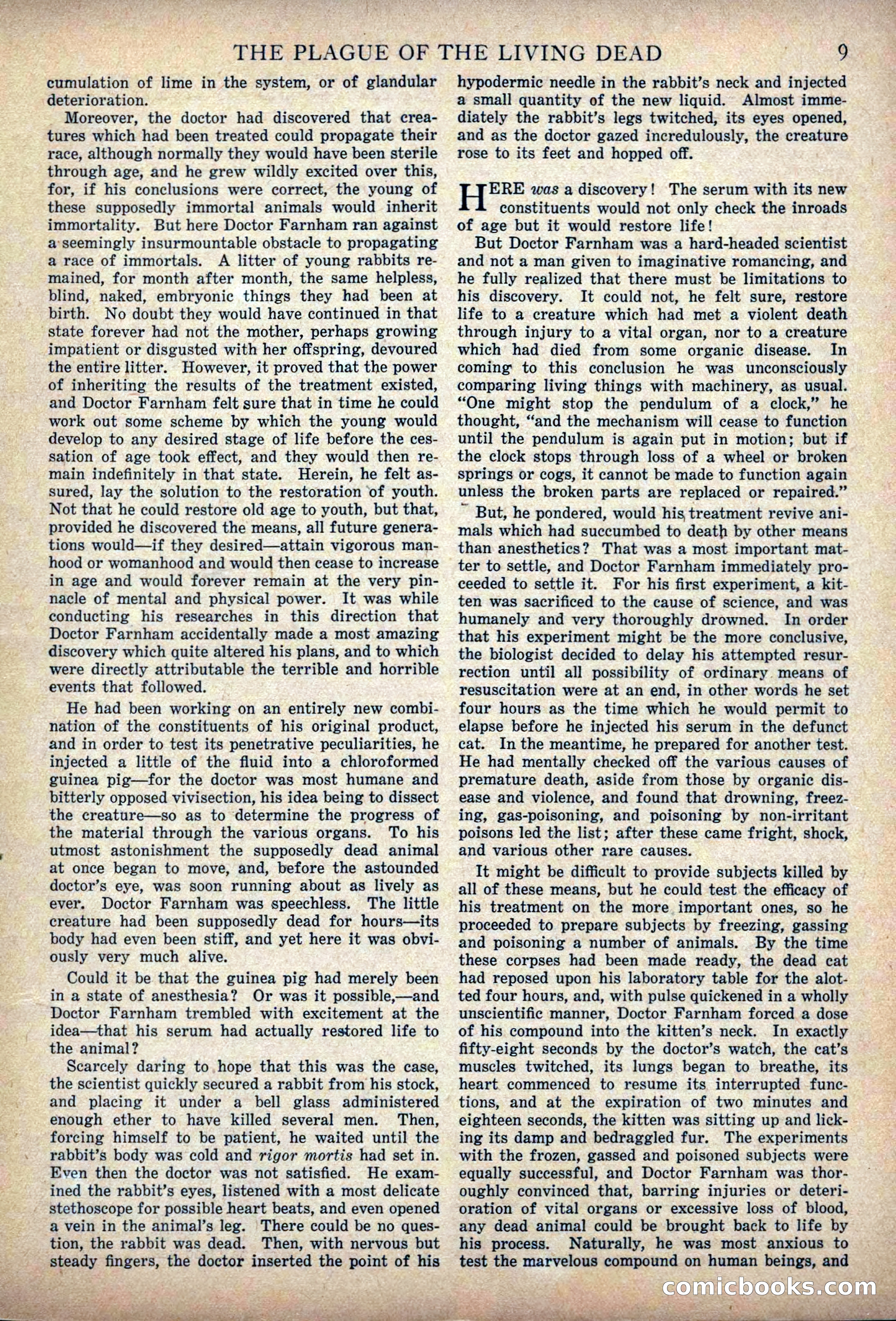
A restored page from Pulp Fiction, 1927. Page through the whole issue in the reader above.
📄 Transcribed text from this page (OCR, searchable)
Machine-transcribed from the original scan — historical spelling and the odd misread are preserved.
THE PLAGUE OF THE LIVING DEAD ea cumulation of lime in the system, or of glandular deterioration. _ Moreover, the doctor had discovered that crea- tures which had been treated could propagate their race, although normally they would have been sterile through age, and he grew wildly excited over this, for, if his conclusions were correct, the young of these supposedly immortal animals would inherit immortality. But here Doctor Farnham ran against a seemingly insurmountable obstacle to propagating a race of immortals. A litter of young rabbits re- mained, for month after month, the same helpless, blind, naked, embryonic things they had been at birth. No doubt they would have continued in that state forever had not the mother, perhaps growing impatient or disgusted with her offspring, devoured the entire litter. However, it proved that the power of inheriting the results of the treatment existed, and Doctor Farnham felt sure that in time he could work out some scheme by which the young would develop to any desired stage of life before the ces- sation of age took effect, and they would then re- main indefinitely in that state. Herein, he felt as- sured, lay the solution to the restoration of youth. Not that he could restore old age to youth, but that, provided he discovered the means, all future genera- tions would—if they desired—attain vigorous man- hood or womanhood and would then cease to increase in age and would forever remain at the very pin- nacle of mental and physical power. It was while conducting his researches in this direction that Doctor Farnham accidentally made a most amazing discovery which quite altered his plans, and to which were directly attributable the terrible and horrible events that followed. He had been working on an entirely new combi- nation of the constituents of his original product, and in order to test its penetrative peculiarities, he injected a little of the fluid into a chloroformed guinea pig—for the doctor was most humane and bitterly opposed vivisection, his idea being to dissect the creature—so as to determine the progress of the material through the various organs. To his utmost astonishment the supposedly dead animal at once began to move, and, before the astounded doctor’s eye, was soon running about as lively as ever. Doctor Farnham was speechless. The little creature had been supposedly dead for hours—its body had even been stiff, and yet here it was obvi- ously very much alive. Could it be that the guinea pig had merely been in a state of anesthesia? Or was it possible,—and Doctor Farnham trembled with excitement at the idea—that his serum had actually restored life to the animal? Scarcely daring to hope that this was the case, the scientist quickly secured a rabbit from his stock, and placing it under a bell glass administered enough ether to have killed several men. Then, forcing himself to be patient, he waited until the rabbit’s body was cold and rigor mortis had set in. Even then the doctor was not satisfied. He exam- ined the rabbit’s eyes, listened with a most delicate _ stethoscope for possible heart beats, and even opened a vein in the animal’s leg. There could be no ques- tion, the rabbit was dead. Then, with nervous but 47 SEs La +e Mens steady fingers, the doctor inserted the point of his ee = y . - . POD, 1 irk gt " Soct .y Sore a ; a » M “= a) <7) Fi _*. ty. es ne 4 => pe - abe é oa SEE, SERED SES ee Ne et RR hypodermic needle in the rabbit’s neck and injected a small quantity of the new liquid. Almost imme- diately the rabbit’s legs twitched, its eyes opened, and as the doctor gazed incredulously, the creature rose to its feet and hopped off. ERE was a discovery! The serum with its new constituents would not only check the inroads of age but it would restore life! But Doctor Farnham was a hard-headed scientist and not a man given to imaginative romancing, and he fully realized that there must be limitations to his discovery. It could not, he felt sure, restore life to a creature which had met a violent death through injury to a vital organ, nor to a creature which had died from some organic disease. In coming to this conclusion he was unconsciously comparing living things with machinery, as usual. “One might stop the pendulum of a clock,” he thought, “and the mechanism will cease to function until the pendulum is again put in motion; but if the clock stops through loss of a wheel or broken springs or cogs, it cannot be made to function again unless the broken parts are replaced or repaired.” ~ But, he pondered, would his treatment revive ani- mals which had succumbed to death by other means than anesthetics? That was a most important mat- ter to settle, and Doctor Farnham immediately pro- ceeded to settle it. For his first experiment, a kit- ten was sacrificed to the cause of science, and was humanely and very thoroughly drowned. In order that his experiment might be the more conclusive, the biologist decided to delay his attempted resur- rection until all possibility of ordinary means of resuscitation were at an end, in other words he set four hours as the time which he would permit to elapse before he injected his serum in the defunct cat. In the meantime, he prepared for another test. He had mentally checked off the various causes of premature death, aside from those by organic dis- ease and violence, and found that drowning, freez- ing, gas-poisoning, and poisoning by non-irritant poisons led the list; after these came fright, shock, and various other rare causes. It might be difficult to provide subjects killed by all of these means, but he could test the efficacy of his treatment on the more important ones, so he proceeded to prepare subjects by freezing, gassing and poisoning a number of animals. By the time these corpses had been made ready, the dead cat had reposed upon his laboratory table for the alot- ted four hours, and, with pulse quickened in a wholly unscientific manner, Doctor Farnham forced a dose of his compound into the kitten’s neck. In exactly fifty-eight seconds by the doctor’s watch, the cat’s muscles twitched, its lungs began to breathe, its heart commenced to resume its interrupted func- tions, and at the expiration of two minutes and eighteen seconds, the kitten was sitting up and lick- ing its damp and bedraggled fur. The experiments with the frozen, gassed and poisoned subjects were equally successful, and Doctor Farnham was thor- oughly convinced that, barring injuries or deteri- oration of vital organs or excessive loss of blood, any dead animal could be brought back to life by his process. Naturally, he was most anxious to test the marvelous compound on human beings, and “Ss ‘ > comicboo Se PEO ey Rey ee ge (ee) f vty - “- “ ae Ue a oe, a