
Pulp Fiction, 1927 · page 8 of 108
Amazing Stories, Vol. 2, No. 1 — page 8: what you’re looking at
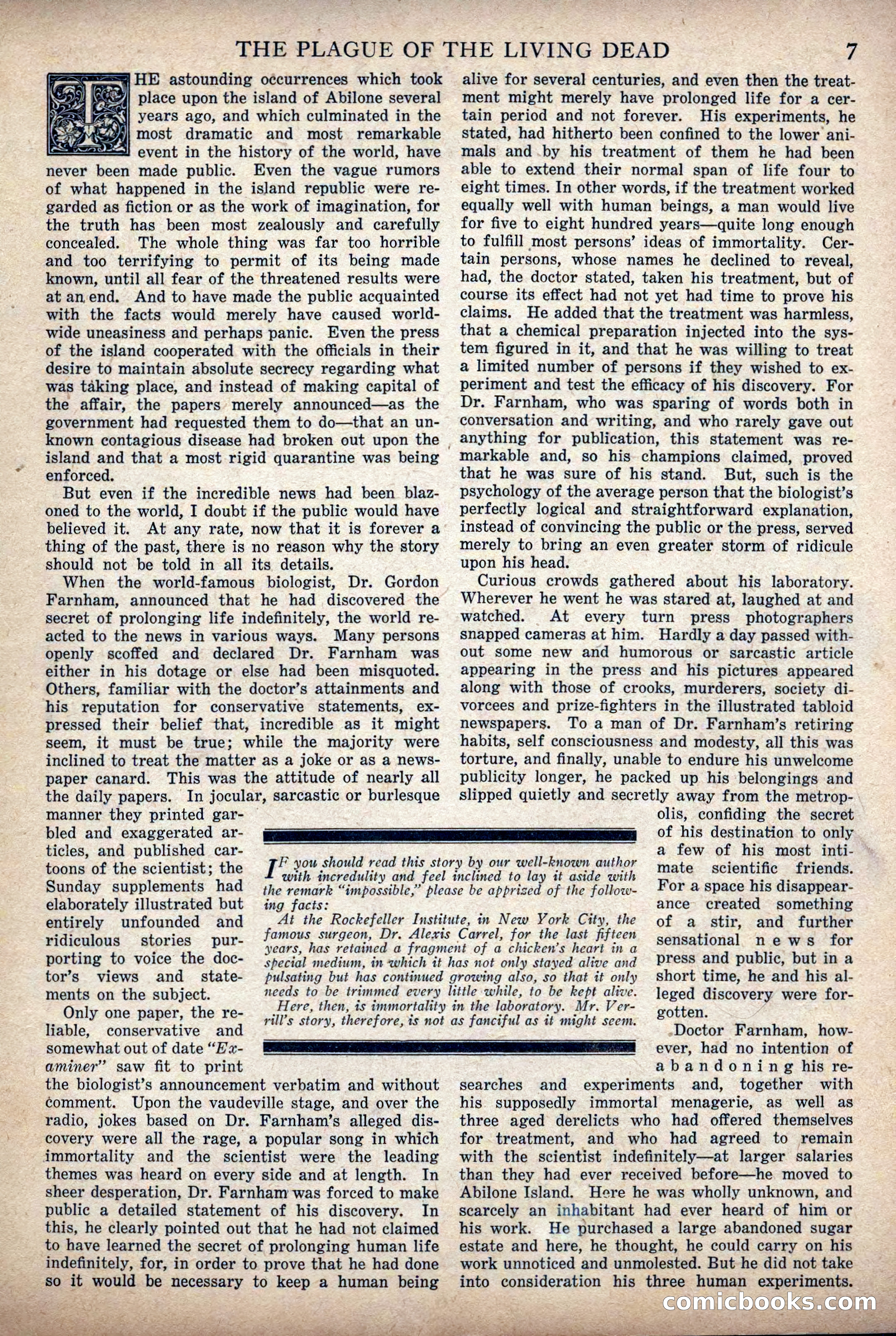
A restored page from Pulp Fiction, 1927. Page through the whole issue in the reader above.
📄 Transcribed text from this page (OCR, searchable)
Machine-transcribed from the original scan — historical spelling and the odd misread are preserved.
™ + i oe 7. “« THE PLAGUE OF THE LIVING DEAD | Z 1HE astounding occurrences which took place upon the island of Abilone several Pe Vax3| years ago, and which culminated in the y) most dramatic and most remarkable Sai!) event in the history of the world, have never been made public. Even the vague rumors of what happened in the island republic were re- garded as fiction or as the work of imagination, for the truth has been most zealously and carefully concealed. The whole thing was far too horrible and too terrifying to permit of its being made known, until all fear of the threatened results were at an end. And to have made the public acquainted with the facts would merely have caused world- wide uneasiness and perhaps panic. Even the press of the island cooperated with the officials in their desire to maintain absolute secrecy regarding what was taking place, and instead of making capital of the affair, the papers merely announced—as the government had requested them to do—that an un- known contagious disease had broken out upon the | island and that a most rigid quarantine was being enforced. But even if the incredible news had been blaz- oned to the world, I doubt if the public would have believed it. At any rate, now that it is forever a thing of the past, there is no reason why the story should not be told in all its details. When the world-famous biologist, Dr. Gordon Farnham, announced that he had discovered the secret of prolonging life indefinitely, the world re- acted to the news in various ways. Many persons openly scoffed and declared Dr. Farnham was either in his dotage or else had been misquoted. Others, familiar with the doctor’s attainments and his reputation for conservative statements, ex- pressed their belief that, incredible as it might seem, it must be true; while the majority were inclined to treat the matter as a joke or as a news- paper canard. This was the attitude of nearly all the daily papers. In jocular, sarcastic or burlesque manner they printed gar- — bled and exaggerated ar- ticles, and published car- toons of the scientist; the Sunday supplements had elaborately illustrated but entirely unfounded and ridiculous’ stories pur- porting to voice the doc- tor’s views and_ state- ments on the subject. Only one paper, the re- liable, conservative and somewhat out of date “E'xz- aminer”’ saw fit to print the biologist’s announcement verbatim and without comment. Upon the vaudeville stage, and over the radio, jokes based on Dr. Farnham’s alleged dis- covery were all the rage, a popular song in which immortality and the scientist were the leading themes was heard on every side and at length. In sheer desperation, Dr. Farnham was forced to make public a detailed statement of his discovery. In this, he clearly pointed out that he had not claimed to have learned the secret of prolonging human life indefinitely, for, in order to prove that he had done so it would be necessary to keep a human being ing facts: F you should read this story by our well-known author with incredulity and feel inclined to lay it aside with the remark “impossible,” please be apprised of the follow- At the Rockefeller Institute, in New York City, the famous surgeon, Dr. Alexis Carrel, for the last fifteen years, has retained a fragment of a chicken’s heart in a special medium, in which it has not only stayed alive and pulsating but has continued growing also, so that itt only needs to be trimmed every little while, to be kept alive. Here, then, ts immortality in the laboratory. Mr. Ver- rill’s story, therefore, is not as fanciful as it might seem. eae aes alive for several centuries, and even then the treat- ment might merely have prolonged life for a cer- tain period and not forever. His experiments, he stated, had hitherto been confined to the lower ani- mals and .by his treatment of them he had been able to extend their normal span of life four to eight times. In other words, if the treatment worked equally well with human beings, a man would live for five to eight hundred years—quite long enough to fulfill most persons’ ideas of immortality. Cer- tain persons, whose names he declined to reveal, had, the doctor stated, taken his treatment, but of course its effect had not yet had time to prove his claims. He added that the treatment was harmless, that a chemical preparation injected into the sys- tem figured in it, and that he was willing to treat a limited number of persons if they wished to ex- periment and test the efficacy of his discovery. For Dr. Farnham, who was sparing of words both in conversation and writing, and who rarely gave out anything for publication, this statement was re- markable and, so his champions claimed, proved that he was sure of his stand. But, such is the psychology of the average person that the biologist’s perfectly logical and straightforward explanation, instead of convincing the public or the press, served merely to bring an even greater storm of ridicule upon his head. Curious crowds gathered about his laboratory. Wherever he went he was stared at, laughed at and watched. At every turn press photographers snapped cameras at him. Hardly a day passed with- out some new and humorous or sarcastic article appearing in the press and his pictures appeared along with those of crooks, murderers, society di- vorcees and prize-fighters in the illustrated tabloid newspapers. To a man of Dr. Farnham’s retiring habits, self consciousness and modesty, all this was torture, and finally, unable to endure his unwelcome publicity longer, he packed up his belongings and slipped quietly and secretly away from the metrop- olis, confiding the secret of his destination to only a few of his most inti- mate scientific friends. For a space his disappear- ance created something of a stir, and further sensational news for press and public, but in a short time, he and his al- leged discovery were for- gotten. .-Doctor Farnham, how- ever, had no intention of abandoning his re- searches and experiments and, together with his supposedly immortal menagerie, as well as three aged derelicts who had offered themselves for treatment, and who had agreed to remain with the scientist indefinitely—at larger salaries than they had ever received before—he moved to Abilone Island. Here he was wholly unknown, and scarcely an inhabitant had ever heard of him or his work. He purchased a large abandoned sugar estate and here, he thought, he could carry on his work unnoticed and unmolested. But he did not take into consideration his three human experiments. Eo) micbooks.co