
Pulp Fiction, 1927 · page 63 of 108
Amazing Stories, Vol. 2, No. 1 — page 63: what you’re looking at
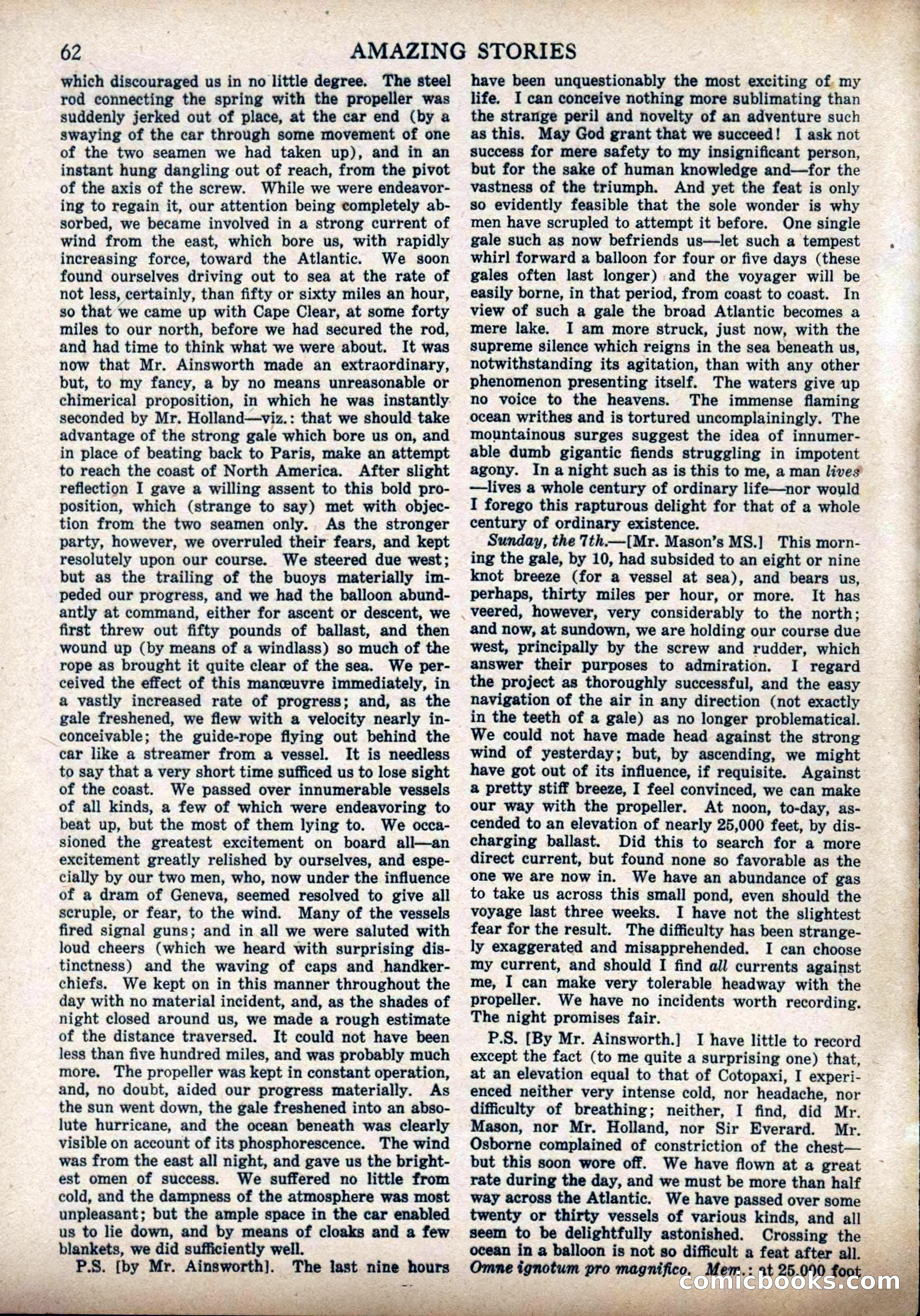
A restored page from Pulp Fiction, 1927. Page through the whole issue in the reader above.
📄 Transcribed text from this page (OCR, searchable)
Machine-transcribed from the original scan — historical spelling and the odd misread are preserved.
62 which discouraged us in no little degree. The steel rod connecting the spring with the propeller was suddenly jerked out of place, at the car end (by a swaying of the car through some movement of one of the two seamen we had taken up), and in an instant hung dangling out of reach, from the pivot of the axis of the screw. While we were endeavor- ing to regain it, our attention being completely ab- sorbed, we became involved in a strong current of wind from the east, which bore us, with rapidly increasing force, toward the Atlantic. We soon found ourselves driving out to sea at the rate of not less, certainly, than fifty or sixty miles an hour, so that we came up with Cape Clear, at some forty miles to our north, before we had secured the rod, and had time to think what we were about. It was now that Mr. Ainsworth made an extraordinary, but, to my fancy, a by no means unreasonable or chimerical proposition, in which he was instantly: seconded by Mr. Holland—viz.: that we should take advantage of the strong gale which bore us on, and in place of beating back to Paris, make an attempt to reach the coast of North America. After slight reflection I gave a willing assent to this bold pro- position, which (strange to say) met with objec- tion from the two seamen only. As the stronger party, however, we overruled their fears, and kept resolutely upon our course. We steered due west; but as the trailing of the buoys materially im- peded our progress, and we had the balloon abund- antly at command, either for ascent or descent, we first threw out fifty pounds of ballast, and then wound up (by means of a windlass) so much of the rope as brought it quite clear of the sea. We per- ceived the effect of this mancwuvre immediately, in a vastly increased rate of progress; and, as the gale freshened, we flew with a velocity nearly in- conceivable; the guide-rope flying out behind the car like a streamer from a vessel. It is needless to say that a very short time sufficed us to lose sight of the coast. We passed over innumerable vessels of all kinds, a few of which were endeavoring to beat up, but the most of them lying to. We occa- sioned the greatest excitement on board all—an excitement greatly relished by ourselves, and espe- cially by our two men, who, now under the influence of a dram of Geneva, seemed resolved to give all scruple, or fear, to the wind. Many of the vessels fired signal guns; and in all we were saluted with loud cheers (which we heard with surprising dis- tinctness) and the waving of caps and handker- chiefs. We kept on in this manner throughout the day with no material incident, and, as the shades of night closed around us, we made a rough estimate of the distance traversed. It could not have been less than five hundred miles, and was probably much more. The propeller was kept in constant operation, and, no doubt, aided our progress materially. As the sun went down, the gale freshened into an abso- lute hurricane, and the ocean beneath was clearly visible on account of its phosphorescence. The wind was from the east all night, and gave us the bright- est omen of success. We suffered no little from cold, and the dampness of the atmosphere was most unpleasant; but the ample space in the car enabled us to lie down, and by means of cloaks and a few blankets, we did sufficiently well. P.S. {by Mr. Ainsworth]. The last nine hours - ee ‘< ‘ . ' * = oy ee = > aa “ “<~ >= a Pe ee es FOE eR es he et) ag ee = - > P< ‘ i > ae e > * - -* me - = me 3 * "4 # 7 é - . , " 4 « - re ‘4 > . ~ pA o » 1 a> gee eS Pee ee eee bi a ta? ch hie 2! pa b Meg wets re . ee ee ae re. ate f 4S ~ a ae — - * Tee, fee ‘on. ae i Nba E ve es Be gee a Se ad ae {tees xe ; ite ge yea 4 va gd a re ak © ee, < me ee Pees ab AMAZING STORIES have been unquestionably the most exciting of. my life. I can conceive nothing more sublimating than the strange peril and novelty of an adventure such as this. May God grant that we succeed! I ask not success for mere safety to my insignificant person, but for the sake of human knowledge and—for the vastness of the triumph. And yet the feat is only so evidently feasible that the sole wonder is why men have scrupled to attempt it before. One single gale such as now befriends us—let such a tempest whirl forward a balloon for four or five days (these gales often last longer) and the voyager will be easily borne, in that period, from coast to coast. In view of such a gale the broad Atlantic becomes a mere lake. I am more struck, just now, with the supreme silence which reigns in the sea beneath us, notwithstanding its agitation, than with any other phenomenon presenting itself. The waters give up no voice to the heavens. The immense flaming ocean writhes and is tortured uncomplainingly. The mountainous surges suggest the idea of innumer- able dumb gigantic fiends struggling in impotent agony. In a night such as is this to me, a man lives —lives a whole century of ordinary life—nor would I forego this rapturous delight for that of a whole century of ordinary existence. Sunday, the 7th—[Mr. Mason’s MS.] This morn- ing the gale, by 10, had subsided to an eight or nine knot breeze (for a vessel at sea), and bears us, perhaps, thirty miles per hour, or more. It has _ veered, however, very considerably to the north; and now, at sundown, we are holding our course due west, principally by the screw and rudder, which answer their purposes to admiration. I regard the project as thoroughly successful, and the easy navigation of the air in any direction (not exactly in the teeth of a gale) as no longer problematical. We could not have made head against the strong wind of yesterday; but, by ascending, we might have got out of its influence, if requisite. Against a pretty stiff breeze, I feel convinced, we can make our way with the propeller. At noon, to-day, as- cended to an elevation of nearly 25,000 feet, by dis- charging ballast. Did this to search for a more direct current, but found none so favorable as the one we are now in. We have an abundance of gas to take us across this small pond, even should the voyage last three weeks. I have not the slightest fear for the result. The difficulty has been strange- ly exaggerated and misapprehended. I can choose my current, and should I find all currents against me, I can make very tolerable headway with the propeller. We have no incidents worth recording. The night promises fair. P.S. [By Mr. Ainsworth.] I have little to record except the fact (to me quite a surprising one) that, at an elevation equal to that of Cotopaxi, I experi- enced neither very intense cold, nor headache, nor difficulty of breathing; neither, I find, did Mr. Mason, nor Mr. Holland, nor Sir Everard. Mr. Osborne complained of constriction of the chest— but this soon wore off. We have flown at a great rate during the day, and we must be more than half way across the Atlantic. We have passed over some twenty or thirty vessels of various kinds, and all seem to be delightfully astonished. Crossing the all. ‘ Shs ocean in a balloon is not so difficult a feat after Py Omne ignotum pro magnifico Mer. : nt ook a : ; = : re = pai oh es me ea. Te eget ALP et see : Nag >. 5 # "i , on > oie a a” PIR Le EMO DENI 5 OT OOF EE GG ON ETE ES 5 x i wey DO 3 Se 7 | +“. <-% x? a