
Pulp Fiction, 1927 · page 62 of 108
Amazing Stories, Vol. 2, No. 1 — page 62: what you’re looking at
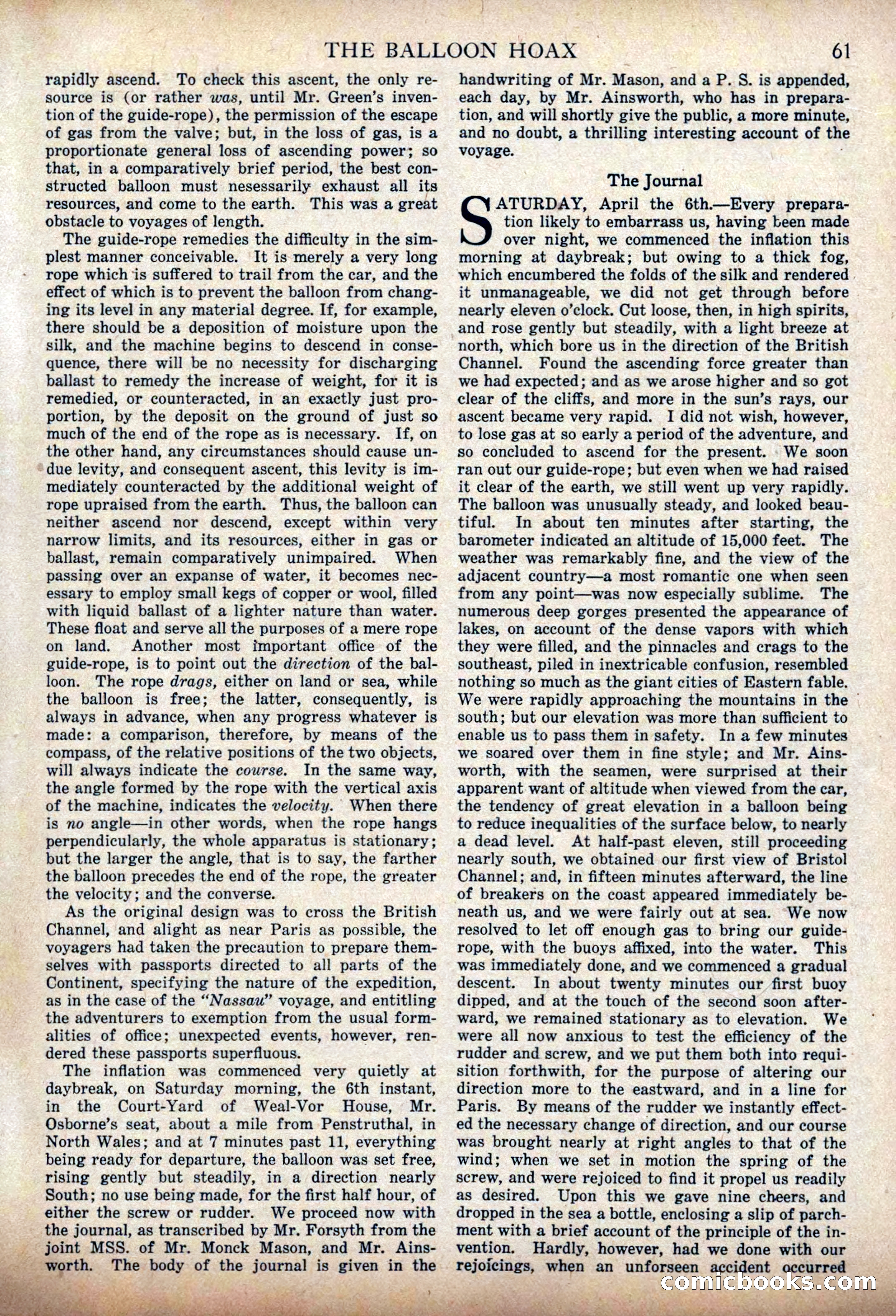
A restored page from Pulp Fiction, 1927. Page through the whole issue in the reader above.
📄 Transcribed text from this page (OCR, searchable)
Machine-transcribed from the original scan — historical spelling and the odd misread are preserved.
THE BALLOON HOAX rapidly ascend. To check this ascent, the only re- source is (or rather was, until Mr. Green’s inven- tion of the guide-rope), the permission of the escape of gas from the valve; but, in the loss of gas, is a proportionate general loss of ascending power; so that, in a comparatively brief period, the best con- structed balloon must nesessarily exhaust all its resources, and come to the earth. This was a great obstacle to voyages of length. The guide-rope remedies the difficulty in the sim- plest manner conceivable. It is merely a very long rope which ‘is suffered to trail from the car, and the effect of which is to prevent the balloon from chang- ing its level in any material degree. If, for example, there should be a deposition of moisture upon the silk, and the machine begins to descend in conse- quence, there will be no necessity for discharging ballast to remedy the increase of weight, for it is remedied, or counteracted, in an exactly just pro- portion, by the deposit on the ground of just so much of the end of the rope as is necessary. If, on the other hand, any circumstances should cause un- ~ due levity, and consequent ascent, this levity is im- mediately counteracted by the additional weight of rope upraised from the earth. Thus, the balloon can neither ascend nor descend, except within very narrow limits, and its resources, either in gas or ballast, remain comparatively unimpaired. When passing over an expanse of water, it becomes nec- essary to employ small kegs of copper or wool, filled with liquid ballast of a lighter nature than water. These float and serve all the purposes of a mere rope on land. Another most important office of the guide-rope, is to point out the direction of the bal- loon. The rope drags, either on land or sea, while the balloon is free; the latter, consequently, is always in advance, when any progress whatever is made: a comparison, therefore, by means of the compass, of the relative positions of the two objects, will always indicate the course. In the same way, the angle formed by the rope with the vertical axis of the machine, indicates the velocity. When there is no angle—in other words, when the rope hangs perpendicularly, the whole apparatus is stationary; but the larger the angle, that is to say, the farther the balloon precedes the end of the rope, the greater the velocity; and the converse. As the original design was to cross the British Channel, and alight as near Paris as possible, the voyagers had taken the precaution to prepare them- selves with passports directed to all parts of the Continent, specifying the nature of the expedition, as in the case of the “Nassaw” voyage, and entitling the adventurers to exemption from the usual form- alities of office; unexpected events, however, ren- dered these passports superfluous. The inflation was commenced very quietly at daybreak, on Saturday morning, the 6th instant, in the Court-Yard of Weal-Vor House, Mr. Osborne’s seat, about a mile from Penstruthal, in North Wales; and at 7 minutes past 11, everything being ready for departure, the balloon was set free, rising gently but steadily, in a direction nearly South; no use being made, for the first half hour, of either the screw or rudder. We proceed now with _ the journal, as transcribed by Mr. Forsyth from the joint MSS. of Mr. Monck Mason, and Mr. Ains- Ge nie worth. oes pote: pf ne journal is given in the tN ie hr ae a4 ite: Ba io > 2 <i bs - ae , So ba Sg xe Pie ap ee i I] 4 , ee Se ot : : ak we a a al OF 0 hae 7 wi di, ae eh ‘ <. ahs 61 handwriting of Mr. Mason, and a P. S. is appended, each day, by Mr. Ainsworth, who has in prepara- tion, and will shortly give the public, a more minute, and no doubt, a thrilling interesting account of the voyage. S tion likely to embarrass us, having been made over night, we commenced the inflation this morning at daybreak; but owing to a thick fog, The Journal ATURDAY, April the 6th—Every prepara- which encumbered the folds of the silk and rendered. it unmanageable, we did not get through before nearly eleven o’clock. Cut loose, then, in high spirits, and rose gently but steadily, with a light breeze at north, which bore us in the direction of the British Channel. Found the ascending force greater than we had expected; and as we arose higher and so got clear of the cliffs, and more in the sun’s rays, our ascent became very rapid. I did not wish, however, to lose gas at so early a period of the adventure, and so concluded to ascend for the present. .We soon ran out our guide-rope; but even when we had raised it clear of the earth, we still went up very rapidly. The balloon was unusually steady, and looked beau- tiful. In about ten minutes after starting, the barometer indicated an altitude of 15,000 feet. The weather was remarkably fine, and the view of the adjacent country—a most romantic one when seen from any point—was now especially sublime. The numerous deep gorges presented the appearance of lakes, on account of the dense vapors with which they were filled, and the pinnacles and crags to the southeast, piled in inextricable confusion, resembled nothing so much as the giant cities of Eastern fable. We were rapidly approaching the mountains in the — south; but our elevation was more than sufficient to enable us to pass them in safety. In a few minutes we soared over them in fine style; and Mr. Ains- worth, with the seamen, were surprised at their apparent want of altitude when viewed from the car, the tendency of great elevation in a balloon being to reduce inequalities of the surface below, to nearly a dead level. At half-past eleven, still proceeding nearly south, we obtained our first view of Bristol Channel; and, in fifteen minutes afterward, the line of breakers on the coast appeared immediately be- neath us, and we were fairly out at sea. We now resolved to let off enough gas to bring our guide- rope, with the buoys affixed, into the water. This was immediately done, and we commenced a gradual descent. In about twenty minutes our first buoy dipped, and at the touch of the second soon after- ward, we remained stationary as to elevation. We were all now anxious to test the efficiency of the rudder and screw, and we put them both into requi- sition forthwith, for the purpose of altering our direction more to the eastward, and in a line for Paris. By means of the rudder we instantly effect- ed the necessary change of direction, and our course was brought nearly at right angles to that of the wind; when we set in motion the spring of the screw, and were rejoiced to find it propel us readily as desired. Upon this we gave nine cheers, and dropped in the sea a bottle, enclosing a slip of parch- ment with a brief account of the principle of the in- vention. Hardly, however, had we done with our com oo rejoicings, when an unforseen nicbook cusrot eon a “ es a