
Pulp Fiction, 1927 · page 64 of 108
Amazing Stories, Vol. 2, No. 1 — page 64: what you’re looking at
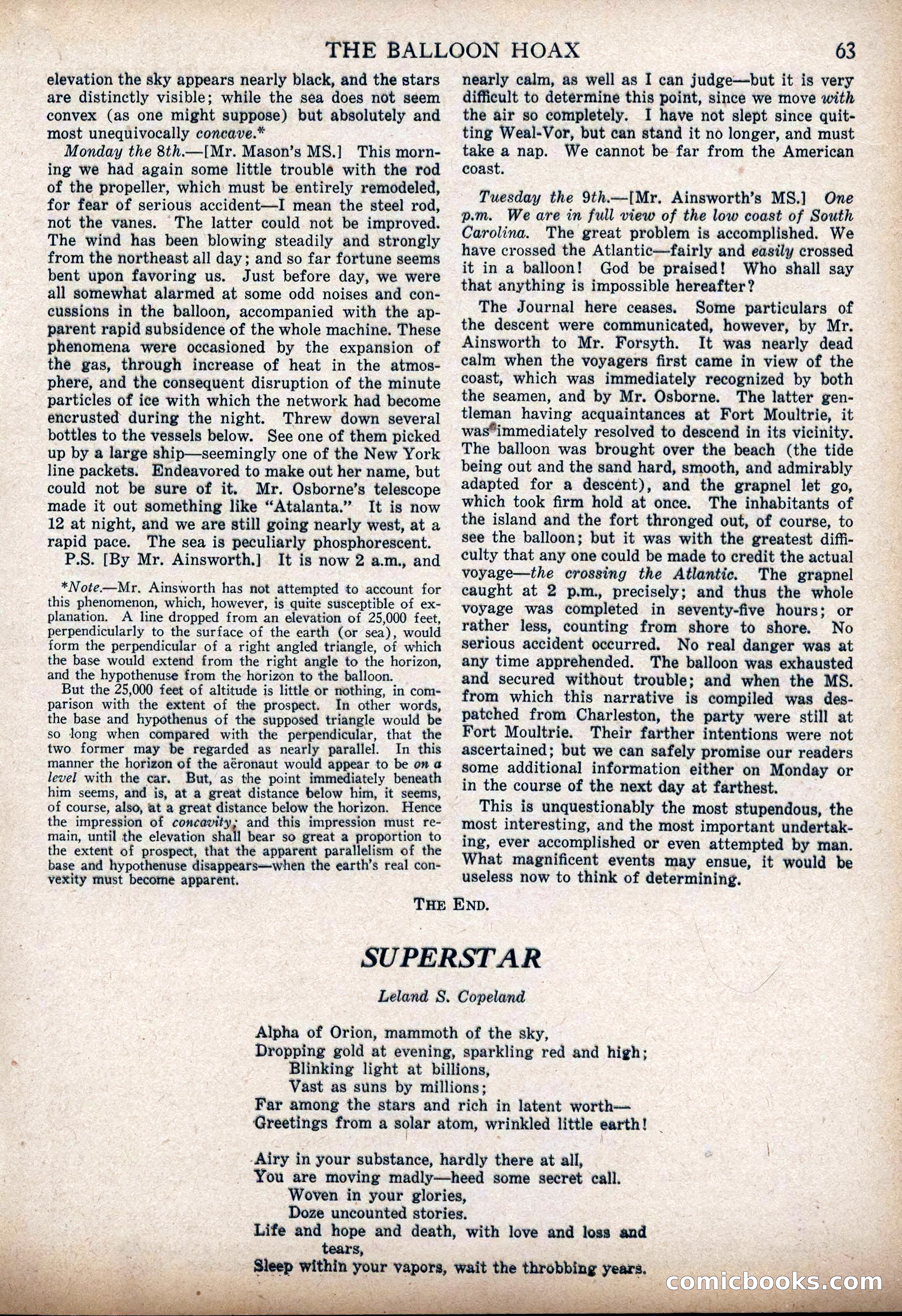
A restored page from Pulp Fiction, 1927. Page through the whole issue in the reader above.
📄 Transcribed text from this page (OCR, searchable)
Machine-transcribed from the original scan — historical spelling and the odd misread are preserved.
SY ole " THE BALLOON HOAX 63 elevation the sky appears nearly black, and the stars are distinctly visible; while the sea does not seem convex (as one might suppose) but absolutely and most unequivocally concave.* Monday the 8th.—[Mr. Mason’s MS.] This morn- ing we had again some little trouble with the rod of the propeller, which must be entirely remodeled, for fear of serious accident—I mean the steel rod, not the vanes. The latter could not be improved. The wind has been blowing steadily and strongly from the northeast all day; and so far fortune seems bent upon favoring us. Just before day, we were all somewhat alarmed at some odd noises and con- cussions in the balloon, accompanied with the ap- parent rapid subsidence of the whole machine. These phenomena were occasioned by the expansion of the gas, through increase of heat in the atmos- phere, and the consequent disruption of the minute particles of ice with which the network had become encrusted during the night. Threw down several bottles to the vessels below. See one of them picked up by a large ship—seemingly one of the New York line packets. Endeavored to make out her name, but could not be sure of it. Mr. Osborne’s telescope made it out something like “Atalanta.” It is now 12 at night, and we are still going nearly west, at a rapid pace. The sea is peculiarly phosphorescent. P.S. [By Mr. Ainsworth.] It is now 2 a.m., and *Note.—Mr. Ainsworth has not attempted to account for this phenomenon, which, however, is quite susceptible of ex- planation. A line dropped from an elevation of 25,000 feet, perpendicularly to the surface of the earth (or sea), would form the perpendicular of a right angled triangle, of which the base would extend from the right angle to the horizon, and the hypothenuse from the horizon to the balloon. But the 25,000 feet of altitude is little or nothing, in com- parison with the extent of the prospect. In other words, the base and hypothenus of the supposed triangle would be so long when compared with the perpendicular, that the two former may be regarded as nearly parallel. In this manner the horizon of the aéronaut would appear to be on a level with the car. But, as the point immediately beneath him seems, and is, at a great distance below him, it seems, of course, also, at a great distance below the horizon. Hence the impression of concavity; and this impression must re- main, until the elevation shal bear so great a proportion to the extent of prospect, that the apparent parallelism of the base and hypothenuse disappears—when the earth’s real con- vexity must become apparent. nearly calm, as well as I can judge—but it is very difficult to determine this point, since we move with the air so completely. I have not slept since quit- ting Weal-Vor, but can stand it no longer, and must take a nap. We cannot be far from the American coast. Tuesday the 9th.—[Mr. Ainsworth’s MS.] One p.m. We are in full view of the low coast of South Carolina. The great problem is accomplished. We have crossed the Atlantic—fairly and easily crossed it in a balloon! God be praised! Who shall say that anything is impossible hereafter? The Journal here ceases. Some particulars of the descent were communicated, however, by Mr. Ainsworth to Mr. Forsyth. It was nearly dead calm when the voyagers first came in view of the coast, which was immediately recognized by both the seamen, and by Mr. Osborne. The latter gen- tleman having acquaintances at Fort Moultrie, it was*immediately resolved to descend in its vicinity. The balloon was brought over the beach (the tide being out and the sand hard, smooth, and admirably adapted for a descent), and the grapnel let go, which took firm hold at once. The inhabitants of the island and the fort thronged out, of course, to see the balloon; but it was with the greatest diffi- culty that any one could be made to credit the actual voyage—the crossing the Atlantic. The grapnel caught at 2 p.m. precisely; and thus the whole voyage was completed in seventy-five hours; or rather less, counting from shore to shore. No serious accident occurred. No real danger was at any time apprehended. The balloon was exhausted and secured without trouble; and when the MS. from which this narrative is compiled was des- patched from Charleston, the party were still at Fort Moultrie. Their farther intentions were not ascertained; but we can safely promise our readers some additional information either on Monday or in the course of the next day at farthest. 3 This is unquestionably the most stupendous, the most interesting, and the most important undertak- ing, ever accomplished or even attempted by man. What magnificent events may ensue, it would be useless now to think of determining. THE END. SUPERSTAR Leland S. Copeland Alpha of Orion, mammoth of the sky, Dropping gold at evening, sparkling red and high; Blinking light at billions, . Vast as suns by millions; Far among the stars and rich in latent worth— Greetings from a solar atom, wrinkled little earth! | -Airy in your substance, hardly there at all, You are moving madly—heed some secret call. Woven in your glories, Doze uncounted stories. Life and hope and death, with love and loss and tears, Sleep within your vapors, ; ate i +t, Ae ~~ 4 ag a ss F; * : : wait the throbbing years. ey Fa RM eee OPEN Hs alg A NS 5 On BT ee ee ; ee Se Rect eee : 3 ee te ae ag aaa PN eed SC SO ae ‘ . 2 ~comicbook: x,