
Pulp Fiction, 1927 · page 55 of 108
Amazing Stories, Vol. 2, No. 1 — page 55: what you’re looking at
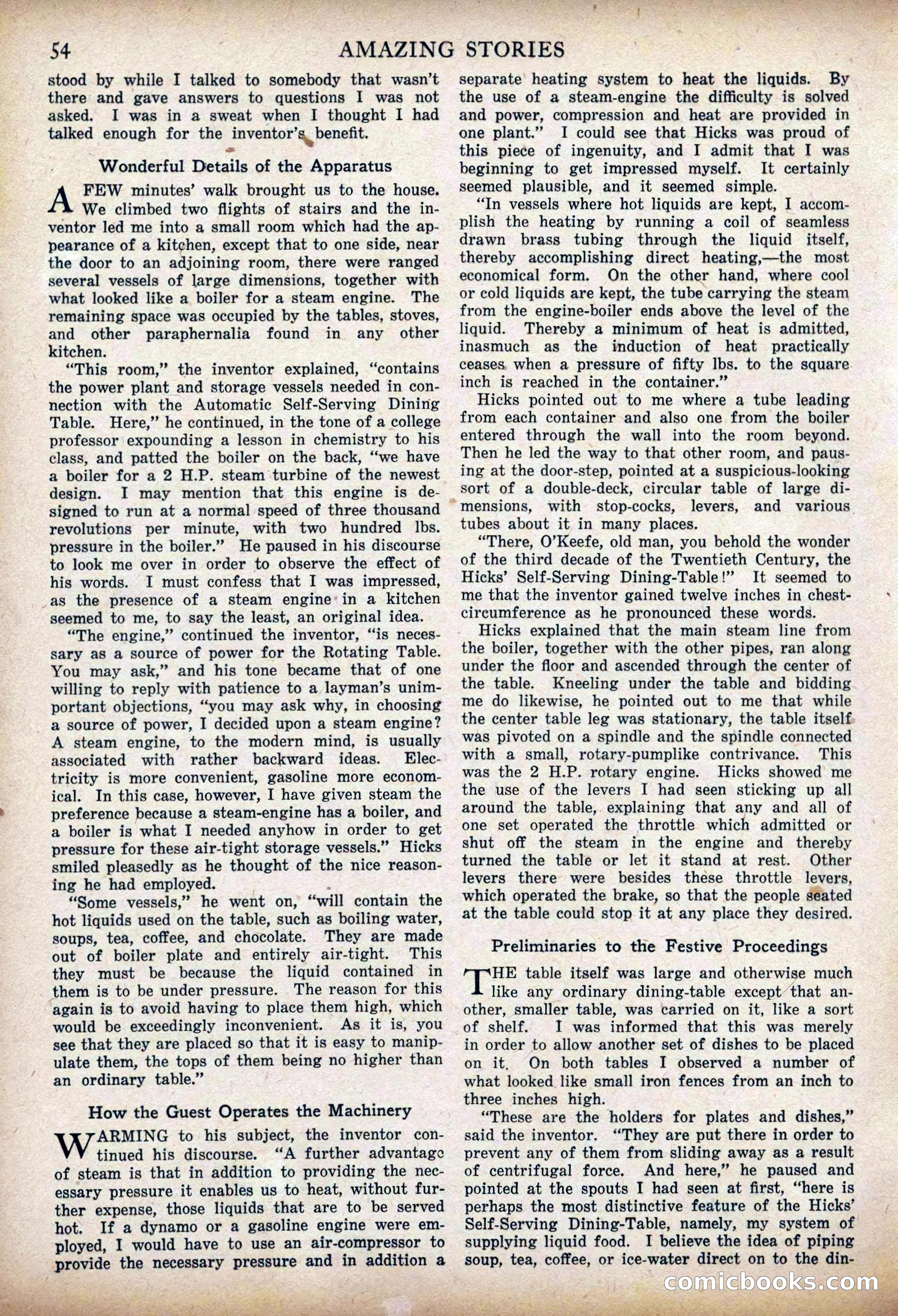
A restored page from Pulp Fiction, 1927. Page through the whole issue in the reader above.
📄 Transcribed text from this page (OCR, searchable)
Machine-transcribed from the original scan — historical spelling and the odd misread are preserved.
aye tree ats te “46 * ‘ , Z asad ep CNR ee Tee ete tk Ae. Ca oe ee a 7 oa ‘ : * ‘ tr Y 54 AMAZING STORIES stood by while I talked to somebody that wasn’t there and gave answers to questions I was not asked. I was in a sweat when I thought I had talked enough for the inventor’s, benefit. Wonderful Details of the Apparatus FEW minutes’ walk brought us to the house. We climbed two flights of stairs and the in- ventor led me into a small room which had the ap- pearance of a kitchen, except that to one side, near the door to an adjoining room, there were ranged several vessels of large dimensions, together with what looked like a boiler for a steam engine. The remaining space was occupied by the tables, stoves, and other paraphernalia found in any other kitchen. “This room,” the inventor explained, “contains the power plant and storage vessels needed in con- nection with the Automatic Self-Serving Dining Table. Here,’ he continued, in the tone of a college professor expounding a lesson in chemistry to his class, and patted the boiler on the back, “we have a boiler for a 2 H.P. steam turbine of the newest design. I may mention that this engine is de- signed to run at a normal speed of three thousand revolutions per minute, with two hundred lbs. pressure in the boiler.” He paused in his discourse to look me over in order to observe the effect of his words. I must confess that I was impressed, as the presence of a steam engine’in a kitchen seemed to me, to say the least, an original idea. “The engine,” continued the inventor, “is neces- sary as a source of power for the Rotating Table. You may ask,” and his tone became that of one willing to reply with patience to a layman’s unim- portant objections, “you may ask why, in choosing a source of power, I decided upon a steam engine? A steam engine, to the modern mind, is usually associated with rather backward ideas. Elec- tricity is more convenient, gasoline more econom- ical. In this case, however, I have given steam the preference because a steam-engine has a boiler, and a boiler is what I needed anyhow in order to get pressure for these air-tight storage vessels.” Hicks smiled pleasedly as he thought of the nice reason- ing he had employed. : “Some vessels,’ he went on, “will contain the hot liquids used on the table, such as boiling water, soups, tea, coffee, and chocolate. They are made out of boiler plate and entirely air-tight. This they must be because the liquid contained in them is to be under pressure. The reason for this again is to avoid having to place them high, which would be exceedingly inconvenient. As it is, you see that they are placed so that it is easy to manip- ulate them, the tops of them being no higher than an ordinary table.” How the Guest Operates the Machinery A? Geant to his subject, the inventor con- tinued his discourse. “A further advantage of steam is that in addition to providing the nec- essary pressure it enables us to heat, without fur- ther expense, those liquids that are to be served hot. If a dynamo or a gasoline engine were em- ployed, I would have to use an air-compressor to provide the necessary pressure and in addition a ~ mensions, . . : . 4 ’ - é~ 2 . $F ghey SF > : » +6 =: Fe hekee Ca res Set ee oe, “ yt, a “Ee wule a= Sn Oe ee, Fae | oe Ps Re 2 RE ee es ae So ot. ie - > ob a os separate heating system to heat the liquids. By the use of a steam-engine the difficulty is solved and power, compression and heat are provided in one plant.” I could see that Hicks was proud of this piece of ingenuity, and I admit that I was beginning to get impressed myself. It certainly seemed plausible, and it seemed simple. “In vessels where hot liquids are kept, I accom- plish the heating by running a coil of seamless drawn brass tubing through the liquid itself, thereby accomplishing direct heating,—the most economical form. On the other hand, where cool or cold liquids are kept, the tube carrying the steam from the engine-boiler ends above the level of the liquid. Thereby a minimum of heat is admitted, inasmuch as the induction of heat practically ceases. when a pressure of fifty Ibs. to the square inch is reached in the container.” Hicks pointed out to me where a tube leading from each container and also one from the boiler entered through the wall into the room beyond. Then he led the way to that other room, and paus- ing at the door-step, pointed at a suspicious-looking sort of a double-deck, circular table of large di- with stop-cocks, levers, and various tubes about it in many places. “There, O’Keefe, old man, you behold the wonder of the third decade of the Twentieth Century, the Hicks’ Self-Serving Dining-Table!” It seemed to me that the inventor gained twelve inches in chest- circumference as he pronounced these words. Hicks explained that the main steam line from the boiler, together with the other pipes, ran along under the floor and ascended through the center of the table. Kneeling under the table and bidding me do likewise, he pointed out to me that while the center table leg was stationary, the table itself was pivoted on a spindle and the spindle connected with a small, rotary-pumplike contrivance. This was the 2 H.P. rotary engine. Hicks showed me the use of the levers I had seen sticking up all around the table, explaining that any and all of one set operated the throttle which admitted or shut off the steam in the engine and thereby turned the table or let it stand at rest. Other levers there were besides these throttle levers, which operated the brake, so that the people seated at the table could stop it at any place they desired. Preliminaries to the Festive Proceedings HE table itself was large and otherwise much like any ordinary dining-table except that an- other, smaller table, was carried on it, like a sort of shelf. I was informed that this was merely in order to allow another set of dishes to be placed on it. On both tables I observed a number of what looked like small iron fences from an inch to three inches high. “These are the holders for plates and dishes,” said the inventor. “They are put there in order to prevent any of them from sliding away as a result of centrifugal force. And here,” he paused and pointed at the spouts I had seen at first, “here is perhaps the most distinctive feature of the Hicks’ Self-Serving Dining-Table, namely, my system of supplying liquid food. I believe the idea of piping soup, tea, coffee, or ice-water direct on to the din- EComicboo “ |