
Pulp Fiction, 1927 · page 16 of 108
Amazing Stories, Vol. 2, No. 1 — page 16: what you’re looking at
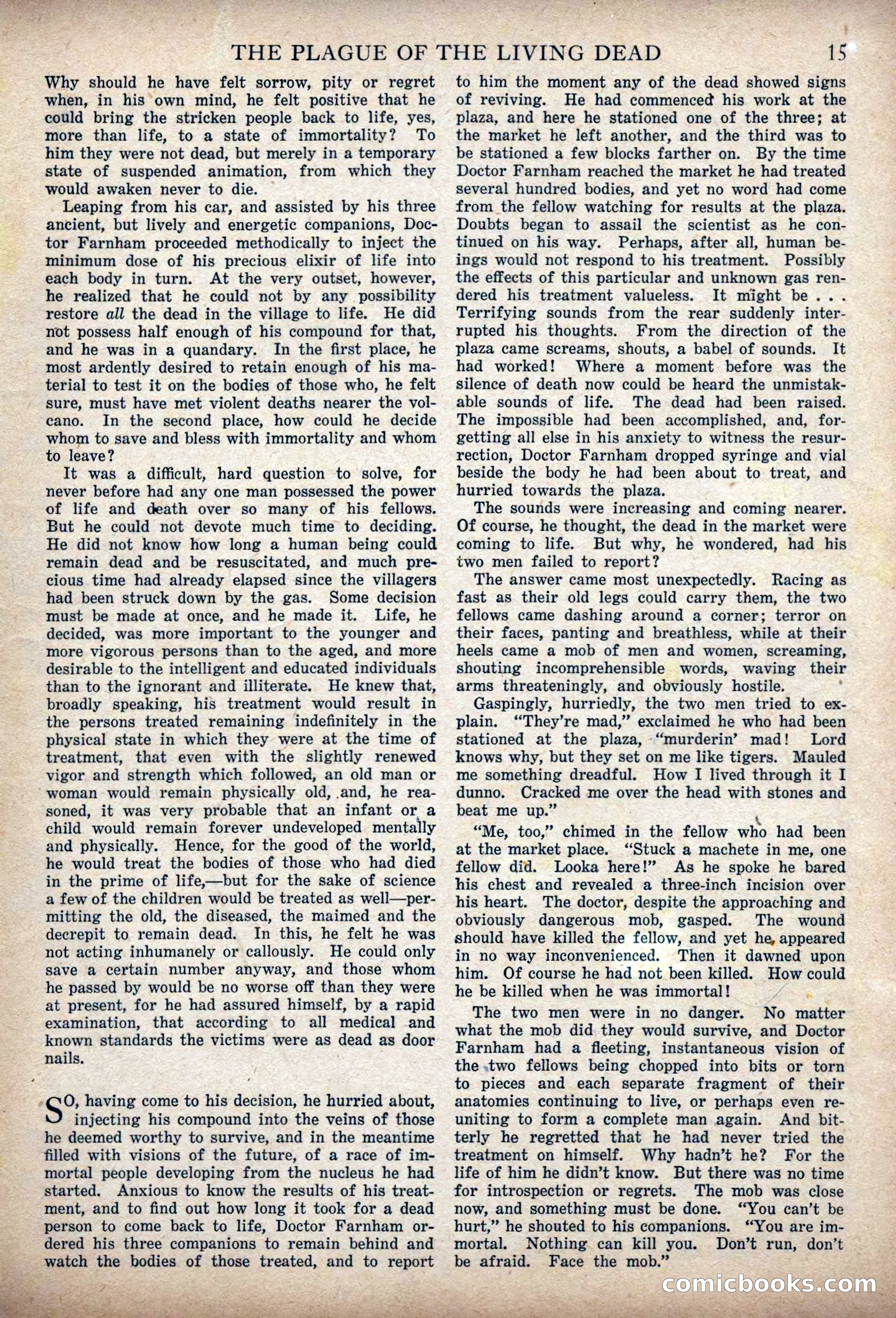
A restored page from Pulp Fiction, 1927. Page through the whole issue in the reader above.
📄 Transcribed text from this page (OCR, searchable)
Machine-transcribed from the original scan — historical spelling and the odd misread are preserved.
“2 THE PLAGUE OF THE LIVING DEAD eS Why should he have felt sorrow, pity or regret when, in his own mind, he felt positive that he could bring the stricken people back to life, yes, more than life, to a state of immortality? To him they were not dead, but merely in a temporary state of suspended animation, from which they would awaken never to die. Leaping from his car, and assisted by his three ancient, but lively and energetic companions, Doc- tor Farnham proceeded methodically to inject the minimum dose of his precious elixir of life into each body in turn. At the very outset, however, he realized that he could not by any possibility restore all the dead in the village to life. He did not possess half enough of his compound for that, and he was in a quandary. In the first place, he most ardently desired to retain enough of his ma- terial to test it on the bodies of those who, he felt sure, must have met violent deaths nearer the vol- cano. In the second place, how could he decide whom to save and bless with immortality and whom to leave? It was a difficult, hard question to solve, for never before had any one man possessed the power of life and death over so many of his fellows. But he could not devote much time to deciding. He did not know how long a human being could remain dead and be resuscitated, and much pre- cious time had already elapsed since the villagers had been struck down by the gas. Some decision must be made at once, and he made it. Life, he decided, was more important to the younger and more vigorous persons than to the aged, and more desirable to the intelligent and educated individuals than to the ignorant and illiterate. He knew that, broadly speaking, his treatment would result in the persons treated remaining indefinitely in the physical state in which they were at the time of treatment, that even with the slightly renewed vigor and strength which followed, an old man or woman would remain physically old, and, he rea- soned, it was very probable that an infant or a child would remain forever undeveloped mentally and physically. Hence, for the good of the world, he would treat the bodies of those who had died in the prime of life,—but for the sake of science a few of the children would be treated as well—per- mitting the old, the diseased, the maimed and the decrepit to remain dead. In this, he felt he was not acting inhumanely or callously. He could only gave a certain number anyway, and those whom he passed by would be no worse off than they were at present, for he had assured himself, by a rapid examination, that according to all medical and known standards the victims were as dead as door nails. Ss having come to his decision, he hurried about, injecting his compound into the veins of those he deemed worthy to survive, and in the meantime filled with visions of the future, of a race of im- mortal people developing from the nucleus he had started. Anxious to know the results of his treat- ment, and to find out how long it took for a dead person to come back to life, Doctor Farnham or- dered his three companions to remain behind and ___watch the bodies of those treated, and to report to him the moment any of the dead showed signs of reviving. He had commenced his work at the plaza, and here he stationed one of the three; at the market he left another, and the third was to be stationed a few blocks farther on. By the time Doctor Farnham reached the market he had treated several hundred bodies, and yet no word had come from the fellow watching for results at the plaza. Doubts began to assail the scientist as he con- tinued on his way. Perhaps, after all, human be- ings would not respond to his treatment. Possibly the effects of this particular and unknown gas ren- dered his treatment valueless. It might be... Terrifying sounds from the rear suddenly inter- rupted his thoughts. From the direction of the plaza came screams, shouts, a babel of sounds. It had worked! Where a moment before was the silence of death now could be heard the unmistak- able sounds of life. The dead had been raised. The impossible had been accomplished, and, for- getting all else in his anxiety to witness the resur- rection, Doctor Farnham dropped syringe and vial beside the body he had been about to treat, and hurried towards the plaza. The sounds were increasing and coming nearer. Of course, he thought, the dead in the market were coming to life. But why, he wondered, had his two men failed to report? The answer came most unexpectedly. Racing as fast as their old legs could carry them, the two fellows came dashing around a corner; terror on their faces, panting and breathless, while at their heels came a mob of men and women, screaming, shouting incomprehensible words, waving their arms threateningly, and obviously hostile. , Gaspingly, hurriedly, the two men tried to ex- plain. “They’re mad,” exclaimed he who had been stationed at the plaza, “murderin’ mad! Lord knows why, but they set on me like tigers. Mauled me something dreadful. How I lived through it I dunno. Cracked me over the head with stones and beat me up.” “Me, too,” chimed in the fellow who had been at the market place. “Stuck a machete in me, one fellow did. Looka here!” As he spoke he bared his chest and revealed a three-inch incision over his heart. The doctor, despite the approaching and obviously dangerous mob, gasped. The wound should have killed the fellow, and yet he, appeared in no way inconvenienced. Then it dawned upon him. Of course he had not been killed. How could he be killed when he was immortal! a The two men were in no danger. No matter what the mob did they would survive, and Doctor Farnham had a fleeting, instantaneous vision of the .two fellows being chopped into bits or torn to pieces and each separate fragment of their anatomies continuing to live, or perhaps even re- uniting to form a complete man again. And bit- terly he regretted that he had never tried the treatment on himself. Why hadn’t he? For the life of him he didn’t know. But there was no time for introspection or regrets. The mob was close now, and something must be done. “You can’t be hurt,” he shouted to his companions. “You are im- mortal. Nothing can kill you. Don’t run, don’t be afraid. Face the mob.” (ele) ae > e.* P A. 7 ae “a