
Pulp Fiction, 1927 · page 15 of 108
Amazing Stories, Vol. 2, No. 1 — page 15: what you’re looking at
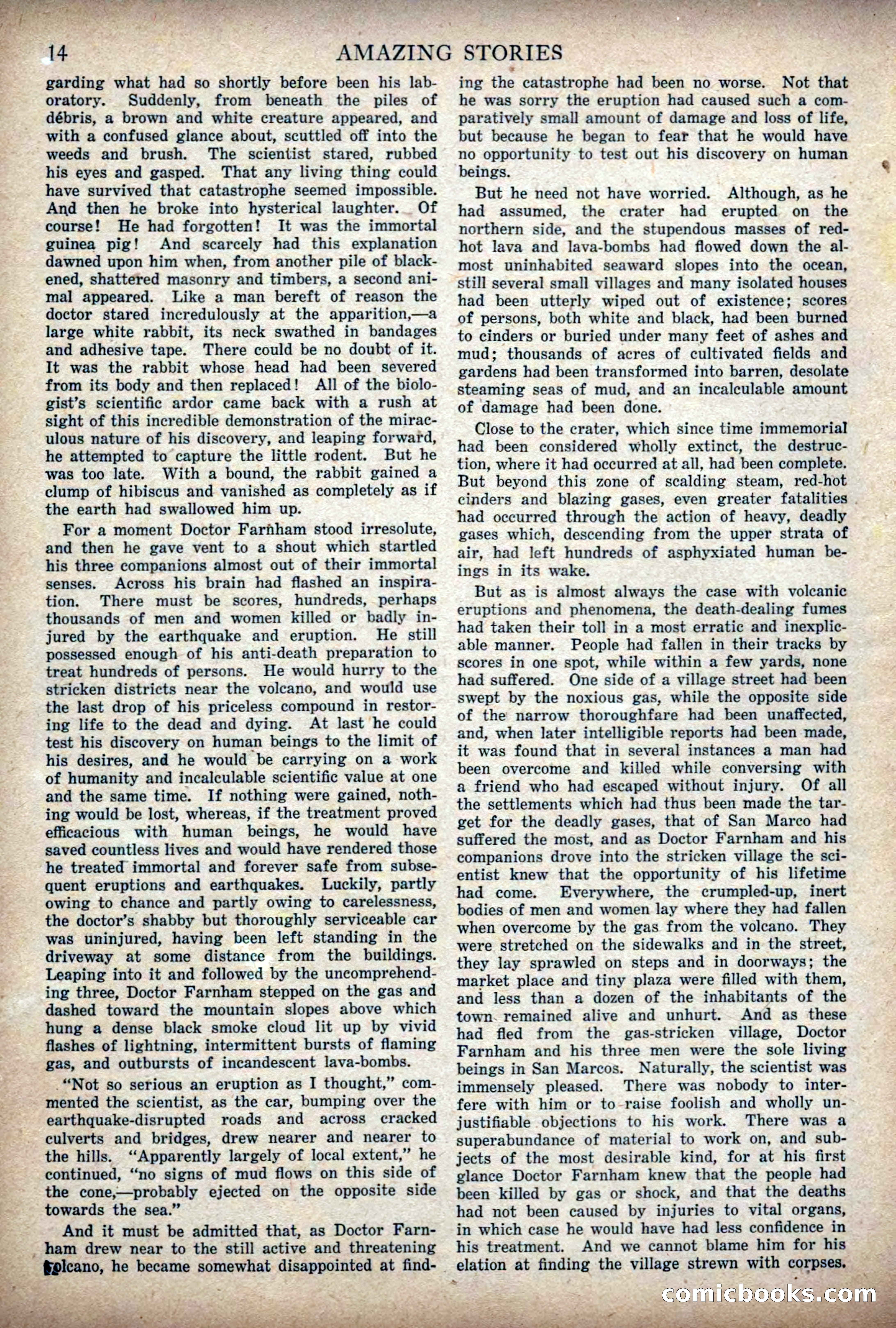
A restored page from Pulp Fiction, 1927. Page through the whole issue in the reader above.
📄 Transcribed text from this page (OCR, searchable)
Machine-transcribed from the original scan — historical spelling and the odd misread are preserved.
; mr, a —— he became somewhat capers at find- | ’ . af. % te ry te OA ae bP Oe ree MATOS Peet, ho ee ’ *’ « / a as , garding what had so shortly before been his lab- oratory. Suddenly, from beneath the piles of débris, a brown and white creature appeared, and with a confused glance about, scuttled off into the weeds and brush. The scientist stared, rubbed his eyes and gasped. That any living thing could have survived that catastrophe seemed impossible. And then he broke into hysterical laughter. Of course! He had forgotten! It was the immortal guinea pig! And scarcely had this explanation dawned upon him when, from another pile of black- ened, shattered masonry and timbers, a second ani- mal appeared. Like a man bereft of reason the doctor stared incredulously at the apparition,—a large white rabbit, its neck swathed in bandages and adhesive tape. There could be no doubt of it. It was the rabbit whose head had been severed from its body and then replaced! All of the biolo- gist’s scientific ardor came back with a rush at sight of this incredible demonstration of the mirac- ulous nature of his discovery, and leaping forward, he attempted to capture the little rodent. But he was too late. With a bound, the rabbit gained a clump of hibiscus and vanished as completely as if the earth had swallowed him up. For a moment Doctor Farnham stood irresolute, and then he gave vent to a shout which startled his three companions almost out of their immortal senses. Across his brain had flashed an inspira- tion. ‘There must be scores, hundreds, perhaps thousands of men and women killed or badly in- jured by the earthquake and eruption. He still possessed enough of his anti-death preparation to treat hundreds of persons. He would hurry to the stricken districts near the volcano, and would use the last drop of his priceless compound in restor- ing life to the dead and dying. At last he could test his discovery on human beings to the limit of his desires, and he would be carrying on a work of humanity and incalculable scientific value at one and the same time. If nothing were gained, noth- ing would be lost, whereas, if the treatment proved efficacious with human beings, he would have saved countless lives and would have rendered those he treated immortal and forever safe from subse- quent eruptions and earthquakes. Luckily, partly owing to chance and partly owing to carelessness, the doctor’s shabby but thoroughly serviceable car was uninjured, having been left standing in the driveway at some distance from the buildings. Leaping into it and followed by the uncomprehend- ing three, Doctor Farnham stepped on the gas and dashed toward the mountain slopes above which hung a dense black smoke cloud lit up by vivid flashes of lightning, intermittent bursts of flaming gas, and outbursts of incandescent lava-bombs. _“Not so serious an eruption as I thought,” com- - mented the scientist, as the car, bumping over the earthquake-disrupted roads and across cracked culverts and bridges, drew nearer and nearer to the hills. “Apparently largely of local extent,” he continued, “no signs of mud flows on this side of the cone,—probably ejected on the opposite side towards the sea.” And it must be admitted that, as Doctor Farn- _ ham drew near to the still active and threatening : v a * < ™ - es . oon ® . 2 Pio: ~ ; : < _ - A Meer on rs rks ae PS res Seri i a! ee Fo gty oS Fe = ~ : eS A AMAZING STORIES , = >» . . Not that he was sorry the eruption had caused such a com- paratively small amount of damage and loss of life, but because he began to fear that he would have no opportunity to test out his discovery on human beings. But he need not have worried. Although, as he ing the catastrophe had been no worse. had assumed, the crater had erupted on the northern side, and the stupendous masses of red- hot lava and lava-bombs had flowed down the al- most uninhabited seaward slopes into the ocean, still several small villages and many isolated houses had been utterly wiped out of existence; scores of persons, both white and black, had been burned to cinders or buried under many feet of ashes and mud; thousands of acres of cultivated fields and gardens had been transformed into barren, desolate steaming seas of mud, and an incalculable amount of damage had been done. Close to the crater, which since time immemorial had been considered wholly extinct, the destruc- tion, where it had occurred at all, had been complete. But beyond this zone of scalding steam, red-hot cinders and blazing gases, even greater fatalities . had occurred through the action of heavy, deadly gases which, descending from the upper strata of air, had left hundreds of asphyxiated human be- ings in its wake. But as is almost always the case with volcanic eruptions and phenomena, the death-dealing fumes had taken their toll in a most erratic and inexplic- able manner. People had fallen in their tracks by scores in one spot, while within a few yards, none had suffered. One side of a village street had been swept by the noxious gas, while the opposite side of the narrow thoroughfare had been unaffected, and, when later intelligible reports had been made, it was found that in several instances a man had been overcome and killed while conversing with a friend who had escaped without injury. Of all the settlements which had thus been made the tar- get for the deadly gases, that of San Marco had suffered the most, and as Doctor Farnham and his companions drove into the stricken village the sci- entist knew that the opportunity of his lifetime had come. Everywhere, the crumpled-up, inert bodies of men and women lay where they had fallen when overcome by the gas from the voleano. They were stretched on the sidewalks and in the street, they lay sprawled on steps and in doorways; the market place and tiny plaza were filled with them, and less than a dozen of the inhabitants of the town. remained alive and unhurt. And as these had fied from the gas-stricken village, Doctor Farnham and his three men were the sole living beings in San Marcos. Naturally, the scientist was immensely pleased. There was nobody to inter- fere with him or to-raise foolish and wholly un-> justifiable objections to his work. There was a superabundance of material to work on, and sub- jects of the most desirable kind, for at his first glance Doctor Farnham knew that the people had been killed by gas or shock, and that the deaths had not been caused by injuries to vital organs, in which case he would have had less confidence in his treatment. And we cannot blame him for his elation at finding the village eed with corpses. ; : om s mewox OKs. ae tte, ody = ae . ~ we 4