
Pulp Fiction, 1927 · page 17 of 108
Amazing Stories, Vol. 2, No. 1 — page 17: what you’re looking at
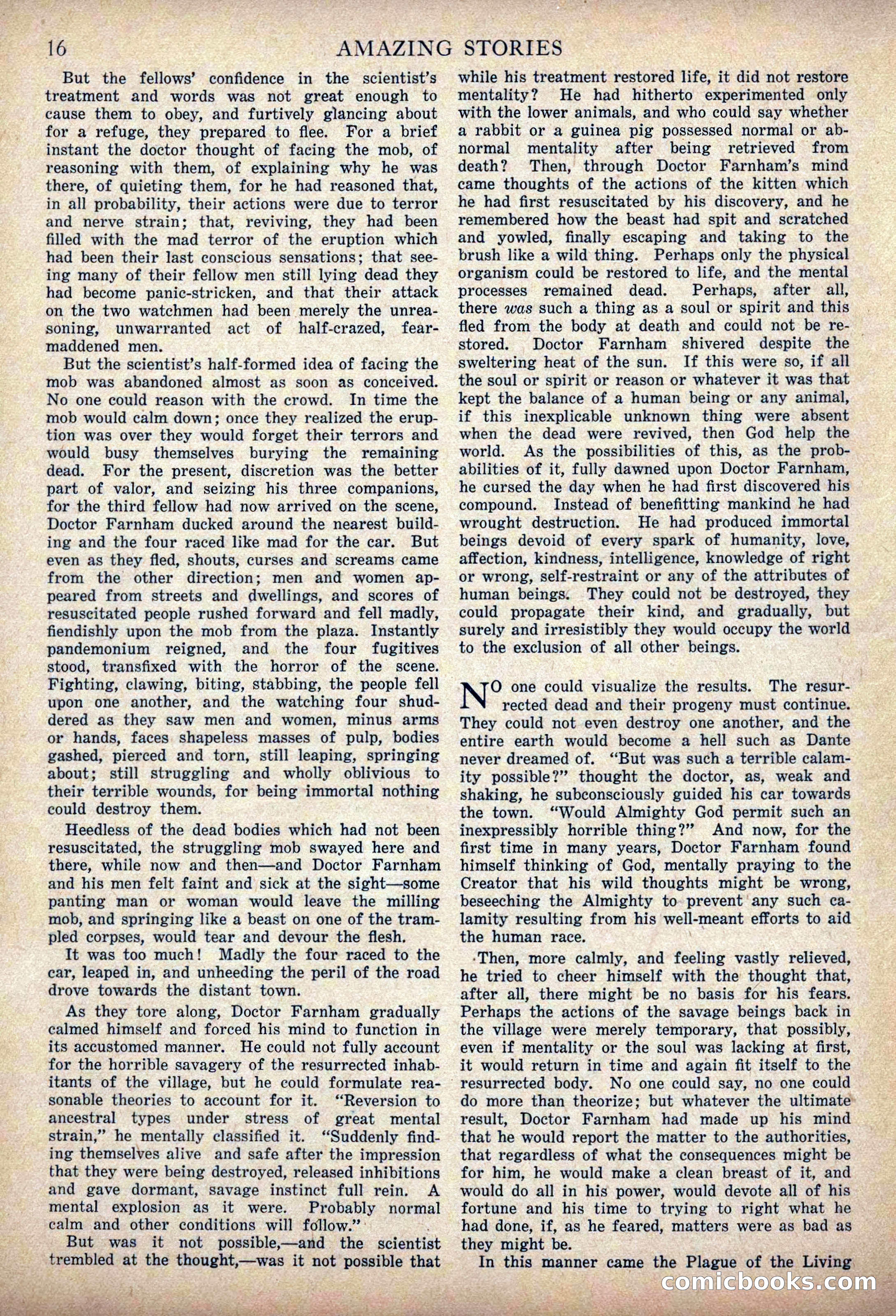
A restored page from Pulp Fiction, 1927. Page through the whole issue in the reader above.
📄 Transcribed text from this page (OCR, searchable)
Machine-transcribed from the original scan — historical spelling and the odd misread are preserved.
16 AMAZING STORIES But the fellows’ confidence in the scientist’s treatment and words was not great enough to cause them to obey, and furtively glancing about for a refuge, they prepared to flee. For a brief instant the doctor thought of facing the mob, of reasoning with them, of explaining why he was there, of quieting them, for he had reasoned that, in all probability, their actions were due to terror and nerve strain; that, reviving, they had been filled with the mad terror of the eruption which had been their last conscious sensations; that see- ing many of their fellow men still lying dead they had become panic-stricken, and that their attack on the two watchmen had been merely the unrea- soning, unwarranted act of half-crazed, fear- maddened men. But the scientist’s half-formed idea of facing the mob was abandoned almost as soon as conceived. No one could reason with the crowd. In time the mob would calm down; once they realized the erup- tion was over they would forget their terrors and would busy themselves burying the remaining dead. For the present, discretion was the better part of valor, and seizing his three companions, for the third fellow had now arrived on the scene, Doctor Farnham ducked around the nearest build- ing and the four raced like mad for the car. But even as they fled, shouts, curses and screams came from the other direction; men and women ap- peared from streets and dwellings, and scores of resuscitated people rushed forward and fell madly, fiendishly upon the mob from the plaza. Instantly pandemonium reigned, and the four fugitives stood, transfixed with the horror of the scene. Fighting, clawing, biting, stabbing, the people fell upon one another, and the watching four shud- dered as they saw men and women, minus arms or hands, faces shapeless masses of pulp, bodies gashed, pierced and torn, still leaping, springing about; still struggling and wholly oblivious to their terrible wounds, for being immortal nothing could destroy them. Heedless of the dead bodies which had not been resuscitated, the struggling mob swayed here and there, while now and then—and Doctor Farnham and his men felt faint and sick at the sight—some panting man or woman would leave the milling mob, and springing like a beast on one of the tram- pled corpses, would tear and devour the flesh, It was too much! Madly the four raced to the car, leaped in, and unheeding the peril of the road drove towards the distant town. As they tore along, Doctor Farnham gradually calmed himself and forced his mind to function in its accustomed manner. He could not fully account for the horrible savagery of the resurrected inhab- itants of the village, but he could formulate rea- sonable theories to account for it. “Reversion to ancestral types under stress of great mental strain,” he mentally classified it. ‘Suddenly find- ing themselves alive and safe after the impression that they were being destroyed, released inhibitions and gave dormant, savage instinct full rein. A mental explosion as it were. Probably normal calm and other conditions will follow.” : But was it not possible,—and the scientist trembled at the thought,—was it not possible that + , . oP ee “a . ; iad ‘ gi p- 8 et _* . - : . vo tid - 4 c Se ee Oe Orr wr while his treatment restored life, it did not restore mentality? He had hitherto experimented only with the lower animals, and who could say whether a rabbit or a guinea pig possessed normal or ab- normal mentality after being retrieved from death? Then, through Doctor Farnham’s mind came thoughts of the actions of the kitten which he had first resuscitated by his discovery, and he remembered how the beast had spit and scratched and yowled, finally escaping and taking to the brush like a wild thing. Perhaps only the physical organism could be restored to life, and the mental processes remained dead. Perhaps, after all, there was such a thing as a soul or spirit and this fled from the body at death and could not be re- — stored. Doctor Farnham shivered despite the sweltering heat of the sun. If this were so, if all the soul or spirit or reason or whatever it was that kept the balance of a human being or any animal, if this inexplicable unknown thing were absent when the dead were revived, then God help the world. As the possibilities of this, as the prob- abilities of it, fully dawned upon Doctor Farnham, he cursed the day when he had first discovered his compound. Instead of benefitting mankind he had wrought destruction. He had produced immortal beings devoid of every spark of humanity, love, affection, kindness, intelligence, knowledge of right or wrong, self-restraint or any of the attributes of human beings. They could not be destroyed, they could propagate their kind, and gradually, but surely and irresistibly they would occupy the world to the exclusion of all other beings. O one could visualize the results. The resur- rected dead and their progeny must continue. They could not even destroy one another, and the entire earth would become a hell such as Dante never dreamed of. “But was such a terrible calam- ity possible?” thought the doctor, as, weak and shaking, he subconsciously guided his car towards the town. “Would Almighty God permit such an inexpressibly horrible thing?” And now, for the first time in many years, Doctor Farnham found himself thinking of God, mentally praying to the Creator that his wild thoughts might be wrong, beseeching the Almighty to prevent any such ca- lamity resulting from his well-meant efforts to aid the human race. ‘Then, more calmly, and feeling vastly relieved, he tried to cheer himself with the thought that, after all, there might be no basis for his fears. Perhaps the actions of the savage beings back in the village were merely temporary, that possibly, even if mentality or the soul was lacking at first, it would return in time and again fit itself to the ~ resurrected body. No one could say, no one could do more than theorize; but whatever the ultimate result, Doctor Farnham had made up his mind that he would report the matter to the authorities, that regardless of what the consequences might be for him, he would make a clean breast of it, and would do all in his power, would devote all of his fortune and his time to trying to right what he had done, if, as he feared, matters were as bad as they might be. In this manner came the Plague of the Living _ eonuereaks.com eee ee eee PIER EASY GPP woe eT ey!