
Pulp Fiction, 1927 · page 14 of 108
Amazing Stories, Vol. 2, No. 1 — page 14: what you’re looking at
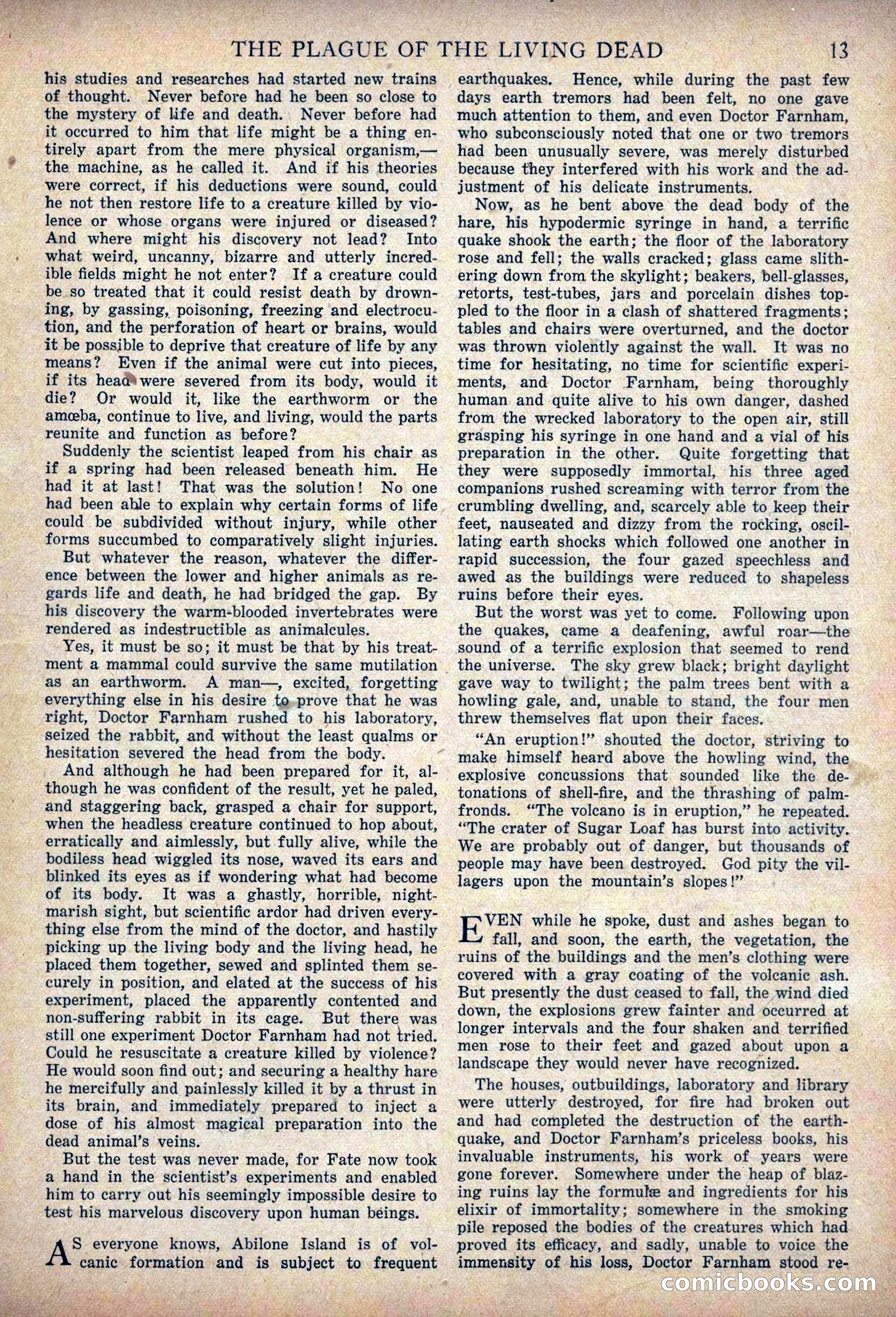
A restored page from Pulp Fiction, 1927. Page through the whole issue in the reader above.
📄 Transcribed text from this page (OCR, searchable)
Machine-transcribed from the original scan — historical spelling and the odd misread are preserved.
THE PLAGUE OF THE LIVING DEAD his studies and researches had started new trains of thought. Never before had he been so close to the mystery of life and death. Never before had it occurred to him that life might be a thing en- tirely apart from the mere physical organism,— the machine, as he called it. And if his theories were correct, if his deductions were sound, could he not then restore life to a creature killed by vio- lence or whose organs were injured or diseased? And where might his discovery not lead? Into what weird, uncanny, bizarre and utterly incred- ible fields might he not enter? If a creature could be so treated that it could resist death by drown- ing, by gassing, poisoning, freezing and electrocu- tion, and the perforation of heart or brains, would it be possible to deprive that creature of life by any means? Even if the animal were cut into pieces, if its head®were severed from its body, would it die? Or would it, like the earthworm or the ameeba, continue to live, and living, would the parts reunite and function as before? Suddenly the scientist leaped from his chair as if a spring had been released beneath him. He had it at last! That was the solution! No one had been able to explain why certain forms of life could be subdivided without injury, while other forms succumbed to comparatively slight injuries. But whatever the reason, whatever the differ- ence between the lower and higher animals as re- gards life and death, he had bridged the gap. By his discovery the warm-blooded invertebrates were rendered as indestructible as animalcules. Yes, it must be so; it must be that by his treat- ment a mammal could survive the same mutilation | as an earthworm. A man—, excited, forgetting everything else in his desire to.prove that he was right, Doctor Farnham rushed to his laboratory, seized the rabbit, and without the least qualms or hesitation severed the head from the body. And although he had been prepared for it, al- though he was confident of the result, yet he paled, and staggering back, grasped a chair for support, when the headless creature continued to hop about, erratically and aimlessly, but fully alive, while the bodiless head wiggled its nose, waved its ears and blinked its eyes as if wondering what had become of its body. It was a ghastly, horrible, night- marish sight, but scientific ardor had driven every- thing else from the mind of the doctor, and hastily picking up the living body and the living head, he placed them together, sewed and splinted them se- curely in position, and elated at the success of his experiment, placed the apparently contented and non-suffering rabbit in its cage. But there was still one experiment Doctor Farnham had not tried. Could he resuscitate a creature killed by violence? He would soon find out; and securing a healthy hare he mercifully and painlessly killed it by a thrust in its brain, and immediately prepared to inject a dose of his almost magical preparation into the dead animal’s veins. But the test was never made, for Fate now took a hand in the scientist’s experiments and enabled him to carry out his seemingly impossible desire to test his marvelous discovery upon human béings. S everyone knows, Abilone Island is of vol- canic formation and is subject to frequent ‘ . a we : » SA ae et ee | o~ ~ J : we oe ; A te Ps AA per bee & bi ee OY - 5 te a SS ~~ 7 s - . = 6. eg ba ~ £2.48 eS ror |. 2 i tl os er ee * earthquakes. Hence, while during the past few days earth tremors had been felt, no one gave much attention to them, and even Doctor Farnham, who subconsciously noted that one or two tremors had been unusually severe, was merely disturbed because they interfered with his work and the ad- justment of his delicate instruments. Now, as he bent above the dead body of the hare, his hypodermic syringe in hand, a terrific quake shook the earth; the floor of the laboratory rose and fell; the walls cracked; glass came slith- ering down from the skylight; beakers, bell-glasses, retorts, test-tubes, jars and porcelain dishes top- pled to the floor in a clash of shattered fragments; tables and chairs were overturned, and the doctor was thrown violently against the wall. It was no time for hesitating, no time for scientific experi- ments, and Doctor Farnham, being thoroughly human and quite alive to his own danger, dashed from the wrecked laboratory to the open air, still grasping his syringe in one hand and a vial of his preparation in the other. Quite forgetting that they were supposedly immortal, his three aged companions rushed screaming with terror from the crumbling dwelling, and, scarcely able to keep their feet, nauseated and dizzy from the roéking, oscil- lating earth shocks which followed one another in rapid succession, the four gazed speechless and awed as the buildings were reduced to shapeless ruins before their eyes. But the worst was yet to come. Following upon the quakes, came a deafening, awful roar—the sound of a terrific explosion that seemed to rend the universe. The sky grew black; bright daylight gave way to twilight; the palm trees bent with a howling gale, and, unable to stand, the four men threw themselves flat upon their faces. “An eruption!” shouted the doctor, striving to make himself heard above the howling wind, the explosive concussions that. sounded like the de- — tonations of shell-fire, and the thrashing of palm- fronds. “The volcano is in eruption,” he repeated. “The crater of Sugar Loaf has burst into activity. We are probably out of danger, but thousands of people may have been destroyed. God pity the vil- lagers upon the mountain’s slopes!” Bere while he spoke, dust and ashes began to fall, and soon, the earth, the vegetation, the ruins of the buildings and the men’s clothing were covered with a gray coating of the volcanic ash. But presently the dust ceased to fall, the wind died down, the explosions grew fainter and occurred at 13 x “ars longer intervals and the four shaken and terrified — men rose to their feet and gazed about upon a landscape they would never have recognized. The houses, outbuildings, laboratory and library were utterly destroyed, for fire had broken out and had completed the destruction of the earth- quake, and Doctor Farnham’s priceless books, his invaluable instruments, his work of years were gone forever. Somewhere under the heap of blaz- ing ruins lay the formule and ingredients for his elixir of immortality; somewhere in the smoking pile reposed the bodies of the creatures which had proved its efficacy, and sadly, unable to voice the immensity of his loss, Doctor Farnham stood re- -~comicbooks:.co . ¢; Jae <> Es. — . ‘ *~ J Yt CE eee oh thy a | Tre mad BY > A, tee he Cx . in ws - a} & 7 hy Ses a ‘ Nery Ae. . : = ke ee ew Ses) i Pa . “See Ss. ae eer