
Pulp Fiction, 1927 · page 13 of 108
Amazing Stories, Vol. 2, No. 1 — page 13: what you’re looking at
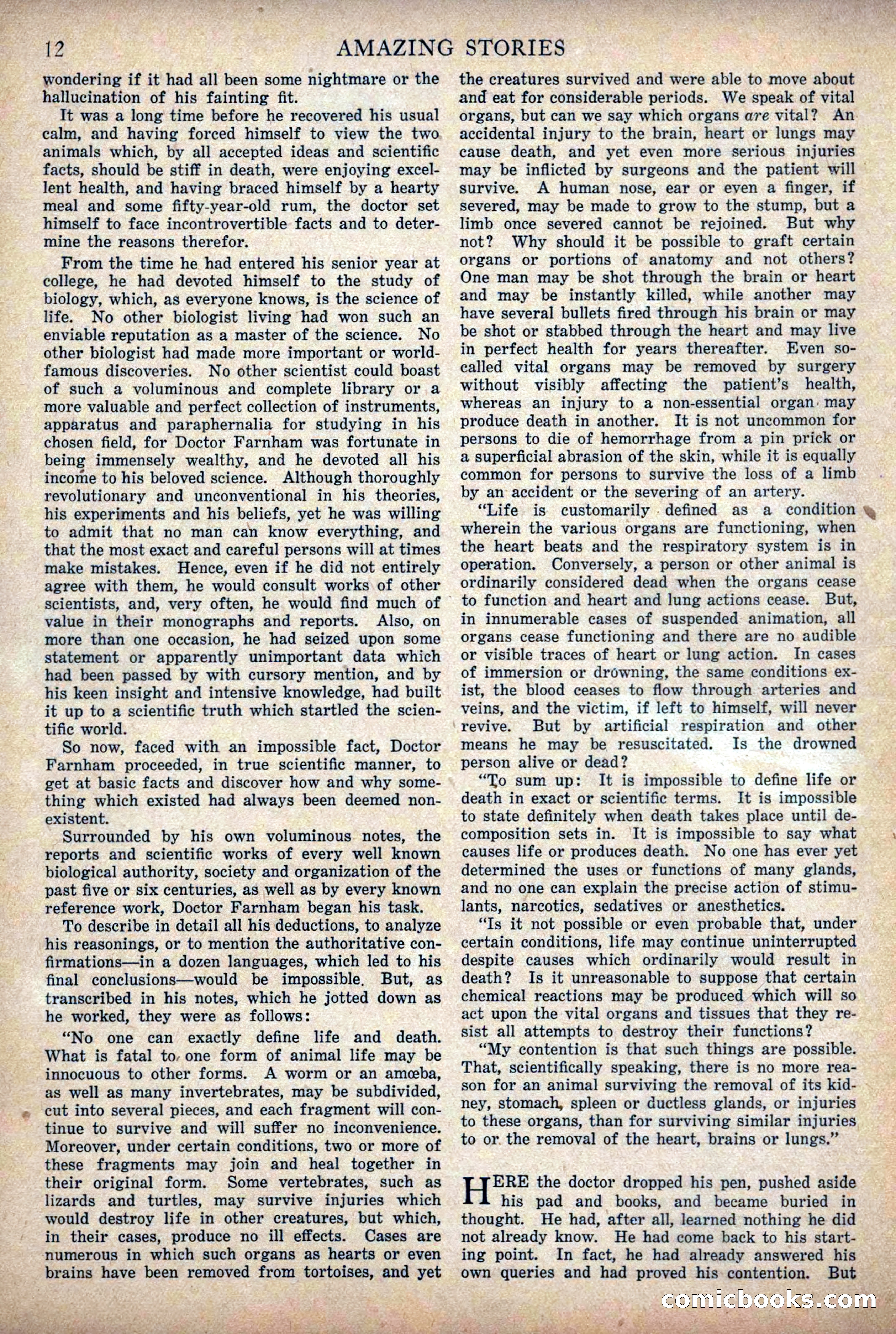
A restored page from Pulp Fiction, 1927. Page through the whole issue in the reader above.
📄 Transcribed text from this page (OCR, searchable)
Machine-transcribed from the original scan — historical spelling and the odd misread are preserved.
ser - - - * => 12 wondering if it had all been some nightmare or the hallucination of his fainting fit. It was a long time before he recovered his usual calm, and having forced himself to view the two animals which, by all accepted ideas and scientific facts, should be stiff in death, were enjoying excel- lent health, and having braced himself by a hearty meal and some fifty-year-old rum, the doctor set himself to face incontrovertible facts and to deter- mine the reasons therefor. From the time he had entered his senior year at college, he had devoted himself to the study of biology, which, as everyone knows, is the science of life. No other biologist living had won such an enviable reputation as a master of the science. No other biologist had made more important or world- famous discoveries. No other scientist could boast of such a voluminous and complete library or a more valuable and perfect collection of instruments, apparatus and paraphernalia for studying in his chosen field, for Doctor Farnham was fortunate in being immensely wealthy, and he devoted all his income to his beloved science. Although thoroughly revolutionary and unconventional in his theories, his experiments and his beliefs, yet he was willing to admit that no man can know everything, and that the most exact and careful persons will at times make mistakes. Hence, even if he did not entirely agree with them, he would consult works of other scientists, and, very often, he would find much of value in their monographs and reports. Also, on more than one occasion, he had seized upon some statement or apparently unimportant data which had been passed by with cursory mention, and by his keen insight and intensive knowledge, had built it up to a scientific truth which startled the scien- tific world. So now, faced with an impossible fact, Doctor Farnham proceeded, in true scientific manner, to get at basic facts and discover how and why some- thing which existed had always been deemed non- existent. Surrounded by his own voluminous. notes, the reports and scientific works of every well known biological authority, society and organization of the past five or six centuries, as well as by every known reference work, Doctor Farnham began his task. To describe in detail all his deductions, to analyze his reasonings, or to mention the authoritative con- firmations—in a dozen languages, which led to his final conclusions—would be impossible, But, as transcribed in his notes, which he jotted down as he worked, they were as follows: “No one can exactly define life and death. What is fatal to- one form of animal life may be innocuous to other forms. A worm or an ameeba, as well as many invertebrates, may be subdivided, cut into several pieces, and each fragment will con- tinue to survive and will suffer no inconvenience. Moreover, under certain conditions, two or more of these fragments may join and heal together in their original form. Some vertebrates, such as lizards and turtles, may survive injuries which would destroy life in other creatures, but which, in their cases, produce no ill effects. Cases are numerous in which such organs as hearts or even brains have been removed from tortoises, and yet a *. = iy >= el arta , Pye - by " is : “ at * See Lt. =» e@ - .* a4 ‘ Pad sate a ~~? Ay: [oo th oo ro: a4 Ste + teehee = Se ty ao tat se & s ’ to function and heart and lung actions cease. revive. « * * ' ?. Lo a ~~ > mn hw ~ a Pte J <dcs ot AD Eee? ote —_ AMAZING STORIES the creatures survived and were able to move about and eat for considerable periods. We speak of vital organs, but can we say which organs are vital? An accidental injury to the brain, heart or lungs may cause death, and yet even more serious injuries may be inflicted by surgeons and the patient will — survive. A human nose, ear or even a finger, if severed, may be made to grow to the stump, but a limb once severed cannot be rejoined. But why not? Why should it be possible to graft certain organs or portions of anatomy and not others? One man may be shot through the brain or heart and may be instantly killed, while another may have several bullets fired through his brain or may be shot or stabbed through the heart and may live in perfect health for years thereafter. Even so- called vital organs may be removed by surgery without visibly affecting the patient’s health, whereas an injury to a non-essential organ: may produce death in another. It is not uncommon for persons to die of hemorrhage from a pin prick or a superficial abrasion of the skin, while it is equally common for persons to survive the loss of a limb by an accident or the severing of an artery. “Life is customarily . defined as a condition & wherein the various organs are functioning, when the heart beats and the respiratory system is in operation. Conversely, a person or other animal is ordinarily considered dead when the organs cease But, in innumerable cases of suspended animation, all organs cease functioning and there are no audible or visible traces of heart or lung action. In cases of immersion or drowning, the same conditions ex- ist, the blood ceases to flow through arteries and veins, and the victim, if left to himself, will never But by artificial respiration and other means he may be resuscitated. Is the drowned person alive or dead? “To sum up: It is impossible to define life or death in exact or scientific terms. It is impossible to state definitely when death takes place until de- composition sets in. It is impossible to say what causes life or produces death. No one has ever yet determined the uses or functions of many glands, and no one can explain the precise action of stimu- lants, narcotics, sedatives or anesthetics. “Ts it not possible or even probable that, under certain conditions, life may continue uninterrupted despite causes which ordinarily would result in death? Is it unreasonable to suppose that certain chemical reactions may be produced which will so act upon the vital organs and tissues that they re- sist all attempts to destroy their functions? “My contention is that such things are possible. That, scientifically speaking, there is no more rea- son for an animal surviving the removal of its kid- - ney, stomach, spleen or ductless glands, or injuries to these organs, than for surviving similar injuries to or. the removal of the heart, brains or lungs.” H®. the doctor dropped his pen, pushed aside his pad and books, and became buried in thought. He had, after all, learned nothing he did not already know. He had come back to his start- ing point. In fact, he had already answered his own queries and had proved his contention. But — *comicbooks : ss eX i > “ > Se ¢ an oe 4% Bie ae =s 3 so +.Apertet . LJ J, Se gee ey awh oo SO RO “rg ory tne eee