
Pulp Fiction, 1927 · page 12 of 108
Amazing Stories, Vol. 2, No. 1 — page 12: what you’re looking at
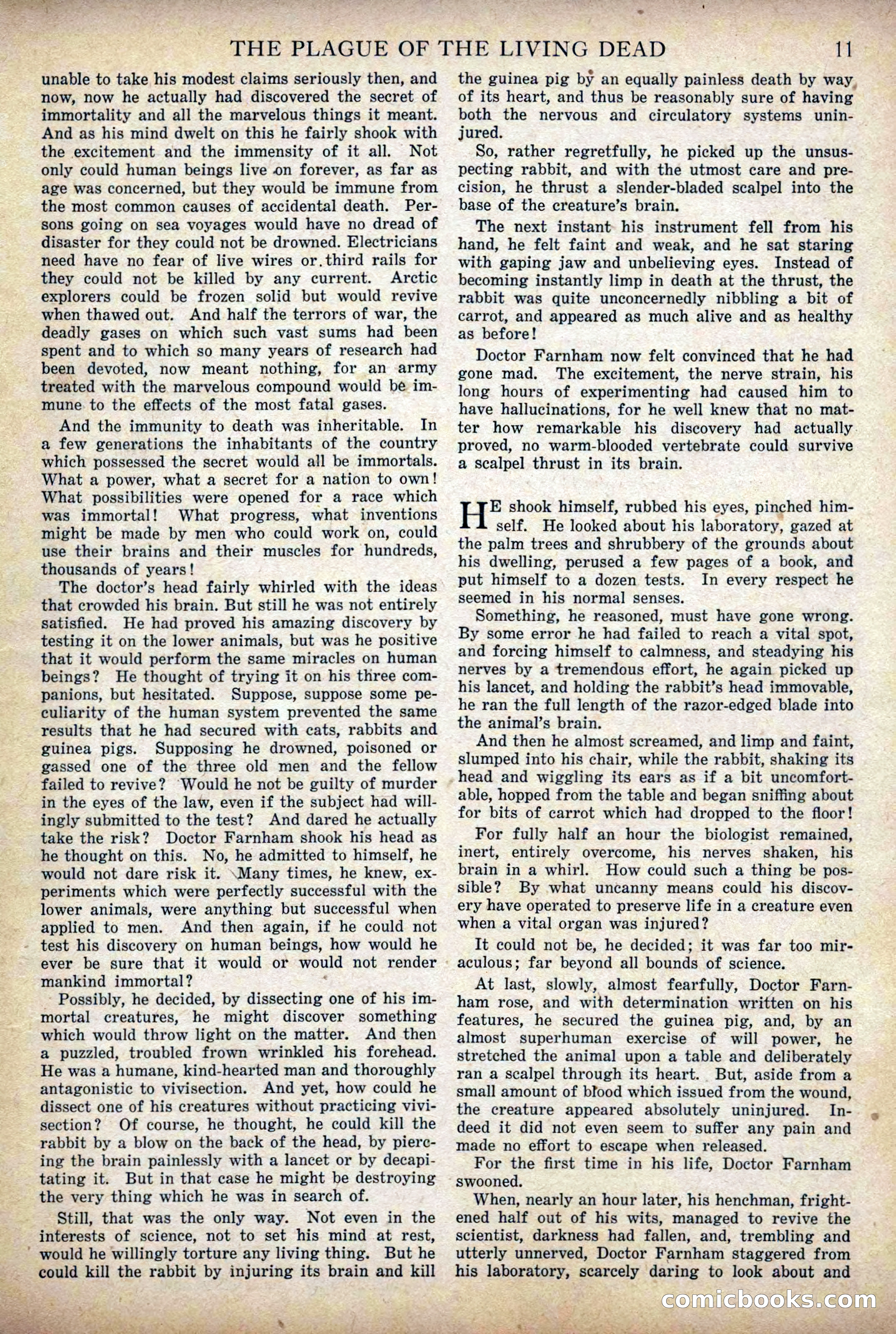
A restored page from Pulp Fiction, 1927. Page through the whole issue in the reader above.
📄 Transcribed text from this page (OCR, searchable)
Machine-transcribed from the original scan — historical spelling and the odd misread are preserved.
i» eae ee me We Pe a = <6? ™ Fy > ht _ ~ —— a im ee ae ate — . ‘ a: u : = . ae’ al “ = eet rs ““ > i a 4 ‘ THE PLAGUE OF THE LIVING DEAD unable to take his modest claims seriously then, and now, now he actually had discovered the secret of immortality and all the marvelous things it meant. And as his mind dwelt on this he fairly shook with the excitement and the immensity of it all. Not only could human beings live on forever, as far as age was concerned, but they would be immune from the most common causes of accidental death. Per- sons going on sea voyages would have no dread of disaster for they could not be drowned. Electricians need have no fear of live wires or.third rails for they could not be killed by any current. Arctic explorers could be frozen solid but would revive when thawed out. And half the terrors of war, the deadly gases on which such vast sums had been spent and to which so many years of research had been devoted, now meant nothing, for an army treated with the marvelous compound would be im- mune. to the effects of the most fatal gases. And the immunity to death was inheritable. In a few generations the inhabitants of the country which possessed the secret would all be immortals. What a power, what a secret for a nation to own! What possibilities were opened for a race which was immortal! What progress, what inventions might be made by men who could work on, could use their brains and their muscles for hundreds, thousands of years! The doctor’s head fairly whirled with the ideas that crowded his brain. But still he was not entirely satisfied. He had proved his amazing discovery by testing it on the lower animals, but was he positive that it would perform the same miracles on human beings? He thought of trying it on his three com- panions, but hesitated. Suppose, suppose some pe- culiarity of the human system prevented the same results that he had secured with cats, rabbits and guinea pigs. Supposing he drowned, poisoned or gassed one of the three old men and the fellow failed to revive? Would he not be guilty of murder in the eyes of the law, even if the subject had will- ingly submitted to the test? And dared he actually take the risk? Doctor Farnham shook his head as he thought on this. No, he admitted to himself, he would not dare risk it. \Many times, he knew, ex- periments which were perfectly successful with the lower animals, were anything but successful when applied to men. And then again, if he could not - test his discovery on human beings, how would he ever be sure that it would or would not render mankind immortal? : ~ Possibly, he decided, by dissecting one of his im- mortal creatures, he might discover something which would throw light on the matter. And then a puzzled, troubled frown wrinkled his forehead. He was a humane, kind-hearted man and thoroughly antagonistic to vivisection. And yet, how could he dissect one of his creatures without practicing vivi- section? Of course, he thought, he could kill the rabbit by a blow on the back of the head, by piere- ing the brain painlessly with a lancet or by decapi- tating it. But in that case he might be destroying the very thing which he was in search of. Still, that was the only way. Not even in the interests of science, not to set his mind at rest, would he willingly torture any living thing. But he could kill the rabbit by injuring its brain and kill Fda. ‘ af phe = . 2 : : “’, ' 11 the guinea pig by an equally painless death by way, of its heart, and thus be reasonably sure of having both the nervous and circulatory systems unin- jured. So, rather regretfully, he picked up the unsus- pecting rabbit, and with the utmost care and pre- cision, he thrust a slender-bladed scalpel into the base of the creature’s brain. The next instant his instrument fell from his hand, he felt faint and weak, and he sat staring with gaping jaw and unbelieving eyes. Instead of becoming instantly limp in death at the thrust, the rabbit was quite unconcernedly nibbling a bit of carrot, and appeared as much alive and as healthy as before! Doctor Farnham now felt convinced that he had gone mad. The excitement, the nerve strain, his long hours of experimenting had caused him to have hallucinations, for he well knew that no mat- ter how remarkable his discovery had actually. proved, no warm-blooded vertebrate could survive a scalpel thrust in its brain. H°? shook himself, rubbed his eyes, pinched him- self. He looked about his laboratory, gazed at the palm trees and shrubbery of the grounds about his dwelling, perused a few pages of a book, and put himself to a dozen tests. In every respect he seemed in his normal senses. Something, he reasoned, must have gone wrong. By some error he had failed to reach a vital spot, and forcing himself to calmness, and steadying his nerves by a tremendous effort, he again picked up his lancet, and holding the rabbit’s head immovable, he ran the full length of the razor-edged blade into the animal’s brain. And then he almost screamed, and limp and faint, slumped into his chair, while the rabbit, shaking its -head and wiggling its ears as if a bit uncomfort- able, hopped from the table and began sniffing about for bits of carrot which had dropped to the floor! For fully half an hour the biologist remained, inert, entirely overcome, his nerves shaken, his brain in a whirl. How could such a thing be pos- sible? By what uncanny means could his discov- ery have operated to preserve life in a creature even when a vital organ was injured? It could not be, he decided; it was far too mir- aculous; far beyond all bounds of science. At last, slowly, almost fearfully, Doctor Farn- ham rose, and with determination written on his features, he secured the guinea pig, and, by an almost superhuman exercise of will power, he stretched the animal upon a table and deliberately ran a scalpel through its heart. But, aside from a small amount of blood which issued from the wound, the creature appeared absolutely uninjured. In- deed it did not even seem to suffer any pain and made no effort to escape when released. For the first time in his life, Doctor Farnham swooned. When, nearly an hour later, his henchman, fright- ened half out of his wits, managed to revive the scientist, darkness had fallen, and, trembling and utterly unnerved, Doctor Farnham staggered from his laboratory, scarcely daring to look about and — - comicbooks:co nee eS NT Oe = a a a Be tS 5 Wh Oe - PO mre 3 ie ne a ae, f ail