
Pulp Fiction, 1927 · page 11 of 108
Amazing Stories, Vol. 2, No. 1 — page 11: what you’re looking at
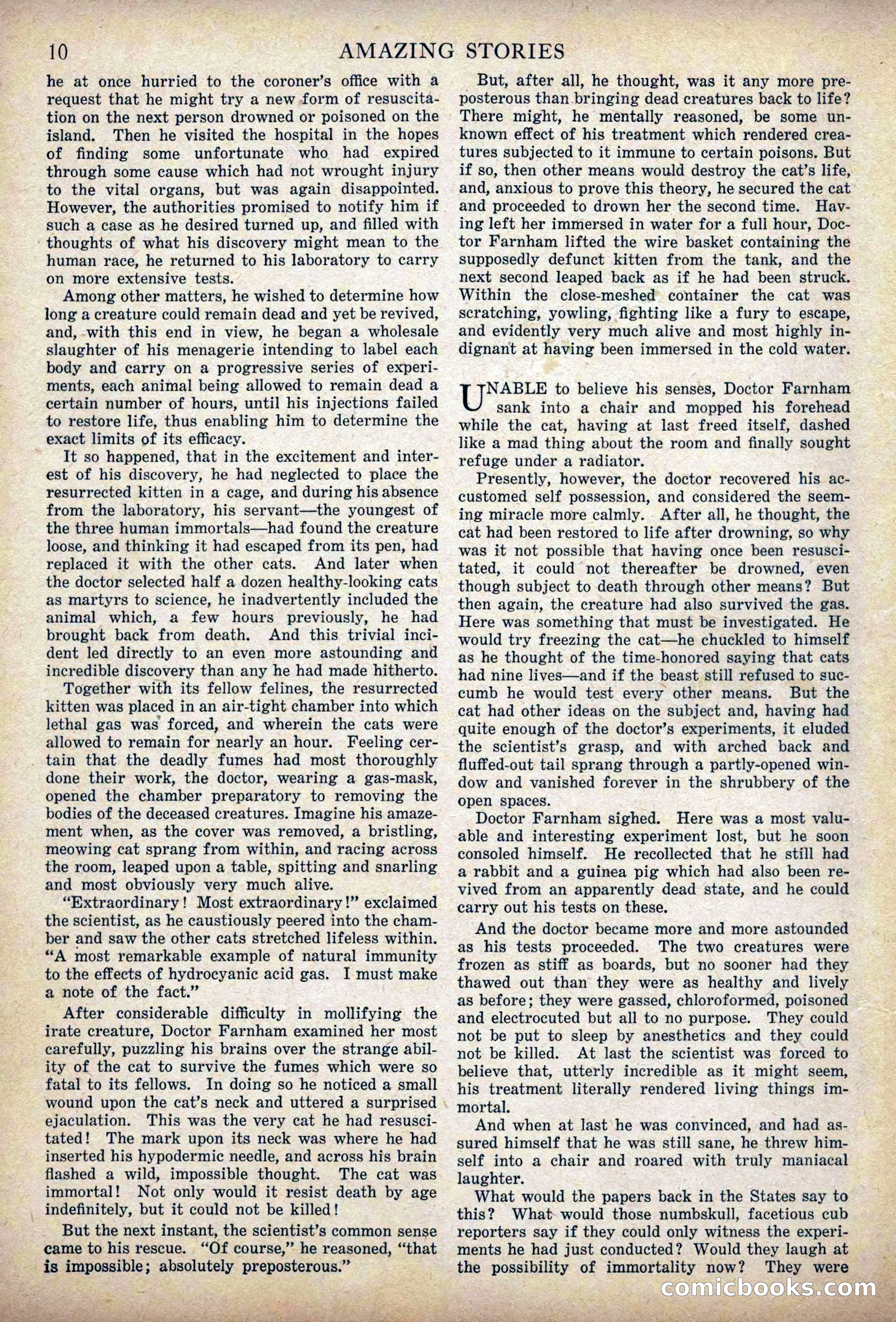
A restored page from Pulp Fiction, 1927. Page through the whole issue in the reader above.
📄 Transcribed text from this page (OCR, searchable)
Machine-transcribed from the original scan — historical spelling and the odd misread are preserved.
10 AMAZING STORIES he at once hurried to the coroner’s office with a request that he might try a new form of resuscita- tion on the next person drowned or poisoned on the island. ‘Then he visited the hospital in the hopes of finding some unfortunate who had expired through some cause which had not wrought injury to the vital organs, but was again disappointed. However, the authorities promised to notify him if such a case as he desired turned up, and filled with ‘thoughts of what his discovery might mean to the human race, he returned to his laboratory to carry on more extensive tests. Among other matters, he wished to determine how long a creature could remain dead and yet be revived, and, with this end in view, he began a wholesale slaughter of his menagerie intending to label each body and carry on a progressive series of experi- ments, each animal being allowed to remain dead a certain number of hours, until his injections failed to restore life, thus enabling him to determine the exact limits of its efficacy. It so happened, that in the excitement and inter- est of his discovery, he had neglected to place the resurrected kitten in a cage, and during his absence from the laboratory, his servant—the youngest of the three human immortals—had found the creature loose, and thinking it had escaped from its pen, had replaced it with the other cats. And later when the doctor selected half a dozen healthy-looking cats as martyrs to science, he inadvertently included the animal which, a few hours previously, he had brought back from death. And this trivial inci- dent led directly to an even more astounding and incredible discovery than any he had made hitherto. Together with its fellow felines, the resurrected kitten was placed in an air-tight chamber into which lethal gas was forced, and wherein the cats were allowed to remain for nearly an hour. Feeling cer- _ tain that the deadly fumes had most thoroughly done their work, the doctor, wearing a gas-mask, opened the chamber preparatory to removing the bodies of the deceased creatures. Imagine his amaze- ment when, as the cover was removed, a bristling, meowing cat sprang from within, and racing across the room, leaped upon a table, spitting and snarling and most obviously very much alive. “Extraordinary! Most extraordinary!” exclaimed the scientist, as he caustiously peered into the cham- ber and saw the other cats stretched lifeless within. “A most remarkable example of natural immunity to the effects of hydrocyanic acid gas. I must make a note of the fact.” After considerable difficulty in mollifying the irate creature, Doctor Farnham examined her most carefully, puzzling his brains over the strange abil- ity of the cat to survive the fumes which were so fatal to its fellows. In doing so he noticed a small wound upon the cat’s neck and uttered a surprised ejaculation. This was the very cat he had resusci- tated! The mark upon its neck was where he had inserted his hypodermic needle, and across his brain flashed a wild, impossible thought. The cat was immortal! Not only would it resist death by age indefinitely, but it could not be killed! But the next instant, the scientist’s common sense came to his rescue. “Of course,” he reasoned, “that is impossible; absolutely preposterous.” et i A me ; eM epee. > : ms Ee ea ee ae ~ yp eae, wae a eA But, after all, he thought, was it any more pre- posterous than bringing dead creatures back to life? There might, he mentally reasoned, be some un- known effect of his treatment which rendered crea- tures subjected to it immune to certain poisons. But if so, then other means would destroy the cat’s life, and, anxious to prove this theory, he secured the cat and proceeded to drown her the second time. Hav- ing left her immersed in water for a full hour, Doc- tor Farnham lifted the wire basket containing the supposedly defunct kitten from the tank, and the next second leaped back as if he had been struck. Within the close-meshed container the cat was scratching, yowling, fighting like a fury to escape, and evidently very much alive and most highly in- dignant at having been immersed in the cold water. NABLE to believe his senses, Doctor Farnham sank into a chair and mopped his forehead while the cat, having at last freed itself, dashed like a mad thing about the room and finally sought refuge under a radiator. Presently, however, the doctor recovered his ac- customed self possession, and considered the seem- ing miracle more calmly. After all, he thought, the cat had been restored to life after drowning, so why was it not possible that having once been resusci- tated, it could not thereafter be drowned, even though subject to death through other means? But then again, the creature had also survived the gas. Here was something that must be investigated. He would try freezing the cat—he chuckled to himself as he thought of the time-honored saying that cats had nine lives—and if the beast still refused to suc- cumb he would test every other means. But the cat had other ideas on the subject and, having had quite enough of the doctor’s experiments, it eluded the scientist’s grasp, and with arched back and fluffed-out tail sprang through a partly-opened win- dow and vanished forever in the shrubbery of the open spaces. Doctor Farnham sighed. Here was a most valu- able and interesting experiment lost, but he soon consoled himself. He recollected that he still had a rabbit and a guinea pig which had also been re- vived from an apparently dead state, and he could carry out his tests on these. And the doctor became more and more astounded as his tests proceeded. The two creatures were frozen as stiff as boards, but no sooner had they thawed out than they were as healthy and lively as before; they were gassed, chloroformed, poisoned and electrocuted but all to no purpose. They could not be put to sleep by anesthetics and they could not be killed. At last the scientist was forced to believe that, utterly incredible as it might seem, his treatment literally rendered living things im- mortal. And when at last he was convinced, and had as- sured himself that he was still sane, he threw him- self into a chair and roared with truly maniacal laughter. What would the papers back in the States say to this? What would those numbskull, facetious cub reporters say if they could only witness the experi- ments he had just conducted? Would they laugh at the possibility of immortality now? They were “comicbooks.com E+ < Ange m ae | . Se et tt : ee es a 2 ct - 7 " m - i « SS Pee _" pee “eo ae SOs tee es 4. Pe ¢ ye abe -_