
Pulp Fiction, 1919 · page 135 of 192
All-Story Weekly, March 1, 1919 — page 135: what you’re looking at
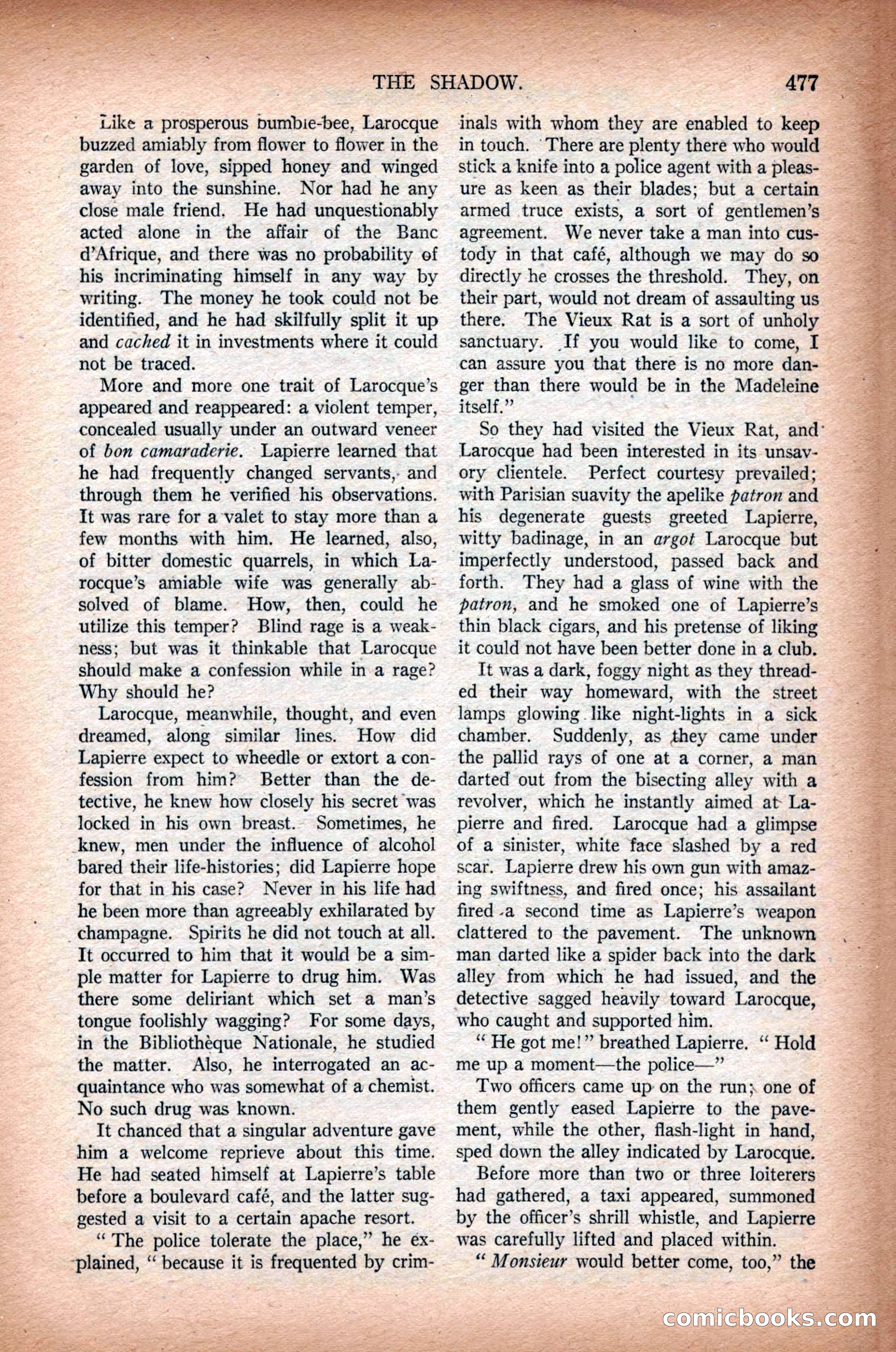
A restored page from Pulp Fiction, 1919. Page through the whole issue in the reader above.
📄 Transcribed text from this page (OCR, searchable)
Machine-transcribed from the original scan — historical spelling and the odd misread are preserved.
Ne ey Th we _ champagne. plained, “‘ because it is frequented by crim- Like a prosperous bumbie-bee, Larocque buzzed amiably from flower to flower in the garden of love, sipped honey and winged away into the sunshine. Nor had he any close male friend. He had unquestionably acted alone in the affair of the Banc d’Afrique, and there was no probability of his incriminating himself in any way by _ writing. The money he took could not be identified, and he had skilfully split it up and cached it in investments where it could not be traced. More and more one trait of Larocque’s appeared and reappeared: a violent temper, concealed usually under an outward veneer of bon camaraderie. Lapierre learned that he had frequently changed servants, and through them he verified his observations. It was rare for a valet to stay more than a few months with him. He learned, also, of bitter domestic quarrels, in which La- rocque’s amiable wife was generally ab- solved of blame. How, then, could he utilize this temper? Blind rage is a weak- ness; but was it thinkable that Larocque should make a confession while in a rage? Why should he? Larocque, meanwhile, thought, and even dreamed, along similar lines. How did _ Lapierre expect to wheedle or extort a con- fession from him? Better than the de- tective, he knew how closely his secret was locked in his own breast.. Sometimes, he -knew, men under the influence of alcohol bared their life-histories; did Lapierre hope for that in his case? Never in his life had he been more than agreeably exhilarated by Spirits he did not touch at all. It occurred to him that it would be a sim- ple matter for Lapierre to drug him. Was there some deliriant which set a man’s tongue foolishly wagging? For some days, in the Bibliotheque Nationale, he studied the matter. Also, he interrogated an ac- quaintance who was somewhat of a chemist. No such drug was known. It chanced that a singular adventure gave him a welcome reprieve about this time. He had seated himself at Lapierre’s table before a boulevard café, and the latter sug- gested a visit to a certain apache resort. “The police tolerate the place,” he ex- a) ingle with whom they are enabled to keep: —— in touch. ‘There are plenty there who would stick a knife into a police agent with a pleas- _ ay ure as keen as their blades; but a vertiin a armed truce exists, a sort of gentlemen’s agreement. We never take a man into cus- tody in that café, although we may do so — = directly he crosses the threshold. They,on their part, would not dream of assaulting us there. The Vieux Rat is a sort of unholy sanctuary. If you would like to come, I 3 can assure you that there is no more dan- _ ger than there would be in the Madeleine itself.” So they had visited the Vieux Rat, and” Larocque had been interested in its unsav-_ ory clientele. Perfect courtesy prevailed; with Parisian suavity the apelike patron and — his degenerate guests greeted Lapierre, witty badinage, in an argot Larocque but — imperfectly understood, passed back and © forth. They had a glass of wine with the patron, and he smoked one of Lapierre’s thin black cigars, and his pretense of liking it could not have been better done in a club. It was a dark, foggy night as they thread- ed their way homeward, with the street lamps glowing like night-lights in a sick chamber. Suddenly, as they came under the pallid rays of one at a corner, a man darted out from the bisecting alley with a revolver, which he instantly aimed at La- pierre and fired. Larocque had a glimpse of a sinister, white face slashed by a red scar. Lapierre drew his own gun with amaz- ing swiftness, and fired once; his assailant fired-a second time as Lapierre’s weapon clattered to the pavement. The unknown man darted like a spider back into the dark : : alley from which he had issued, and the detective sagged heavily toward Larocque, who caught and supported him. “He got me!” breathed Lapierre. ‘“‘ Hold me up a moment—the police—”’ Two officers came upon the run; one of them gently eased Lapierre to the pave-— ment, while the other, flash-light in hand, sped down the alley indicated by Larocque. Before more than two or three loiterers a yet 4 R aut ) We it & cy.) i“. dy ily . Ny ; “to AY AS Tey “4 : ce, * AO wah * y! i Wi: ; ( t eae q Nee 1 oe RA Y : Ten hia i ‘ ¢ hb es Y CE Se su a A Witstie wy Ay PAV ier A \ ea d eee ae erty WA ata i, i) AR ONS Ls te wena . ‘ eS Si is! 4 Ns aie iy + ay is ; + uy veh ad hath iv he Wane venus ry WA? ty Ap ‘ Ws he Vibe lf 4 a) , - * Si VEN s i Osh Py tae ira ‘ ah had gathered, a taxi appeared, summoned by the officer’s shrill whistle, and Lapierre was carefully lifted and placed within. “ Monsieur would better come, too,” the