
Pulp Fiction, 1919 · page 136 of 192
All-Story Weekly, March 1, 1919 — page 136: what you’re looking at
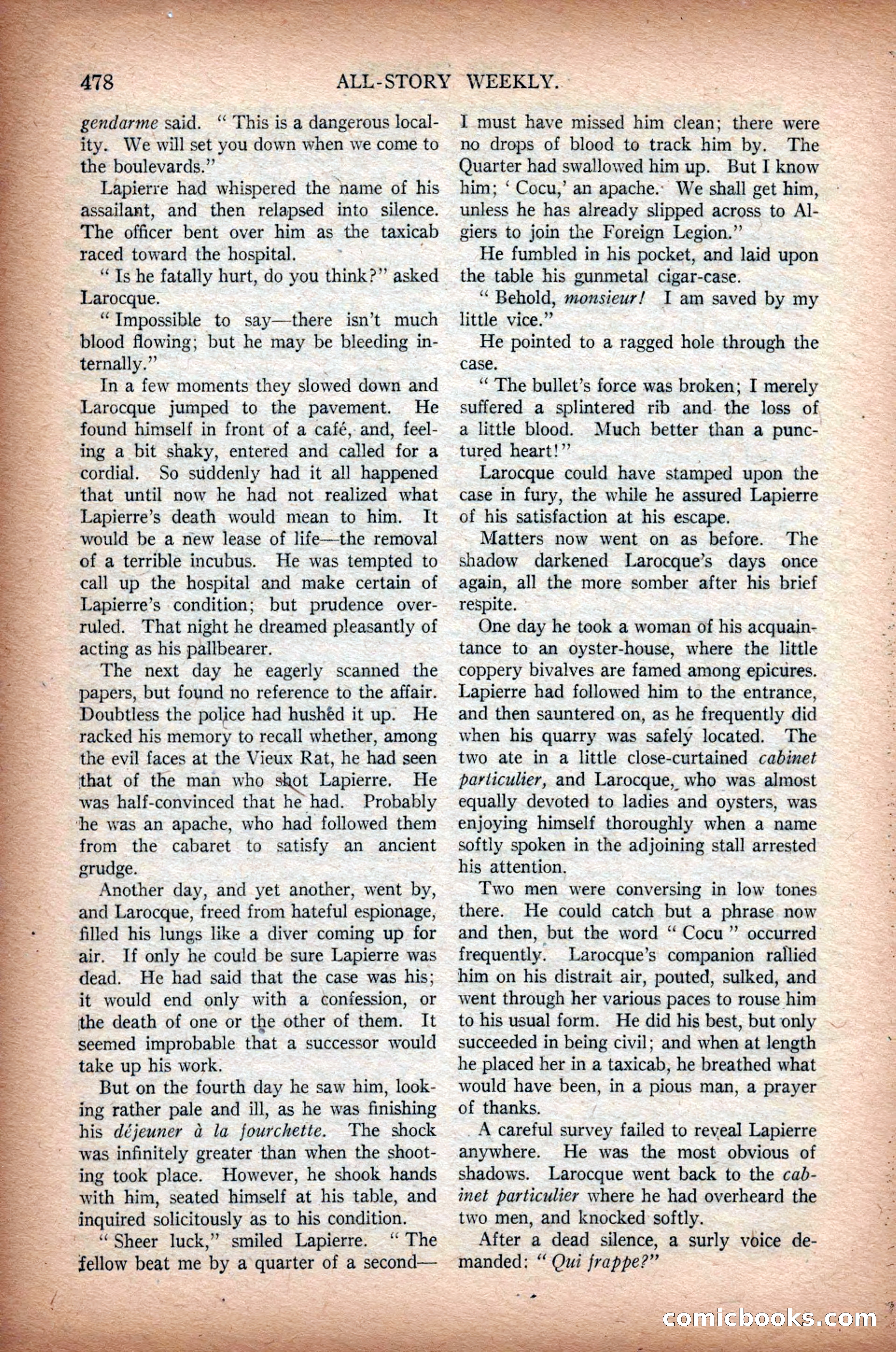
A restored page from Pulp Fiction, 1919. Page through the whole issue in the reader above.
📄 Transcribed text from this page (OCR, searchable)
Machine-transcribed from the original scan — historical spelling and the odd misread are preserved.
ee Saoiane said. pS eS a a Bos Se — Si re ¥ <a = ome : fo ee o ae a, on “This is a dangerous local- ity. We will set you down when we come to _.___ the boulevards.” Lapierre had whispered the name of his — - assailant, and then relapsed into silence. The officer bent over him as the taxicab raced toward the hospital. “Is he fatally hurt, do you think?” asked Larocque. “Impossible to say—there isn’t much - : blood flowing: but he may be bleeding in- ternally.”’ In a few moments they slowed down and Larocque jumped to the pavement. He found himself in front of a café, and, feel- ing a bit shaky, entered and called for a cordial. So suddenly had it all happened : that until now he had not realized what Lapierre’s death would mean to him. It - would be a new lease of life—the removal of a terrible incubus. He was tempted to call up the hospital and make certain of Lapierre’s condition; but prudence over- ruled. That night he dreamed pleasantly of acting as his pallbearer. The next day he eagerly scanned the papers, but found no reference to the affair. Doubtless the police had hushéd it up. He racked his memory to recall whether, among the evil faces at the Vieux Rat, he had seen that of the man who shot Lapierre. He was half-convinced that he had. Probably “he was an apache, who had followed them from the cabaret to satisfy an ancient grudge. Another day, and yet another, went by, E ~. and Larocque, freed from hateful espionage, + filled his lungs like a diver coming up for air. If only he could be sure Lapierre was dead. He had said that the case was his; it would end only with a confession, or the death of one or the other of them. It seemed improbable that a successor would take up his work. But on the fourth day he saw him, look- ng rather pale and ill, as he was finishing his déjeuner a la fourchette. The shock was infinitely greater than when the shoot- ing took place. However, he shook hands with him, seated himself at his table, and -_ Gnquired solicitously as to his condition. + “Sheer luck,” smiled Lapierre. Spe beat me by a 3 oe of a second— —— Lh a ~ “ The — * ‘ALL- STORY ‘WEEKLY. ~ Cae we Se I must have missed him clean; there were no drops of blood to track him by. The Quarter had swallowed him up. But I know him; ‘ Cocu,’ an apache.: We shall get him, unless he has already slipped across to Al- giers to join the Foreign Legion.” He fumbled in his pocket, and laid upon the table his gunmetal cigar-case. ‘ Behold, monsieur! I am saved by my little vice.” He pointed to a ragged hole through the case. ‘The bullet’s force was broken; I merely suffered a splintered rib and. the loss of a little blood. Much better than a punc- tured heart!” Larocque could have stamped upon the case in fury, the while he assured Lapierre of his satisfaction at his escape. - Matters now went on as before. The shadow darkened Larocque’s days once again, all the more somber after his brief respite. One day he took a woman of his acquain- tance to an oyster-house, where the little coppery bivalves are famed among epicures. Lapierre had followed him to the entrance, and then sauntered on, as he frequently did when his quarry was safely located. The two ate in a little close-curtained cabinet particulier, and Larocque, who was almost equally devoted to ladies and oysters, was enjoying himself thoroughly when a name softly spoken in the adjoining stall arrested his attention. Two men were conversing in low tones there. He could catch but a phrase now and then, but the word “ Cocu”’ occurred frequently. Larocque’s companion rallied him on his distrait air, pouted, sulked, and went through her various paces to rouse him to his usual form. He did his best, but only succeeded in being civil; and when at length he placed her in a taxicab, he breathed what would have been, in a pious man, a prayer of thanks. _A careful survey failed to reveal Lapierre anywhere. He was the most obvious of shadows. Larocque went back to the cab- inet particulier where he had overheard the two men, and knocked softly. After a dead silence, a surly voice de- ‘manded: “ Oui jrappe?” | tot . Aas ety ihe ye OS ae ea | = bus f . a tee ee . Dato ae LAO: ae ee if a TES aa i4 ; STO) ae ao