
Pulp Fiction, 1919 · page 134 of 192
All-Story Weekly, March 1, 1919 — page 134: what you’re looking at
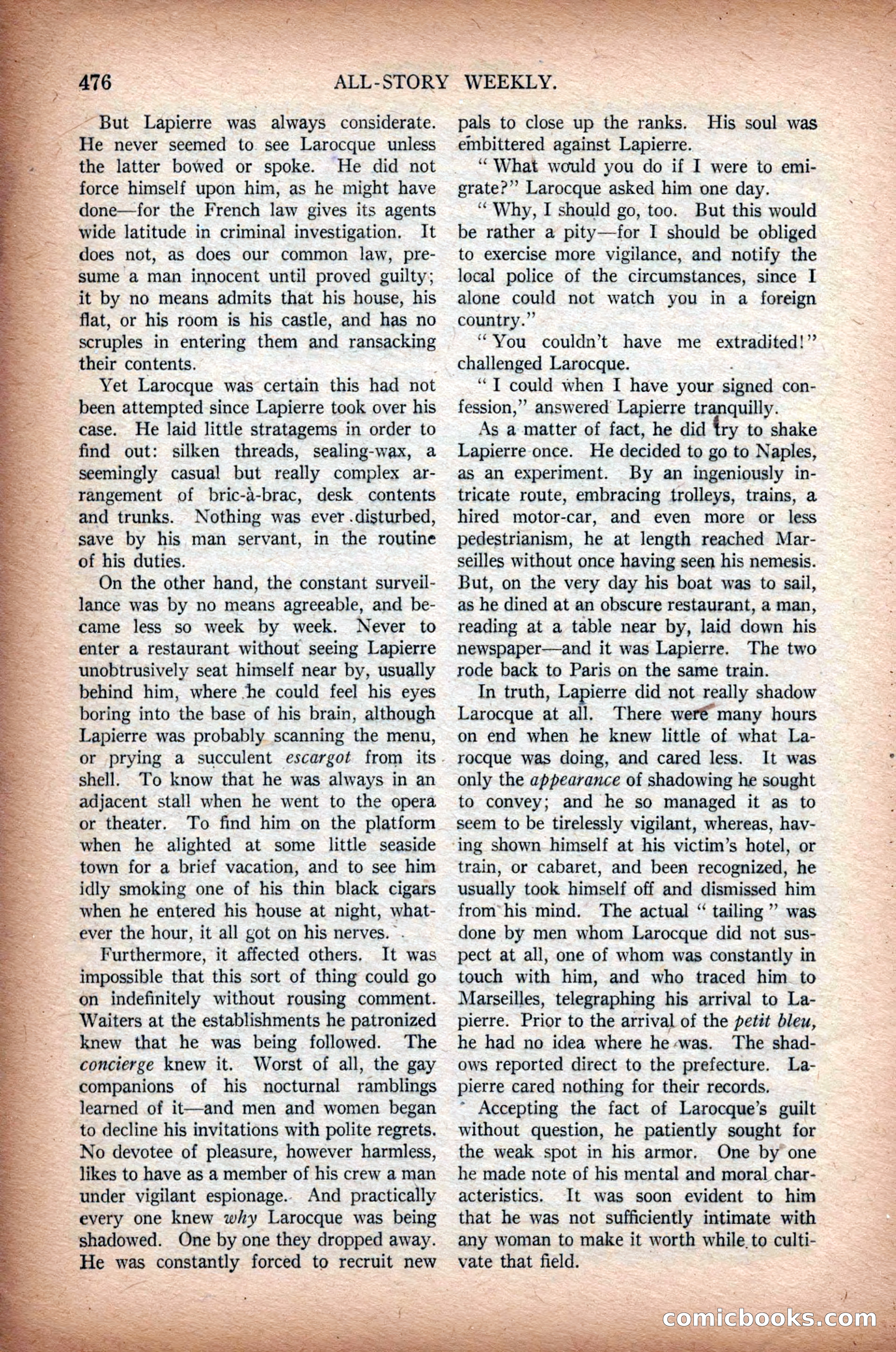
A restored page from Pulp Fiction, 1919. Page through the whole issue in the reader above.
📄 Transcribed text from this page (OCR, searchable)
Machine-transcribed from the original scan — historical spelling and the odd misread are preserved.
But Lapierre was always considerate. _ He never seemed to see Larocque unless _ the latter bowed or spoke. He did not force himself upon him, as he might have _ done—for the French law gives its agents wide latitude in criminal investigation. It does not, as does our common law, pre- sume a man innocent until proved guilty; it by no means admits that his house, his flat, or his room is his castle, and has no scruples in entering them and ransacking their contents. Yet Larocque was certain this had not been attempted since Lapierre took over his case. He laid little stratagems in order to find out: silken threads, sealing-wax, a seemingly casual but really complex ar- rangement of bric-a-brac, desk contents and trunks. Nothing was ever .disturbed, gave by his man servant, in the routine of his duties. On the other hand, the constant surveil- lance was by no means agreeable, and be- came less so week by week. Never to enter a restaurant without seeing Lapierre unobtrusively seat himself near by, usually behind him, where ‘he could feel his eyes boring into the base of his brain, although Lapierre was probably scanning the menu, Shell. To know that he was always in an adjacent stall when he went to the opera : or theater. To find him on the platform when he alighted at some little seaside town for a brief vacation, and to see him idly smoking one of his thin black cigars when he entered his house at night, what- ever the hour, it all got on his nerves. . Furthermore, it affected others. It was impossible that this sort of thing could go on indefinitely without rousing comment. Waiters at the establishments he patronized knew that he was being followed. The concierge knew it. Worst of all, the gay companions of his nocturnal ramblings learned of it—and men and women began to decline his invitations with polite regrets. No devotee of pleasure, however harmless, ___ jikes to have as a member of his crew a man __- under vigilant espionage.. And practically every one knew why Larocque was being shadowed. One by one they dropped away. He was constantly forced to recruit new Ate toes WEEKLY. or prying a succulent escargot from its. a8, ? 5. Z a ‘ Ret iy ? pals to close up the ranks. His soul was embittered against Lapierre. _ “What would you do if I were to emi- grate?”’ Larocque asked him one day. ‘Why, I should go, too. But this would be rather a pity—for I should be obliged to exercise more vigilance, and notify the local police of the circumstances, since I alone could not watch you in a foreign country.” ‘You couldn’t have me _ extradited!” challenged Larocque. ‘““T could when I have your signed con- fession,” answered Lapierre tranquilly. As a matter of fact, he did try to shake Lapierre once. He decided to go to Naples, as an experiment. By an ingeniously in- tricate route, embracing trolleys, trains, a hired motor-car, and even more or less pedestrianism, he at length reached Mar- seilles without once having seen his nemesis. But, on the very day his boat was to sail, as he dined at an obscure restaurant, a man, reading at a table near by, laid down his newspaper—and it was Lapierre. The two rode back to Paris on the same train. In truth, Lapierre did not really shadow Larocque at all. There wer€ many hours on end when he knew little of what La- rocque was doing, and cared less. It was only the appearance of shadowing he sought to convey; and he so managed it as to seem to be tirelessly vigilant, whereas, hay- ‘ing shown himself at his victim’s hotel, or train, or cabaret, and been recognized, he usually took himself off and dismissed him from’ his mind. The actual “ tailing” was done by men whom Larocque did not sus- pect at all, one of whom was constantly in touch with him, and who traced him. to Marseilles, telegraphing his arrival to La- pierre. Prior to the arrival of the petit bleu, he had no idea where he was. The shad- ows reported direct to the prefecture. La- pierre cared nothing for their records. ~ Accepting the fact of Larocque’s guilt without question, he patiently sought for the weak spot in his armor. One by one he made note of his mental and moral char- acteristics. It was soon evident to him that he was not sufficiently intimate with any woman to make it worth while. to culti- vate that field.