
Pulp Fiction, 1919 · page 133 of 192
All-Story Weekly, March 1, 1919 — page 133: what you’re looking at
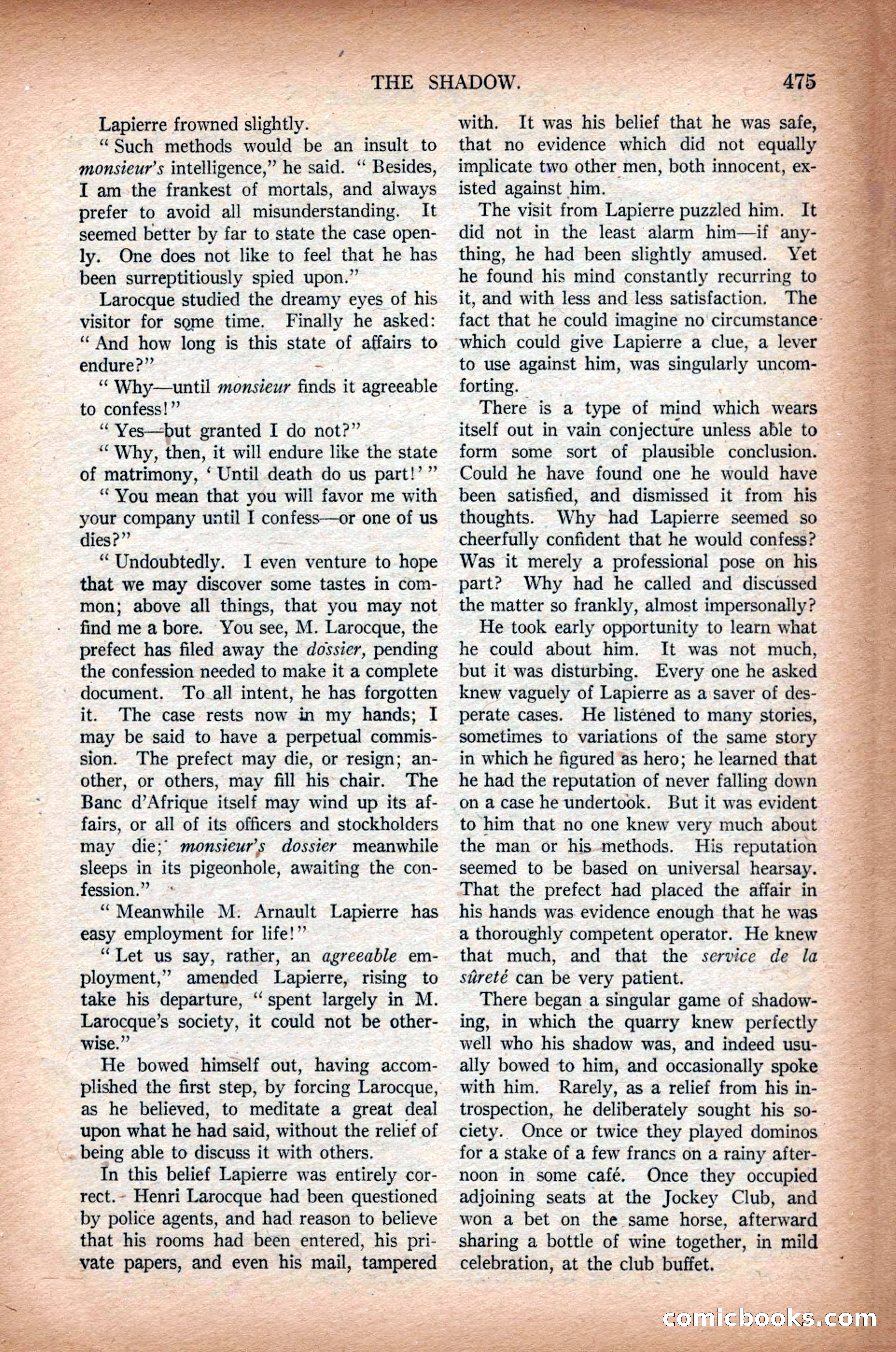
A restored page from Pulp Fiction, 1919. Page through the whole issue in the reader above.
📄 Transcribed text from this page (OCR, searchable)
Machine-transcribed from the original scan — historical spelling and the odd misread are preserved.
Lapierre frowned slightly. “ Such methods would be an insult to monsieur’s intelligence,” he said. ‘‘ Besides, I am the frankest of mortals, and always prefer to avoid all misunderstanding. It seemed better by far to state the case open- ly. One does not like to feel that he has been surreptitiously spied upon.” Larocque studied the dreamy eyes of his visitor for some time. Finally he asked: ‘And how long is this state of affairs to endure?” - “ Why—until monsieur finds it agreeable to confess!” “Yes—but granted I do not?” ‘““ Why, then, it will endure like the state of matrimony, ‘ Until death do us part!’”’ “You mean that you will favor me with your company until I confess—or one of us dies?” | “ Undoubtedly. I even venture to hope that we may discover some tastes in com- mon; above all things, that you may not find me a bore. You see, M. Larocque, the prefect has filed away the dossier, pending the confession needed to make it a complete - document. To all intent, he has forgotten it. The case rests now in my hands; I may be said to have a perpetual commis- sion. The prefect may die, or resign; an- other, or others, may fill his chair. The Banc d’Afrique itself may wind up its af- fairs, or all of its officers and stockholders may die; monsieur’s dossier meanwhile sleeps in its pigeonhole, awaiting the con- fession.” : “ Meanwhile M: Arnault Lapierre has easy employment for life!” “Let us say, rather, an agreeable em- ployment,” amended Lapierre, rising to take his departure, “spent largely in M. ok Larocque’s society, it could not be other- wise.”’ : He bowed himself out, having accom- plished the first step, by forcing Larocque, as he believed, to meditate a great deal | upon what he had said, without the relief of being able to discuss it with others. E In this belief Lapierre was entirely cor- a rect.~ Henri Larocque had been questioned by police agents, and had reason to believe that his rooms had been entered, his pri- vate papers, and even his mail, tampered - <- s —— eee —* > mJ “THE “SHADOW. ~, —_——- BREE ~— Sw So" eat Ree. ES os see oe ee sn es : with. It was his belief that he was safe, that no evidence which did not a implicate two other men, both innocent, ex- isted against him. The visit from Lapierre puzzled him. It did not in the least alarm him—if any- — thing, he had been slightly amused. te he found his mind constantly recurring to it, and with less and less satisfaction. The fact that he could imagine no circumstance’ ‘which could give Lapierre a clue, a lever to use against him, was singularly uncom- forting. < 4 There is a type of mind which wears 3 itself out in vain conjecture unless able to form some sort of plausible conclusion. = Could he have found one he would have __ been satisfied, and dismissed it from his thoughts. Why had Lapierre seemed so 3 8 cheerfully confident that he would confess? — Was it merely a professional pose on his — = part? Why had he called and discussed = the matter so frankly, almost impersonally? He took early opportunity to learn what he could about him. It was not much, but it was disturbing. Every one he ackaas a knew vaguely of Lapierre as a saver of des- 4 3 perate cases. He listened to many stories, a sometimes to variations of the same story — in which he figured as hero; he learned that he had the reputation of never falling down on a case he undertook. But it was evident to him that no one knew very much about the man or his methods. His reputation —— | seemed to be based on universal hearsay. That the prefect had placed the affair in his hands was evidence enough that he was a thoroughly competent operator. He knew that much, and that the service de la sureté can be very patient. 7 There began a singular game of shadow- = ing, in which the quarry knew perfectly well who his shadow was, and indeed usu- ally bowed to him, and occasionally spoke with him. Rarely, as a relief from his in- — trospection, he deliberately sought his so- ciety. Once or twice they played dominos = for a stake of a few francs on a rainy after- = 3 noon in some café. Once they occupied é adjoining seats at the Jockey Club, and won a bet on the same horse, afterward = 2 sharing a bottle of wine together, in mild — celebration, at the club buffet. “ = as ee «