
Pulp Fiction, 1938 · page 64 of 100
Air Stories — page 64: what you’re looking at
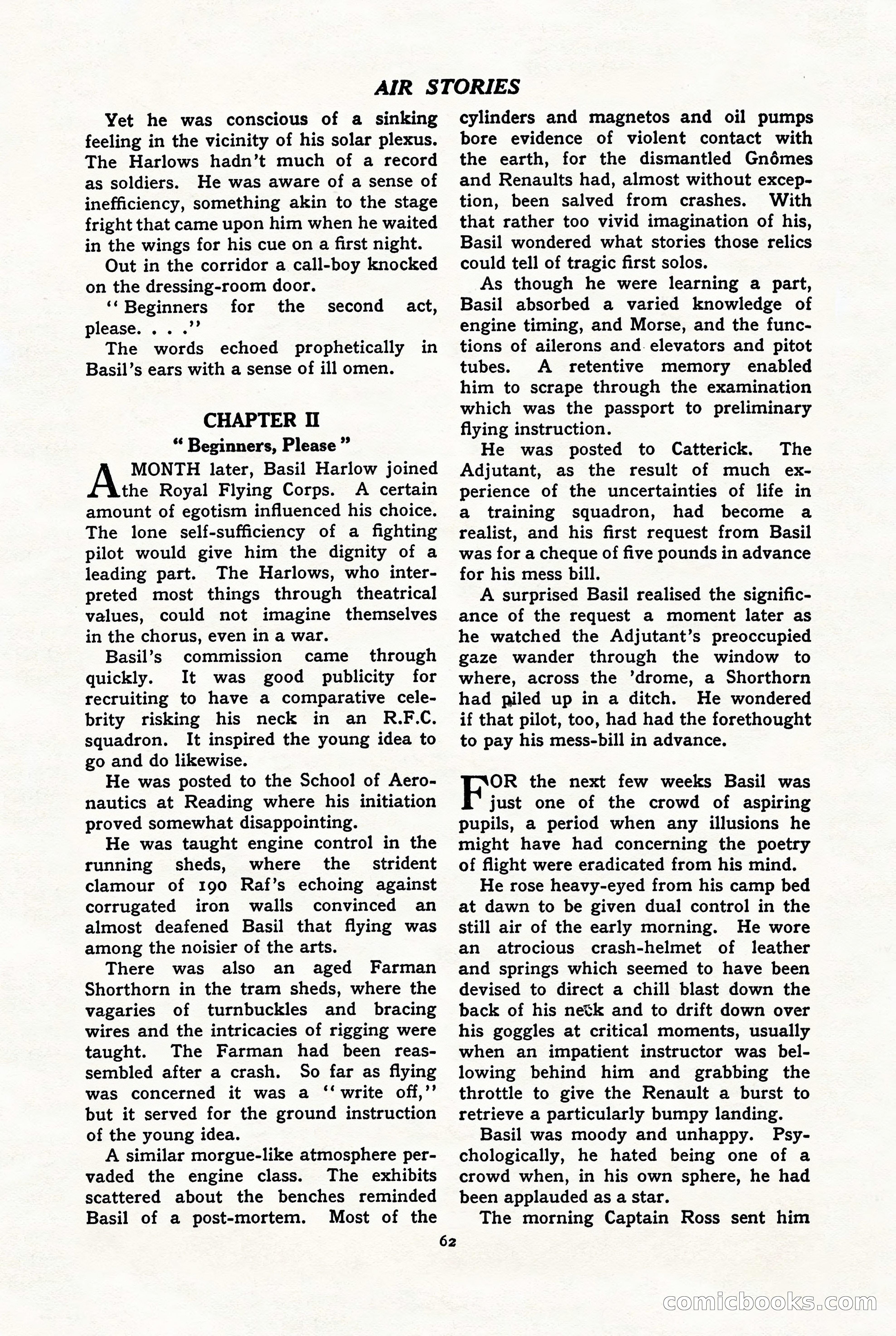
A restored page from Pulp Fiction, 1938. Page through the whole issue in the reader above.
📄 Transcribed text from this page (OCR, searchable)
Machine-transcribed from the original scan — historical spelling and the odd misread are preserved.
AIR STORIES Yet he was conscious of a sinking feeling in the vicinity of his solar plexus. The Harlows hadn’t much of a record as soldiers. He was aware of a sense of inefficiency, something akin to the stage fright that came upon him when he waited in the wings for his cue on a first night. Out in the corridor a call-boy knocked on the dressing-room door. ‘‘ Beginners for the please... .’’ The words echoed prophetically Basil’s ears with a sense of ill omen. second act, in CHAPTER I ‘** Beginners, Please ” MONTH later, Basil Harlow joined the Royal Flying Corps. A certain amount of egotism influenced his choice. The lone self-sufficiency of a fighting pilot would give him the dignity of a leading part. The Harlows, who inter- preted most things through theatrical values, could not imagine themselves in the chorus, even in a war. Basil’s commission came _ through quickly. It was good publicity for recruiting to have a comparative cele- brity risking his neck in an R.F.C. squadron. It inspired the young idea to go and do likewise. He was posted to the School of Aero- nautics at Reading where his initiation proved somewhat disappointing. He was taught engine control in the running sheds, where the strident clamour of 190 Raf’s echoing against corrugated iron walls convinced an almost deafened Basil that flying was among the noisier of the arts. There was also an aged Farman Shorthorn in the tram sheds, where the vagaries of turnbuckles and bracing wires and the intricacies of rigging were taught. The Farman had been reas- sembled after a crash. So far as flying was concerned it was a ‘‘ write off,’’ but it served for the ground instruction of the young idea. A similar morgue-like atmosphere per- vaded the engine class. The exhibits scattered about the benches reminded Basil of a post-mortem. Most of the 62 cylinders and magnetos and oil pumps bore evidence of violent contact with the earth, for the dismantled Gnémes and Renaults had, almost without excep- tion, been salved from crashes. With that rather too vivid imagination of his, Basil wondered what stories those relics could tell of tragic first solos. As though he were learning a part, Basil absorbed a varied knowledge of engine timing, and Morse, and the func- tions of ailerons and. elevators and pitot tubes. A _ retentive memory enabled him to scrape through the examination which was the passport to preliminary flying instruction. He was posted to Catterick. The Adjutant, as the result of much ex- perience of the uncertainties of life in a training squadron, had become a realist, and his first request from Basil was for a cheque of five pounds in advance for his mess bill. A surprised Basil realised the signific- ance of the request a moment later as he watched the Adjutant’s preoccupied gaze wander through the window to where, across the ’drome, a Shorthorn had piled up in a ditch. He wondered if that pilot, too, had had the forethought to pay his mess-bill in advance. OR the next few weeks Basil was just one of the crowd of aspiring pupils, a period when any illusions he might have had concerning the poetry of flight were eradicated from his mind. He rose heavy-eyed from his camp bed at dawn to be given dual control in the still air of the early morning. He wore an atrocious crash-helmet of leather and springs which seemed to have been devised to direct a chill blast down the back of his netk and to drift down over his goggles at critical moments, usually when an impatient instructor was bel- lowing behind him and grabbing the throttle to give the Renault a burst to retrieve a particularly bumpy landing. Basil was moody and unhappy. Psy- chologically, he hated being one of a crowd when, in his own sphere, he had been applauded as a star. The morning Captain Ross sent him LDOO