
Pulp Fiction, 1938 · page 65 of 100
Air Stories — page 65: what you’re looking at
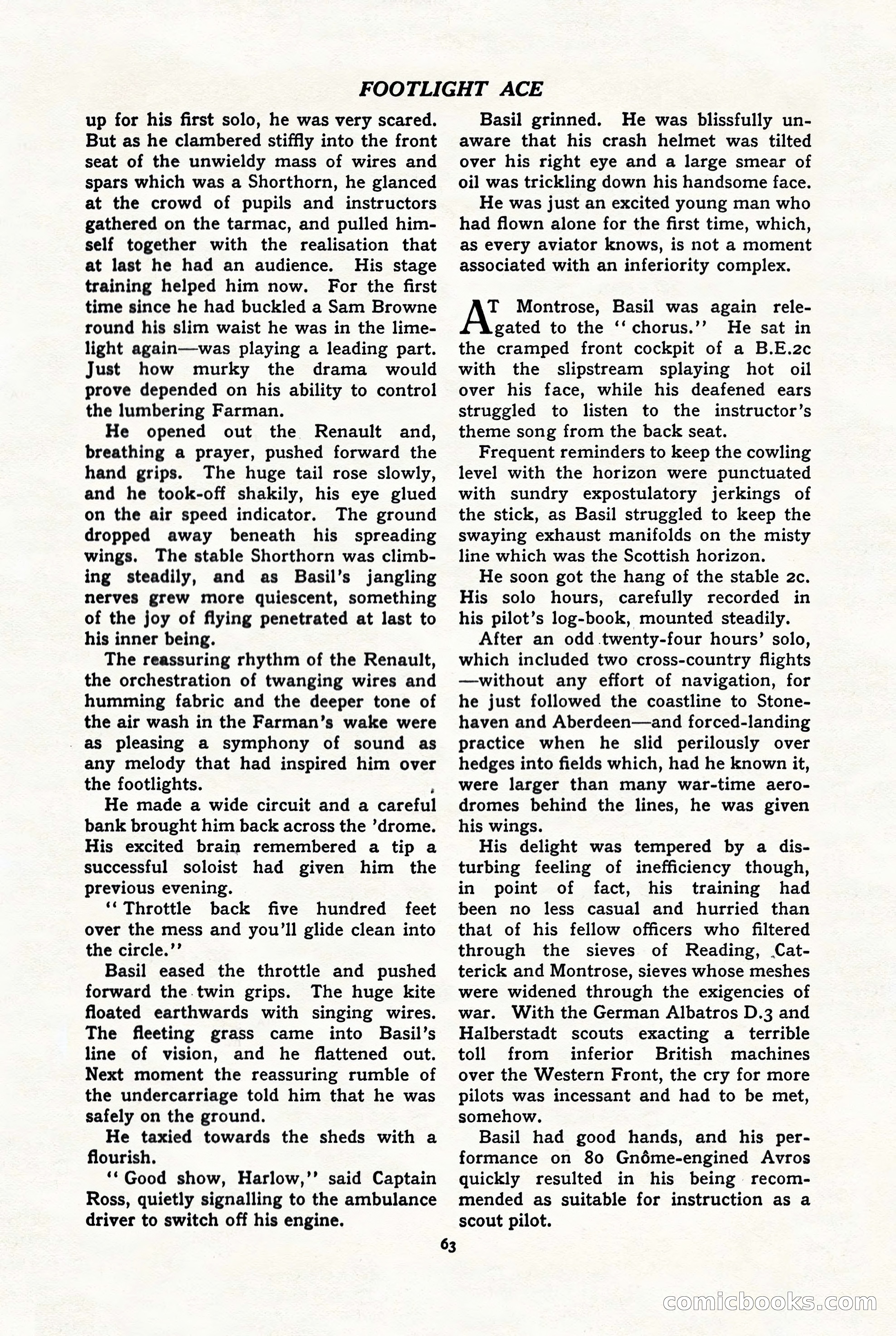
A restored page from Pulp Fiction, 1938. Page through the whole issue in the reader above.
📄 Transcribed text from this page (OCR, searchable)
Machine-transcribed from the original scan — historical spelling and the odd misread are preserved.
FOOTLIGHT ACE up for his first solo, he was very scared. But as he clambered stiffly into the front seat of the unwieldy mass of wires and spars which was a Shorthorn, he glanced at the crowd of pupils and instructors gathered on the tarmac, and pulled him- self together with the realisation that at last he had an audience. His stage training helped him now. For the first time since he had buckled a Sam Browne round his slim waist he was in the lime- light again—was playing a leading part. Just how murky the drama would prove depended on his ability to control the lumbering Farman. He opened out the Renault and, breathing a prayer, pushed forward the hand grips. The huge tail rose slowly, and he took-off shakily, his eye glued on the air speed indicator. The ground dropped away beneath his spreading wings. The stable Shorthorn was climb- ing steadily, and as Basil’s jangling nerves grew more quiescent, something of the joy of flying penetrated at last to his inner being. The reassuring rhythm of the Renault, the orchestration of twanging wires and humming fabric and the deeper tone of the air wash in the Farman’s wake were _ as pleasing a symphony of sound as any melody that had inspired him over the footlights. : He made a wide circuit and a careful bank brought him back across the ’drome. His excited brain remembered a tip a successful soloist had given him the previous evening. ‘‘ Throttle back five hundred feet over the mess and you’ll glide clean into the circle.’’ Basil eased the throttle and pushed forward the twin grips. The huge kite floated earthwards with singing wires. The fleeting grass came into Basil’s line of vision, and he flattened out. Next moment the reassuring rumble of the undercarriage told him that he was safely on the ground. He taxied towards the sheds with a flourish. ‘* Good show, Harlow,’’ said Captain Ross, quietly signalling to the ambulance driver to switch off his engine. 63 Basil grinned. He was blissfully un- aware that his crash helmet was tilted over his right eye and a large smear of oil was trickling down his handsome face. He was just an excited young man who had flown alone for the first time, which, as every aviator knows, is not a moment associated with an inferiority complex. T Montrose, Basil was again rele- gated to the ‘‘ chorus.’’ He sat in the cramped front cockpit of a B.E.2c with the slipstream splaying hot oil over his face, while his deafened ears struggled to listen to the instructor’s theme song from the back seat. Frequent reminders to keep the cowling level with the horizon were punctuated with sundry expostulatory jerkings of the stick, as Basil struggled to keep the swaying exhaust manifolds on the misty line which was the Scottish horizon. He soon got the hang of the stable 2c. His solo hours, carefully recorded in his pilot’s log-book, mounted steadily. After an odd twenty-four hours’ solo, which included two cross-country flights —without any effort of navigation, for he just followed the coastline to Stone- haven and Aberdeen—and forced-landing practice when he slid perilously over hedges into fields which, had he known it, were larger than many war-time aero- dromes behind the lines, he was given his wings. His delight was tempered by a dis- turbing feeling of inefficiency though, in point of fact, his training had been no less casual and hurried than that of his fellow officers who filtered through the sieves of Reading, Cat- terick and Montrose, sieves whose meshes were widened through the exigencies of war. With the German Albatros D.3 and Halberstadt scouts exacting a terrible toll from inferior British machines over the Western Front, the cry for more pilots was incessant and had to be met, somehow. Basil had good hands, and his per- formance on 80 Gndéme-engined Avros quickly resulted in his being recom- mended as suitable for instruction as a scout pilot. CoOMmicloo ©