
Pulp Fiction, 1938 · page 63 of 100
Air Stories — page 63: what you’re looking at
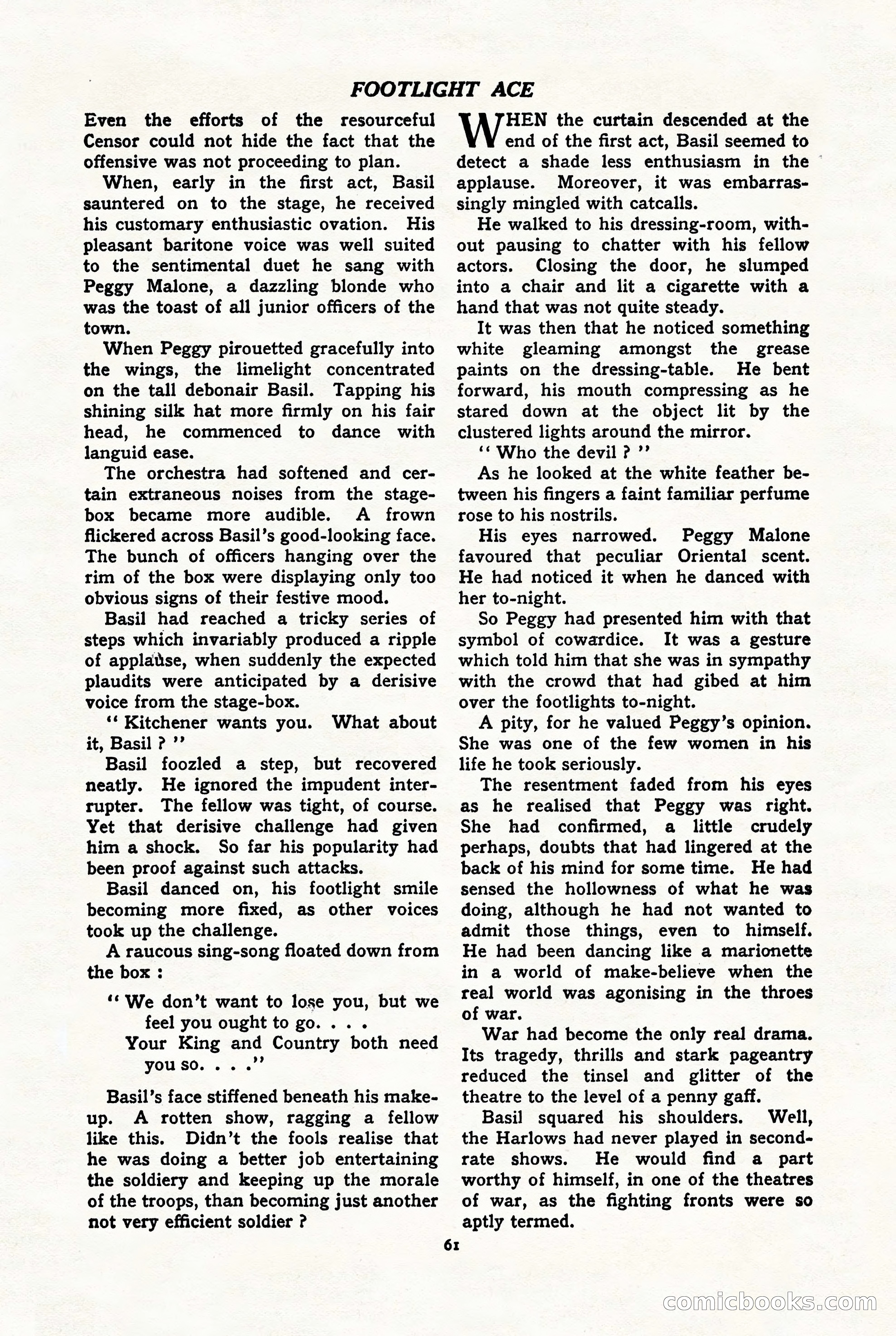
A restored page from Pulp Fiction, 1938. Page through the whole issue in the reader above.
📄 Transcribed text from this page (OCR, searchable)
Machine-transcribed from the original scan — historical spelling and the odd misread are preserved.
FOOTLIGHT ACE Even the efforts of the resourceful Censor could not hide the fact that the offensive was not proceeding to plan. When, early in the first act, Basil sauntered on to the stage, he received his customary enthusiastic ovation. His pleasant baritone voice was well suited to the sentimental duet he sang with Peggy Malone, a dazzling blonde who was the toast of all junior officers of the town. When Peggy pirouetted gracefully into the wings, the limelight concentrated on the tall debonair Basil. Tapping his shining silk hat more firmly on his fair head, he commenced to dance with languid ease. The orchestra had softened and cer- tain extraneous noises from the stage- box became more audible. A frown flickered across Basil’s good-looking face. The bunch of officers hanging over the rim of the box were displaying only too obvious signs of their festive mood. Basil had reached a tricky series of steps which invariably produced a ripple of applause, when suddenly the expected plaudits were anticipated by a derisive voice from the stage-box. ‘* Kitchener wants you. it, Basil ? ’’ Basil foozled a step, but recovered neatly. He ignored the impudent inter- rupter. The fellow was tight, of course. Yet that derisive challenge had given him a shock. So far his popularity had been proof against such attacks. Basil danced on, his footlight smile becoming more fixed, as other voices took up the challenge. A raucous sing-song floated down from the box : ‘‘ We don’t want to lose you, but we feel you ought to go. ... Your King and Country both need youso....’’ What about Basil’s face stiffened beneath his make- up. A rotten show, ragging a fellow like this. Didn’t the fools realise that he was doing a better job entertaining the soldiery and keeping up the morale of the troops, than becoming just another not very efficient soldier P 61 HEN the curtain descended at the end of the first act, Basil seemed to detect a shade less enthusiasm in the © applause. Moreover, it was embarras- singly mingled with catcalls. He walked to his dressing-room, with- out pausing to chatter with his fellow actors. Closing the door, he slumped into a chair and lit a cigarette with a hand that was not quite steady. It was then that he noticed something white gleaming amongst the grease paints on the dressing-table. He bent forward, his mouth compressing as he stared down at the object lit by the clustered lights around the mirror. ‘“ Who the devil ? ”’ As he looked at the white feather be- tween his fingers a faint familiar perfume rose to his nostrils. His eyes narrowed. Peggy Malone favoured that peculiar Oriental scent. He had noticed it when he danced with her to-night. So Peggy had presented him with that symbol of cowardice. It was a gesture which told him that she was in sympathy with the crowd that had gibed at him over the footlights to-night. A pity, for he valued Peggy’s opinion. She was one of the few women in his life he took seriously. The resentment faded from his eyes as he realised that Peggy was right. She had confirmed, a little crudely perhaps, doubts that had lingered at the back of his mind for some time. He had sensed the hollowness of what he was doing, although he had not wanted to admit those things, even to himself. He had been dancing like a marionette in a world of make-believe when the real world was agonising in the throes of war. War had become the only real drama. Its tragedy, thrills and stark pageantry reduced the tinsel and glitter of the theatre to the level of a penny gaff. Basil squared his shoulders. Well, the Harlows had never played in second- rate shows. He would find a part worthy of himself, in one of the theatres of war, as the fighting fronts were so aptly termed. CO DOO)