
Pulp Fiction, 1938 · page 54 of 100
Air Stories — page 54: what you’re looking at
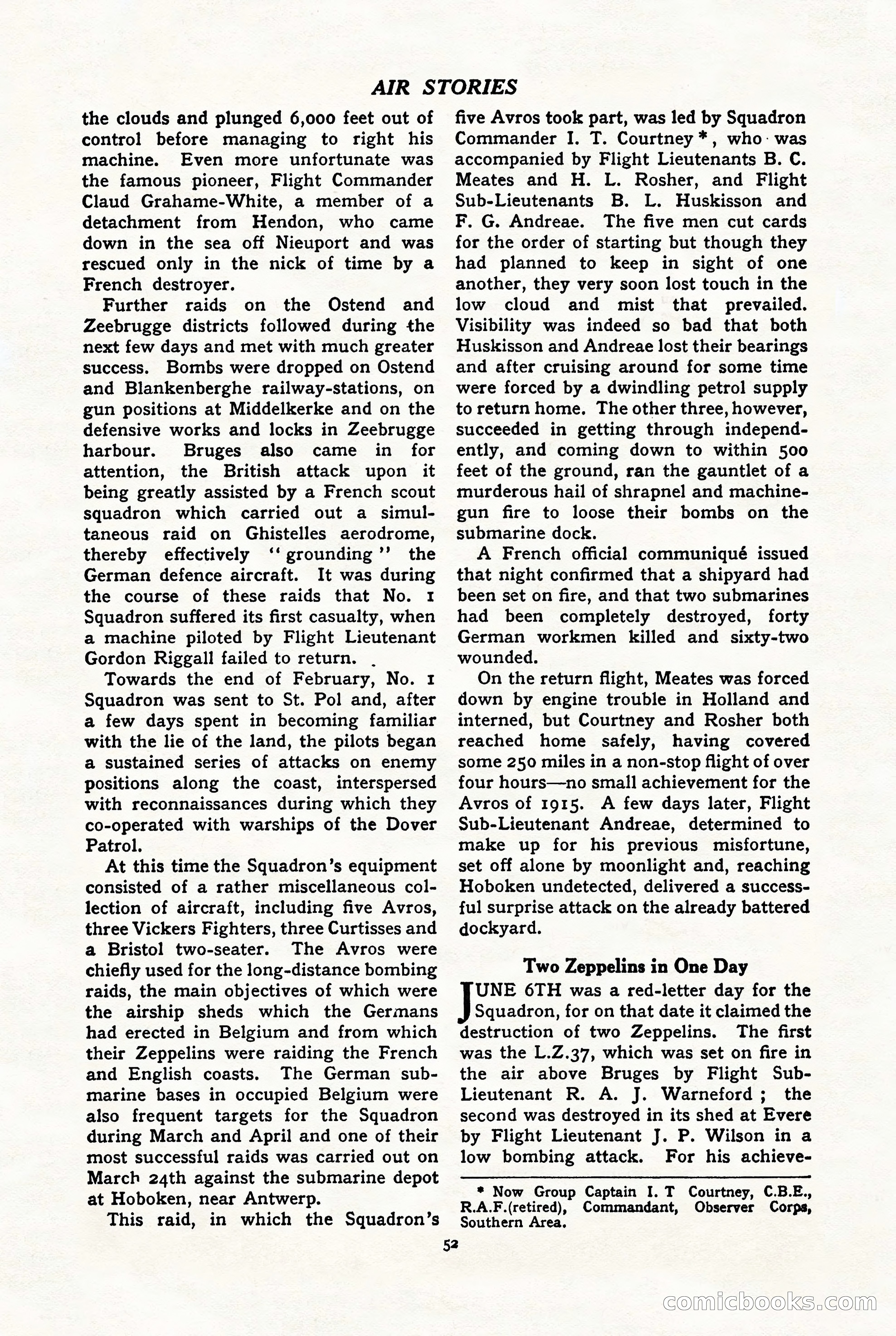
A restored page from Pulp Fiction, 1938. Page through the whole issue in the reader above.
📄 Transcribed text from this page (OCR, searchable)
Machine-transcribed from the original scan — historical spelling and the odd misread are preserved.
AIR STORIES the clouds and plunged 6,000 feet out of control before managing to right his machine. Even more unfortunate was the famous pioneer, Flight Commander Claud Grahame-White, a member of a detachment from Hendon, who came down in the sea off Nieuport and was rescued only in the nick of time by a French destroyer. Further raids on the Ostend and Zeebrugge districts followed during the next few days and met with much greater success. Bombs were dropped on Ostend and Blankenberghe railway-stations, on gun positions at Middelkerke and on the defensive works and locks in Zeebrugge harbour. Bruges also came in _ for attention, the British attack upon it being greatly assisted by a French scout squadron which carried out a simul- taneous raid on Ghistelles aerodrome, thereby effectively ‘‘ grounding ’’ the German defence aircraft. It was during the course of these raids that No. 1 Squadron suffered its first casualty, when a machine piloted by Flight Lieutenant Gordon Riggall failed to return. . Towards the end of February, No. 1 Squadron was sent to St. Pol and, after a few days spent in becoming familiar with the lie of the land, the pilots began a sustained series of attacks on enemy positions along the coast, interspersed with reconnaissances during which they co-operated with warships of the Dover Patrol. At this time the Squadron’s equipment consisted of a rather miscellaneous col- lection of aircraft, including five Avros, three Vickers Fighters, three Curtisses and a Bristol two-seater. The Avros were chiefly used for the long-distance bombing raids, the main objectives of which were the airship sheds which the Germans had erected in Belgium and from which their Zeppelins were raiding the French and English coasts. The German sub- marine bases in occupied Belgium were also frequent targets for the Squadron during March and April and one of their most successful raids was carried out on March 24th against the submarine depot at Hoboken, near Antwerp. This raid, in which the Squadron’s 52 five Avros took part, was led by Squadron Commander I. T. Courtney *, who: was accompanied by Flight Lieutenants B. C. Meates and H. L. Rosher, and Flight Sub-Lieutenants B. L. Huskisson and F, G. Andreae. The five men cut cards for the order of starting but though they had planned to keep in sight of one another, they very soon lost touch in the low cloud and mist that prevailed. Visibility was indeed so bad that both Huskisson and Andreae lost their bearings and after cruising around for some time were forced by a dwindling petrol supply to return home. The other three, however, succeeded in getting through independ- ently, and coming down to within 500 feet of the ground, ran the gauntlet of a murderous hail of shrapnel and machine- gun fire to loose their bombs on the submarine dock. A French official communiqué issued that night confirmed that a shipyard had been set on fire, and that two submarines had been completely destroyed, forty German workmen killed and sixty-two wounded. On the return flight, Meates was forced down by engine trouble in Holland and interned, but Courtney and Rosher both reached home safely, having covered some 250 miles in a non-stop flight of over four hours—no small achievement for the Avros of 1915. A few days later, Flight Sub-Lieutenant Andreae, determined to make up for his previous misfortune, set off alone by moonlight and, reaching Hoboken undetected, delivered a success- ful surprise attack on the already battered dockyard. Two Zeppelins in One Day UNE 6TH was a red-letter day for the Squadron, for on that date it claimed the destruction of two Zeppelins. The first was the L.Z.37, which was set on fire in the air above Bruges by Flight Sub- Lieutenant R. A. J. Warneford; the second was destroyed in its shed at Evere by Flight Lieutenant J. P. Wilson in a low bombing attack. For his achieve- * Now Group Captain I. T Courtney, C.B.E., R.A.F.(retired), Commandant, Observer Corps, Southern Area, Goniebyoolks