
Pulp Fiction, 1938 · page 55 of 100
Air Stories — page 55: what you’re looking at
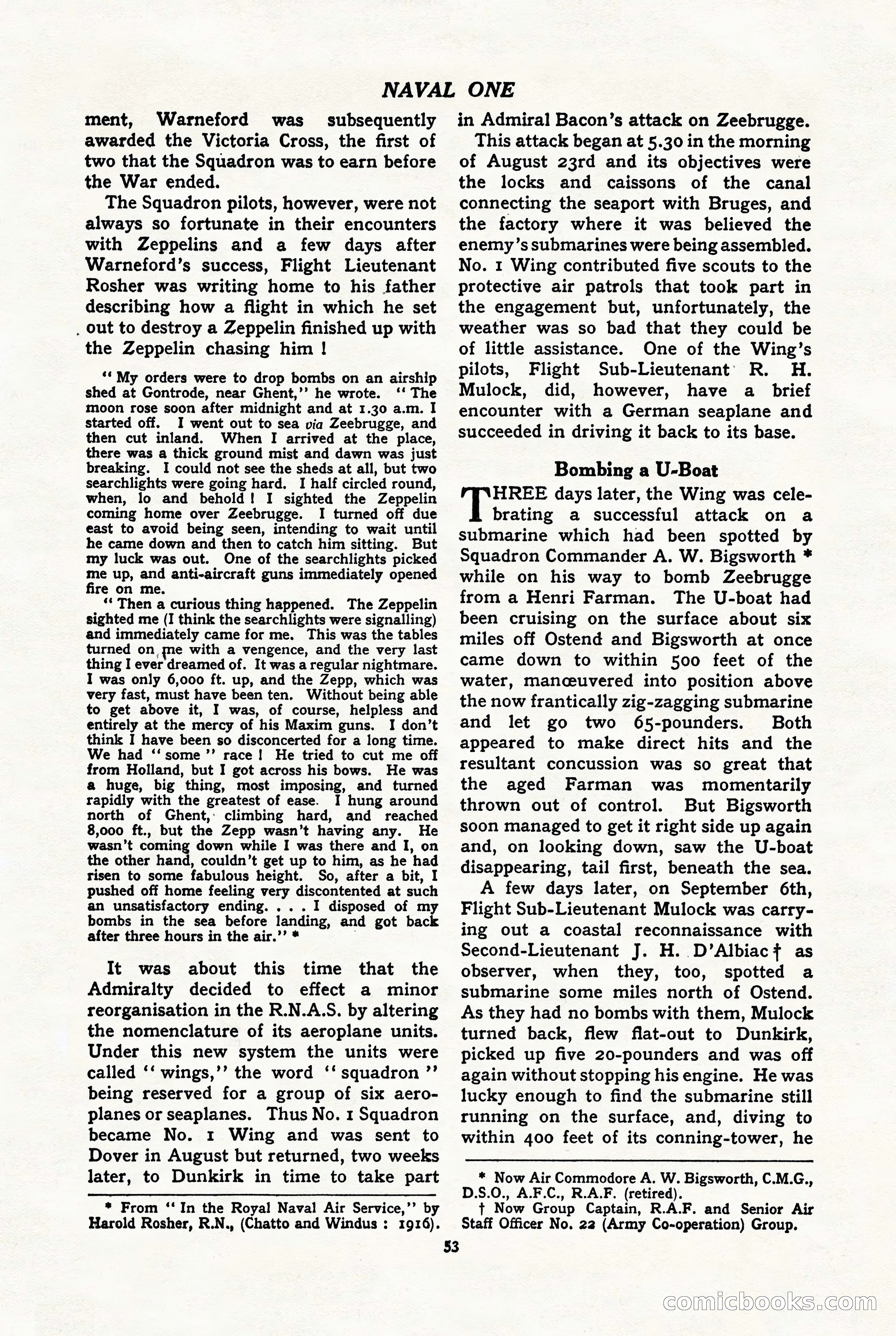
A restored page from Pulp Fiction, 1938. Page through the whole issue in the reader above.
📄 Transcribed text from this page (OCR, searchable)
Machine-transcribed from the original scan — historical spelling and the odd misread are preserved.
NAVAL ONE ment, Warneford was subsequently awarded the Victoria Cross, the first of two that the Squadron was to earn before the War ended. The Squadron pilots, however, were not always so fortunate in their encounters with Zeppelins and a few days after Warneford’s success, Flight Lieutenant Rosher was writing home to his father describing how a flight in which he set . out to destroy a Zeppelin finished up with the Zeppelin chasing him |! ‘* My orders were to drop bombs on an airship shed at Gontrode, near Ghent,’’ he wrote. ‘' The moon rose soon after midnight and at 1.30 a.m. I started off. I went out to sea via Zeebrugge, and then cut inland. When I arrived at the place, there was a thick ground mist and dawn was just breaking. I could not see the sheds at all, but two searchlights were going hard. I half circled round, when, lo and behold! I sighted the Zeppelin coming home over Zeebrugge. I turned off due east to avoid being seen, intending to wait until he came down and then to catch him sitting. But my luck was out. One of the searchlights picked me up, and anti-aircraft guns immediately opened fire on me. ‘* Then a curious thing happened. The Zeppelin sighted me (I think the searchlights were signalling) and immediately came for me. This was the tables turned on me with a vengence, and the very last thing I ever dreamed of. It was a regular nightmare. I was only 6,000 ft. up, and the Zepp, which was very fast, must have been ten. Without being able to get above it, I was, of course, helpless and entirely at the mercy of his Maxim guns. I don’t think I have been so disconcerted for a long time. We had ‘‘ some ’’ race! He tried to cut me off from Holland, but I got across his bows. He was a huge, big thing, most imposing, and turned rapidly with the greatest of ease. I hung around north of Ghent, climbing hard, and reached 8,000 ft., but the Zepp wasn’t having any. He wasn’t coming down while I was there and I, on the other hand, couldn’t get up to him, as he had risen to some fabulous height. So, after a bit, I pushed off home feeling very discontented at such an unsatisfactory ending. ...I1 disposed of m bombs in the sea before landing, and got bac after three hours in the air.’’ * | It was about this time that the Admiralty decided to effect a minor reorganisation in the R.N.A.S. by altering the nomenclature of its aeroplane units. Under this new system the units were called ‘‘ wings,’’ the word ‘‘ squadron ”’ being reserved for a group of six aero- planes or seaplanes. Thus No. 1 Squadron became No. 1 Wing and was sent to Dover in August but returned, two weeks later, to Dunkirk in time to take part * From ‘‘ In the Royal Naval Air Service,’’ by Harold Rosher, R.N., (Chatto and Windus : 1916). 53 in Admiral Bacon’s attack on Zeebrugge. This attack began at 5.30 in the morning of August 23rd and its objectives were the locks and caissons of the canal connecting the seaport with Bruges, and the factory where it was believed the enemy’s submarines were being assembled. No. 1 Wing contributed five scouts to the protective air patrols that took part in the engagement but, unfortunately, the weather was so bad that they could be of little assistance. One of the Wing’s pilots, Flight Sub-Lieutenant’ R. H. Mulock, did, however, have a brief encounter with a German seaplane and succeeded in driving it back to its base. Bombing a U-Boat HREE days later, the Wing was cele- brating a successful attack on a submarine which had been spotted by Squadron Commander A. W. Bigsworth * while on his way to bomb Zeebrugge from a Henri Farman. The U-boat had been cruising on the surface about six miles off Ostend and Bigsworth at once came down to within 500 feet of the water, manceuvered into position above the now frantically zig-zagging submarine and let go two 65-pounders. Both appeared to make direct hits and the resultant concussion was so great that the aged Farman was momentarily thrown out of control. But Bigsworth soon managed to get it right side up again and, on looking down, saw the U-boat disappearing, tail first, beneath the sea. A few days later, on September 6th, Flight Sub-Lieutenant Mulock was carry- ing out a coastal reconnaissance with Second-Lieutenant J. H. D’Albiacf as observer, when they, too, spotted a submarine some miles north of Ostend. As they had no bombs with them, Mulock turned back, flew flat-out to Dunkirk, picked up five 20-pounders and was off again without stopping his engine. He was lucky enough to find the submarine still running on the surface, and, diving to within 400 feet of its conning-tower, he * Now Air Commodore A. W. Bigsworth, C.M.G., D.S.0., A.F.C., R.A.F. (retired). t Now Group Captain, R.A.F. and Senior Air Staff Officer No. 22 (Army Co-operation) Group. CO OO) (Cc (©