
Pulp Fiction, 1936 · page 81 of 98
Air Stories, April 1936 — page 81: what you’re looking at
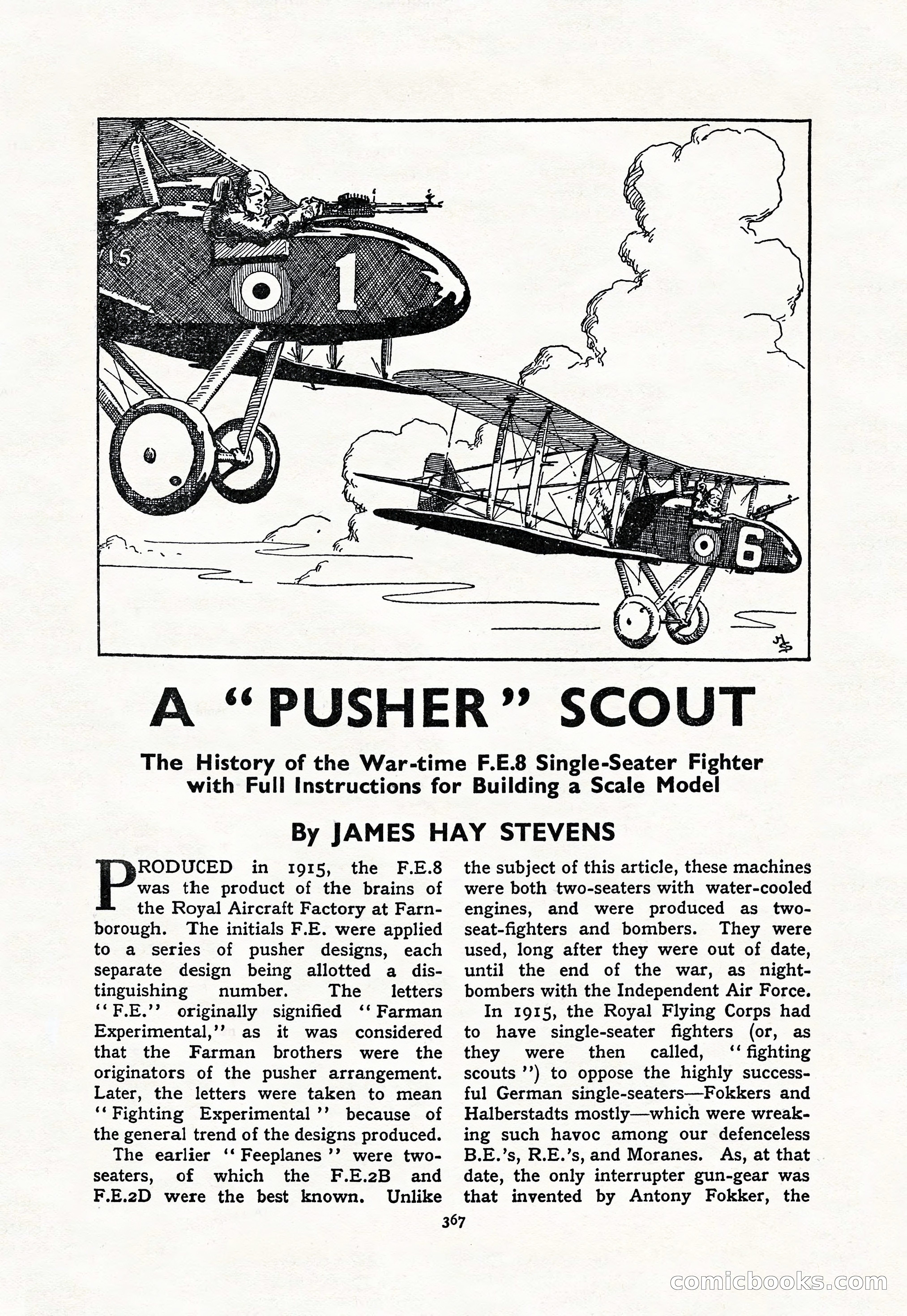
A restored page from Pulp Fiction, 1936. Page through the whole issue in the reader above.
📄 Transcribed text from this page (OCR, searchable)
Machine-transcribed from the original scan — historical spelling and the odd misread are preserved.
A “PUSHER” SCOUT The History of the War-time F.E.8 Single-Seater Fighter with Full Instructions for Building a Scale Model By JAMES HAY STEVENS RODUCED in tIo15, the F.E.8 was the product of the brains of the Royal Aircraft Factory at Farn- borough. The initials F.E. were applied to a series of pusher designs, each separate design being allotted a dis- tinguishing number. The letters ‘‘F.E.’’ originally signified ‘‘ Farman Experimental,’’ as it was considered that the Farman brothers were the originators of the pusher arrangement. Later, the letters were taken to mean ‘‘ Fighting Experimental ’’ because of the general trend of the designs produced. The earlier ‘‘ Feeplanes ’’ were two- seaters, of which the F.E.2B and F.E.2D were the best known. Unlike the subject of this article, these machines were both two-seaters with water-cooled engines, and were produced as _ two- seat-fighters and bombers. They were used, long after they were out of date, until the end of the war, as night- bombers with the Independent Air Force. In 1915, the Royal Flying Corps had to have single-seater fighters (or, as they were then called, ‘‘ fighting scouts ’’) to oppose the highly success- ful German single-seaters—Fokkers and Halberstadts mostly—which were wreak- ing such havoc among our defenceless B.E.’s, R.E.’s, and Moranes. As, at that date, the only interrupter gun-gear was that invented by Antony Fokker, the 367 GOMIGIOO cl SJ (C(O)