
Pulp Fiction, 1936 · page 80 of 98
Air Stories, April 1936 — page 80: what you’re looking at
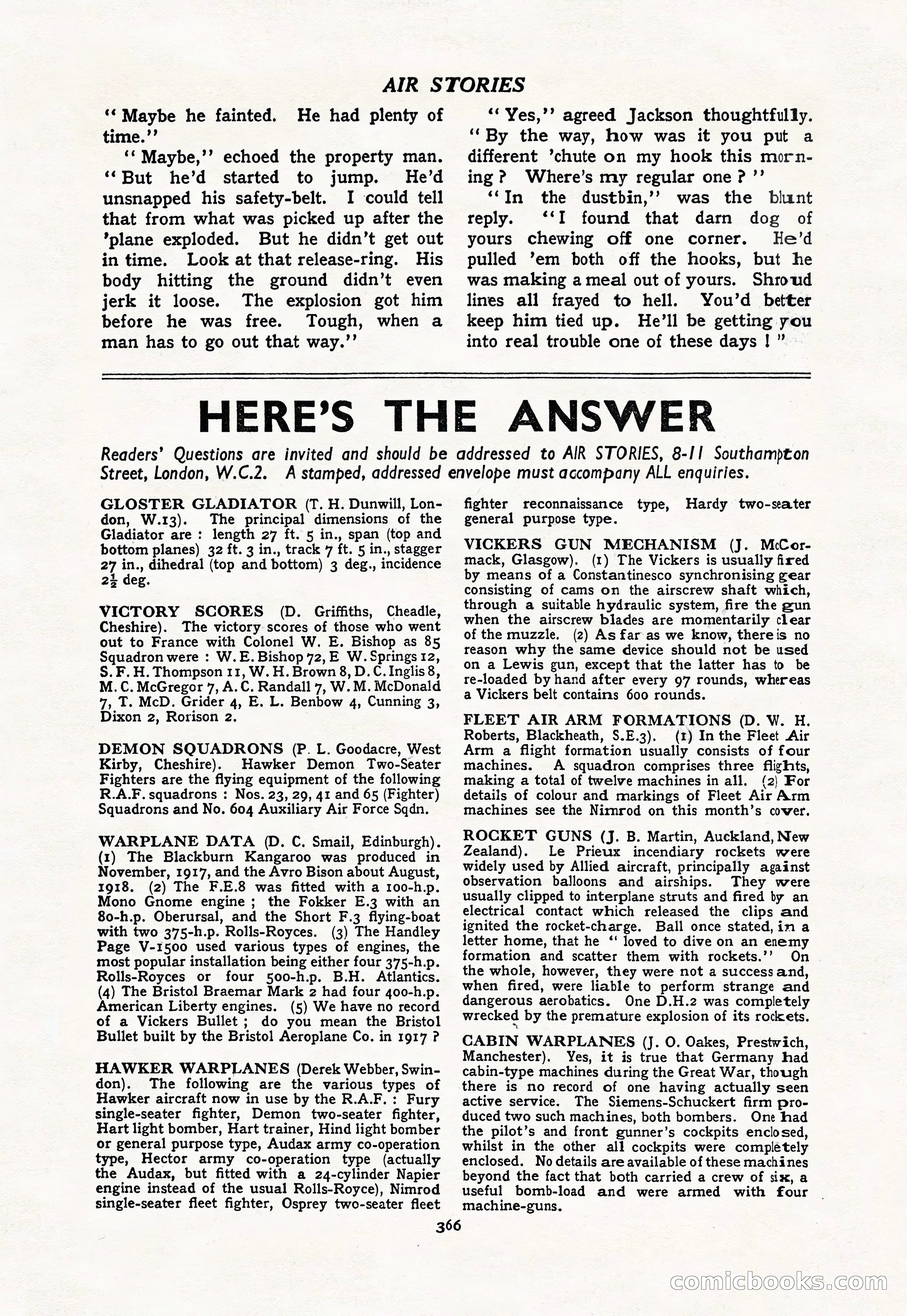
A restored page from Pulp Fiction, 1936. Page through the whole issue in the reader above.
📄 Transcribed text from this page (OCR, searchable)
Machine-transcribed from the original scan — historical spelling and the odd misread are preserved.
AIR STORIES ‘Maybe he fainted. He had plenty of time.’’ ‘* Maybe,’’ echoed the property man. ‘‘But he’d started to jump. He’d unsnapped his safety-belt. I could tell that from what was picked up after the ’plane exploded. But he didn’t get out in time. Look at that release-ring. His body hitting the ground didn’t even jerk it loose. The explosion got him before he was free. Tough, when a man has to go out that way.”’ ‘“Yes,’’ agreed Jackson thoughtfully. ‘‘By the way, how was it you put a different ’chute on my hook this morn- ing P Where’s my regular one P ’”’ ‘““In the dustbin,’?’ was the blunt reply. ‘‘I found that darn dog of yours chewing off one corner. He’d pulled ’em both off the hooks, but he was making a meal out of yours. Shroud lines all frayed to hell. You’d better keep him tied up. He’ll be getting you into real trouble one of these days ! ” HERE’S THE ANSWER Readers’ Questions are invited and should be addressed to AIR STORIES, 8-11 Southampton Street, London, W.C.2. A stamped, addressed envelope must accompany ALL enquiries. GLOSTER GLADIATOR (T. H. Dunwill, Lon- don, W.13). The principal dimensions of the Gladiator are: length 27 ft. 5 in., span (top and bottom planes) 32 ft. 3 in., track 7 ft. 5 in., stagger 27 in., dihedral (top and bottom) 3 deg., incidence 24 deg. VICTORY SCORES (D. Griffiths, Cheadle, Cheshire). The victory scores of those who went out to France with Colonel W. E. Bishop as 85 Squadron were : W.E. Bishop 72, E W. Springs 12, S.F.H. Thompson 11, W.H. Brown 8, D.C. Inglis 8, M.C. McGregor 7, A.C. Randall 7, W.M. McDonald 7, T. McD. Grider 4, E. L. Benbow 4, Cunning 3, Dixon 2, Rorison 2. DEMON SQUADRONS (P. L. Goodacre, West Kirby, Cheshire). Hawker Demon Two-Seater Fighters are the flying equipment of the following R.A.F. squadrons : Nos. 23, 29, 41 and 65 (Fighter) Squadrons and No. 604 Auxiliary Air Force Sqdn. WARPLANE DATA (D. C. Smail, Edinburgh). (1) The Blackburn Kangaroo was produced in November, 1917, and the Avro Bison about August, 1918. (2) The F.E.8 was fitted with a 100-h.p. Mono Gnome engine; the Fokker E.3 with an 80-h.p. Oberursal, and the Short F.3 flying-boat with two 375-h.p. Rolls-Royces. (3) The Handley Page V-1500 used various types of engines, the most popular installation being either four 375-h.p. Rolls-Royces or four 500-h.p. B.H. Atlantics. (4) The Bristol Braemar Mark 2 had four 4o00-h.p. American Liberty engines. (5) We have no record of a Vickers Bullet ; do you mean the Bristol Bullet built by the Bristol Aeroplane Co. in 1917 P HAWKER WARPLANES (Derek Webber, Swin- don). The following are the various types of Hawker aircraft now in use by the R.A.F.: Fury single-seater fighter, Demon two-seater fighter, Hart light bomber, Hart trainer, Hind light bomber or general purpose type, Audax army co-operation type, Hector army co-operation type (actually the Audax, but fitted with a 24-cylinder Napier engine instead of the usual Rolls-Royce), Nimrod single-seater fleet fighter, Osprey two-seater fleet 366 fighter reconnaissance type, Hardy two-seater general purpose type. VICKERS GUN MECHANISM (J. McCor- mack, Glasgow). (1) The Vickers is usually fired by means of a Constantinesco synchronising gear consisting of cams on the airscrew shaft which, through a suitable hydraulic system, fire the gun when the airscrew blades are momentarily clear of the muzzle. (2) As faras we know, thereis no reason why the same device should not be used on a Lewis gun, except that the latter has to be re-loaded by hand after every 97 rounds, whereas a Vickers belt contains 600 rounds. FLEET AIR ARM FORMATIONS (D. W. H. Roberts, Blackheath, $.E.3). (1) In the Fleet Air Arm a flight formation usually consists of four machines. A squadron comprises three flights, making a total of twelve machines in all. (2) For details of colour and markings of Fleet Air Arm machines see the Nimrod on this month’s cower. ROCKET GUNS (J. B. Martin, Auckland, New Zealand). Le Prieux incendiary rockets were widely used by Allied aircraft, principally against observation balloons and airships. They were usually clipped to interplane struts and fired by an electrical contact which released the clips and ignited the rocket-charge. Ball once stated,in a letter home, that he ‘‘ loved to dive on an enemy formation and scatter them with rockets.’’ On the whole, however, they were not a success and, when fired, were liable to perform strange and dangerous aerobatics. One D.H.2 was completely wrecked by the premature explosion of its rockets. CABIN WARPLANES (J. O. Oakes, Prestwich, Manchester). Yes, it is true that Germany had cabin-type machines during the Great War, though there is no record of one having actually seen active service. The Siemens-Schuckert firm pro- duced two such machines, both bombers. One had the pilot’s and front gunner’s cockpits enclosed, whilst in the other all cockpits were completely enclosed. No details are available of these machines beyond the fact that both carried a crew of six, a useful bomb-load and were armed with four machine-guns. GOMIGIOO SJ (Cl QO)