
Pulp Fiction, 1936 · page 82 of 98
Air Stories, April 1936 — page 82: what you’re looking at
A restored page from Pulp Fiction, 1936. Page through the whole issue in the reader above.
📄 Transcribed text from this page (OCR, searchable)
Machine-transcribed from the original scan — historical spelling and the odd misread are preserved.
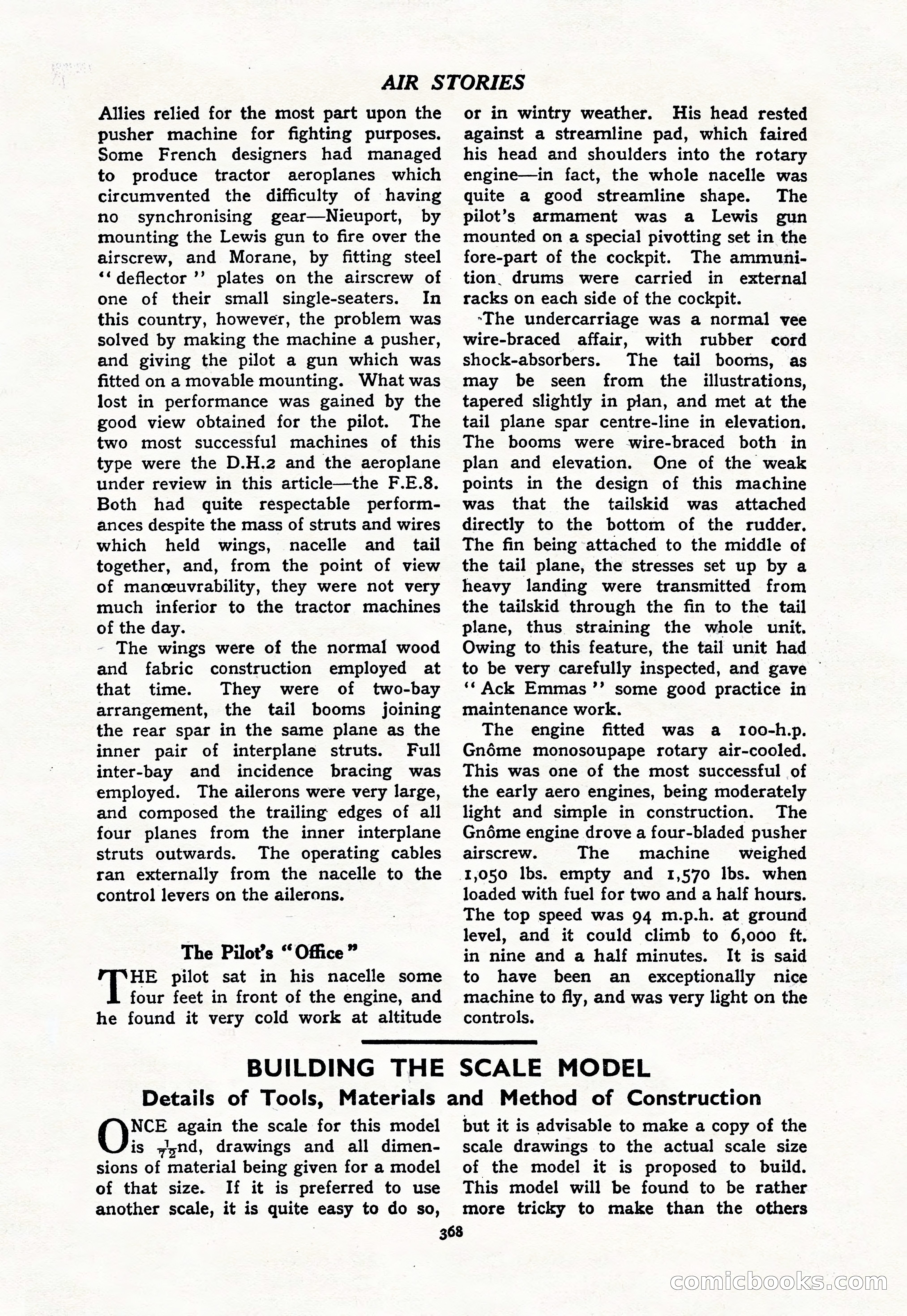
AIR STORIES Allies relied for the most part upon the pusher machine for fighting purposes. Some French designers had managed to produce tractor aeroplanes which circumvented the difficulty of having no synchronising gear—Nieuport, by mounting the Lewis gun to fire over the airscrew, and Morane, by fitting steel “‘ deflector ’’ plates on the airscrew of one of their small single-seaters. In this country, however, the problem was solved by making the machine a pusher, and giving the pilot a gun which was fitted on a movable mounting. What was lost in performance was gained by the good view obtained for the pilot. The two most successful machines of this type were the D.H.2 and the aeroplane under review in this article—the F.E.8. Both had quite respectable perform- ances despite the mass of struts and wires which held wings, nacelle and _ tail together, and, from the point of view of manceuvrability, they were not very much inferior to the tractor machines of the day. The wings were of the normal wood and fabric construction employed at that time. They were of two-bay arrangement, the tail booms joining the rear spar in the same plane as the inner pair of interplane struts. Full inter-bay and incidence bracing was employed. The ailerons were very large, and composed the trailing edges of all four planes from the inner interplane struts outwards. The operating cables ran externally from the nacelle to the control levers on the ailerons. The Pilot’s “ Office ” HE pilot sat in his nacelle some four feet in front of the engine, and he found it very cold work at altitude or in wintry weather. His head rested against a streamline pad, which faired his head and shoulders into the rotary engine—in fact, the whole nacelle was quite a good streamline shape. The pilot’s armament was a Lewis gun mounted on a special pivotting set in the fore-part of the cockpit. The ammuni- tion. drums were carried in external racks on each side of the cockpit. "The undercarriage was a normal vee wire-braced affair, with rubber cord shock-absorbers. The tail booms, as may be seen from the _ illustrations, tapered slightly in plan, and met at the tail plane spar centre-line in elevation. The booms were wire-braced both in plan and elevation. One of the weak points in the design of this machine was that the tailskid was attached directly to the bottom of the rudder. The fin being attached to the middle of the tail plane, the stresses set up by a heavy landing were transmitted from the tailskid through the fin to the tail plane, thus straining the whole unit. Owing to this feature, the tail unit had to be very carefully inspected, and gave ‘‘ Ack Emmas’’ some good practice in maintenance work. The engine fitted was a 100-h.p. Gnéme monosoupape rotary air-cooled. This was one of the most successful of the early aero engines, being moderately light and simple in construction. The Gnome engine drove a four-bladed pusher airscrew. The machine weighed 1,050 lbs. empty and 1,570 lbs. when loaded with fuel for two and a half hours. The top speed was 94 m.p.h. at ground level, and it could climb to 6,000 ft. in nine and a half minutes. It is said to have been an exceptionally nice machine to fly, and was very light on the controls. BUILDING THE SCALE MODEL Details of Tools, Materials and Method of Construction NCE again the scale for this model is znd, drawings and all dimen- sions of material being given for a model of that size. If it is preferred to use another scale, it is quite easy to do so, but it is advisable to make a copy of the scale drawings to the actual scale size of the model it is proposed to build. This model will be found to be rather more tricky to make than the others 368 ecomiclooolks (Cl Q)