
Pulp Fiction, 1936 · page 52 of 98
Air Stories, April 1936 — page 52: what you’re looking at
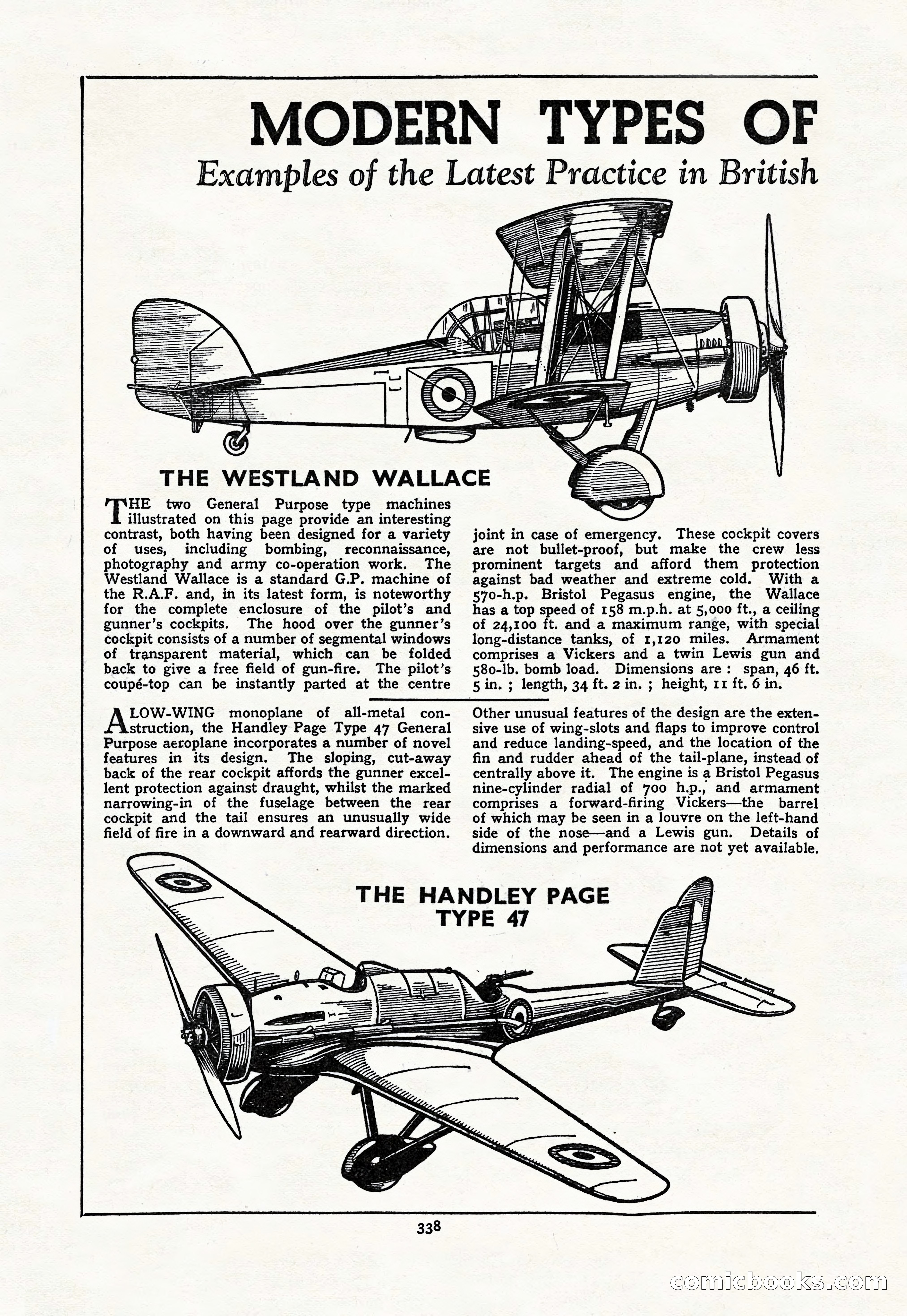
A restored page from Pulp Fiction, 1936. Page through the whole issue in the reader above.
📄 Transcribed text from this page (OCR, searchable)
Machine-transcribed from the original scan — historical spelling and the odd misread are preserved.
fhe two General Purpose type machines illustrated on this page provide an interesting contrast, both having been designed for a variety of uses, including bombing, reconnaissance, photography and army co-operation work. The Westland Wallace is a standard G.P. machine of the R.A.F. and, in its latest form, is noteworthy for the complete enclosure of the pilot’s and gunner’s cockpits. The hood over the gunner’s cockpit consists of a number of segmental windows of transparent material, which can be folded back to give a free field of gun-fire. The pilot’s coupé-top can be instantly parted at the centre LOW-WING monoplane of all-metal con- struction, the Handley Page Type 47 General Purpose aeroplane incorporates a number of novel features in its design. The sloping, cut-away back of the rear cockpit affords the gunner excel- lent protection against draught, whilst the marked narrowing-in of the fuselage between the rear cockpit and the tail ensures an unusually wide field of fire in a downward and rearward direction. THE WESTLAND WALLACE MODERN TYPES OF Examples of the Latest Prac tice in British ————— Nye joint in case of emergency. These cockpit covers are not bullet-proof, but make the crew less prominent targets and afford them protection against bad weather and extreme cold. With a 570-h.p. Bristol Pegasus engine, the Wallace has a top speed of 158 m.p.h. at 5,000 ft., a ceiling of 24,100 ft. and a maximum range, with special long-distance tanks, of 1,120 miles. Armament comprises a Vickers and a twin Lewis gun and 580-lb. bomb load. Dimensions are: span, 46 ft. 5in. ; length, 34 ft.2 in. ; height, 11 ft. 6 in. Other unusual features of the design are the exten- sive use of wing-slots and flaps to improve control and reduce landing-speed, and the location of the fin and rudder ahead of the tail-plane, instead of centrally above it. The engine is a Bristol Pegasus nine-cylinder radial of 700 h.p., and armament comprises a forward-firing Vickers—the barrel of which may be seen in a louvre on the left-hand side of the nose—and a Lewis gun. Details of dimensions and performance are not yet available. THE HANDLEY PAGE TYPE 47 338 JOO (S| QO) SJ (Cl Q)