
Pulp Fiction, 1936 · page 53 of 98
Air Stories, April 1936 — page 53: what you’re looking at
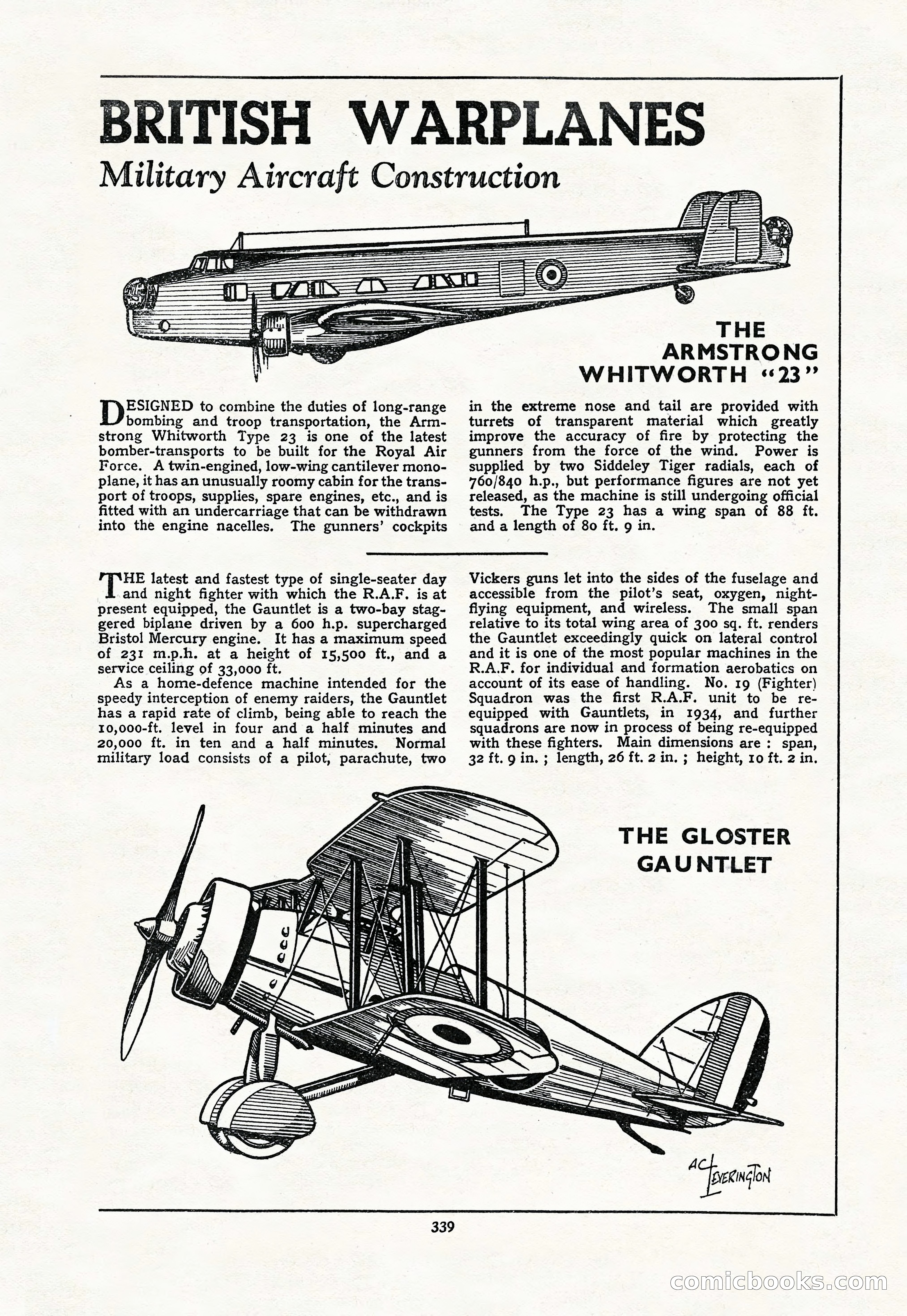
A restored page from Pulp Fiction, 1936. Page through the whole issue in the reader above.
📄 Transcribed text from this page (OCR, searchable)
Machine-transcribed from the original scan — historical spelling and the odd misread are preserved.
BRITISH WARPLANES Military Aircraft Construction | B pesaeees to combine the duties of long-range bombing and troop transportation, the Arm- strong Whitworth Type 23 is one of the latest bomber-transports to be built for the Royal Air Force. A twin-engined, low-wing cantilever mono- plane, it has an unusually roomy cabin for the trans- port of troops, supplies, spare engines, etc., and is fitted with an undercarriage that can be withdrawn into the engine nacelles. The gunners’ cockpits HE latest and fastest type of single-seater day and night fighter with which the R.A.F. is at present equipped, the Gauntlet is a two-bay stag- gered biplane driven by a 600 h.p. supercharged Bristol Mercury engine. It has a maximum speed of 231 m.p.h. at a height of 15,500 ft., and a service ceiling of 33,000 ft. As a home-defence machine intended for the speedy interception of enemy raiders, the Gauntlet has a rapid rate of climb, being able to reach the 10,000-ft. level in four and a half minutes and 20,000 ft. in ten and a half minutes. Normal military load consists of a pilot, parachute, two 339 ARMSTRONG WHITWORTH ¢23” in the extreme nose and tail are provided with turrets of transparent material which greatly improve the accuracy of fire by protecting the gunners from the force of the wind. Power is supplied by two Siddeley Tiger radials, each of 760/840 h.p., but performance figures are not yet released, as the machine is still undergoing official tests. The Type 23 has a wing span of 88 ft. and a length of 80 ft. 9 in. Vickers guns let into the sides of the fuselage and accessible from the pilot’s seat, oxygen, night- flying equipment, and wireless. The small span relative to its total wing area of 300 sq. ft. renders the Gauntlet exceedingly quick on lateral control and it is one of the most popular machines in the R.A.F. for individual and formation aerobatics on account of its ease of handling. No. 19 (Fighter) Squadron was the first R.A.F. unit to be re- equipped with Gauntlets, in 1934, and further squadrons are now in process of being re-equipped with these fighters. Main dimensions are: span, 32 ft.g in. ; length, 26 ft. 2 in. ; height, ro ft. 2 in. THE GLOSTER GAUNTLET “Sani DOOKS (Cl QO) (Cl QO)