
Pulp Fiction, 1936 · page 51 of 98
Air Stories, April 1936 — page 51: what you’re looking at
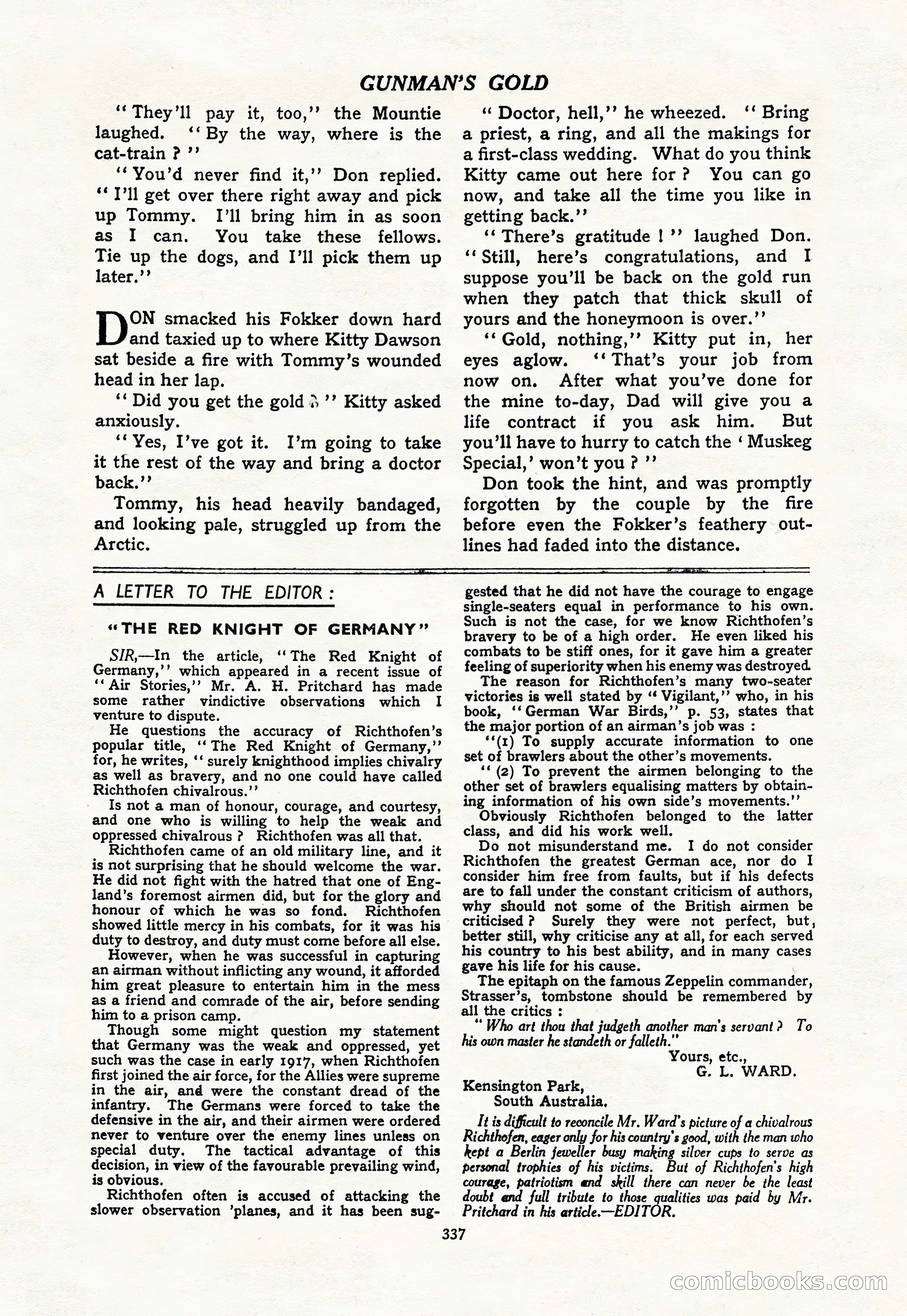
A restored page from Pulp Fiction, 1936. Page through the whole issue in the reader above.
📄 Transcribed text from this page (OCR, searchable)
Machine-transcribed from the original scan — historical spelling and the odd misread are preserved.
GUNMAN’S GOLD ‘*They’ll pay it, too,’? the Mountie laughed. ‘‘ By the way, where is the cat-train ? ”’ ““You’d never find it,’? Don replied. ‘I'll get over there right away and pick up Tommy. I'll bring him in as soon as I can. You take these fellows. Tie up the dogs, and I’ll pick them up later.’’ ON smacked his Fokker down hard and taxied up to where Kitty Dawson sat beside a fire with Tommy’s wounded head in her lap. ‘* Did you get the gold 3 ’’ Kitty asked anxiously. ‘* Yes, I’ve got it. I’m going to take it the rest of the way and bring a doctor back.”’ Tommy, his head heavily bandaged, and looking pale, struggled up from the Arctic. ‘¢ Doctor, hell,’’ he wheezed. ‘‘ Bring a priest, a ring, and all the makings for a first-class wedding. What do you think Kitty came out here for? You can go now, and take all the time you like in getting back.’’ ‘‘There’s gratitude !’’ laughed Don. ‘* Still, here’s congratulations, and I suppose you’ll be back on the gold run when they patch that thick skull of yours and the honeymoon is over.’’ ‘‘Gold, nothing,’’ Kitty put in, her eyes aglow. ‘‘ That’s your job from now on. After what you’ve done for the mine to-day, Dad will give you a life contract if you ask him. But you'll have to hurry to catch the ‘ Muskeg Special,’ won’t you ? ”’ Don took the hint, and was promptly forgotten by the couple by the fire before even the Fokker’s feathery out- lines had faded into the distance. ETS RTT TY SD SETS AAO LS AE ET LARA MS PEAS SCRE SLT RETR AOS STE AEST SO EE SES SSS A LETTER TO THE EDITOR: “THE RED KNIGHT OF GERMANY” SIR,—In the article, ‘‘The Red Knight of Germany,’’ which appeared in a recent issue of ‘‘ Air Stories,’’ Mr. A. H. Pritchard has made some rather vindictive observations which I venture to dispute. He questions the accuracy of Richthofen’s popular title, ‘‘The Red Knight of Germany,’’ for, he writes, ‘‘ surely knighthood implies chivalry as well as bravery, and no one could have called Richthofen chivalrous.’’ Is not a man of honour, courage, and courtesy, and one who is willing to help the weak and oppressed chivalrous ? Richthofen was all that. Richthofen came of an old military line, and it is not surprising that he should welcome the war. He did not fight with the hatred that one of Eng- land’s foremost airmen did, but for the glory and honour of which he was so fond. Richthofen showed little mercy in his combats, for it was his duty to destroy, and duty must come before all else. However, when he was successful in capturing an airman without inflicting any wound, it afforded him great pleasure to entertain him in the mess as a friend and comrade of the air, before sending him to a prison camp. Though some might question my statement that Germany was the weak and oppressed, yet such was the case in early 1917, when Richthofen first joined the air force, for the Allies were supreme in the air, and were the constant dread of the infantry. The Germans were forced to take the defensive in the air, and their airmen were ordered never to venture over the enemy lines unless on special duty. The tactical advantage of this decision, in view of the favourable prevailing wind, is obvious. Richthofen often is accused of attacking the slower observation ’planes, and it has been sug- gested that he did not have the courage to engage single-seaters equal in performance to his own. Such is not the case, for we know Richthofen’s bravery to be of a high order. He even liked his combats to be stiff ones, for it gave him a greater feeling of superiority when his enemy was destroyed. The reason for Richthofen’s many two-seater victories is well stated by ‘‘ Vigilant,’’ who, in his book, ‘‘German War Birds,’’ p. 53, states that the major portion of an airman’s job was : ‘*(r1) To supply accurate information to one set of brawlers about the other’s movements. ‘‘ (2) To prevent the airmen belonging to the other set of brawlers equalising matters by obtain- ing information of his own side’s movements.’’ Obviously Richthofen belonged to the latter class, and did his work well. Do not misunderstand me. I do not consider Richthofen the greatest German ace, nor do I consider him free from faults, but if his defects are to fall under the constant criticism of authors, why should not some of the British airmen be criticised ? Surely they were not perfect, but, better still, why criticise any at all, for each served his country to his best ability, and in many cases gave his life for his cause. The epitaph on the famous Zeppelin commander, Strasser’s, tombstone should be remembered by all the critics : ** Who art thou that judgeth another man’s servant? To his own master he standeth or falleth.” Yours, etc., G. L. WARD. Kensington Park, South Australia, It is difficult to reconcile Mr. Ward’s picture of a chivalrous Richthofen, eager only for his country’s good, with the man who kept a Berlin jeweller busy making siloer cups to serve as personal trophies of his victims. But of Richthofen’s high courage, patriotism and skill there can never be the least doubt and full tribute to those qualities was paid by Mr. Pritchard in his article—EDI TOR. 337 GOMIGIOO SJ (Cl Q)