
Pulp Fiction, 1926 · page 168 of 212
Adventure Magazine Cover — page 168: what you’re looking at
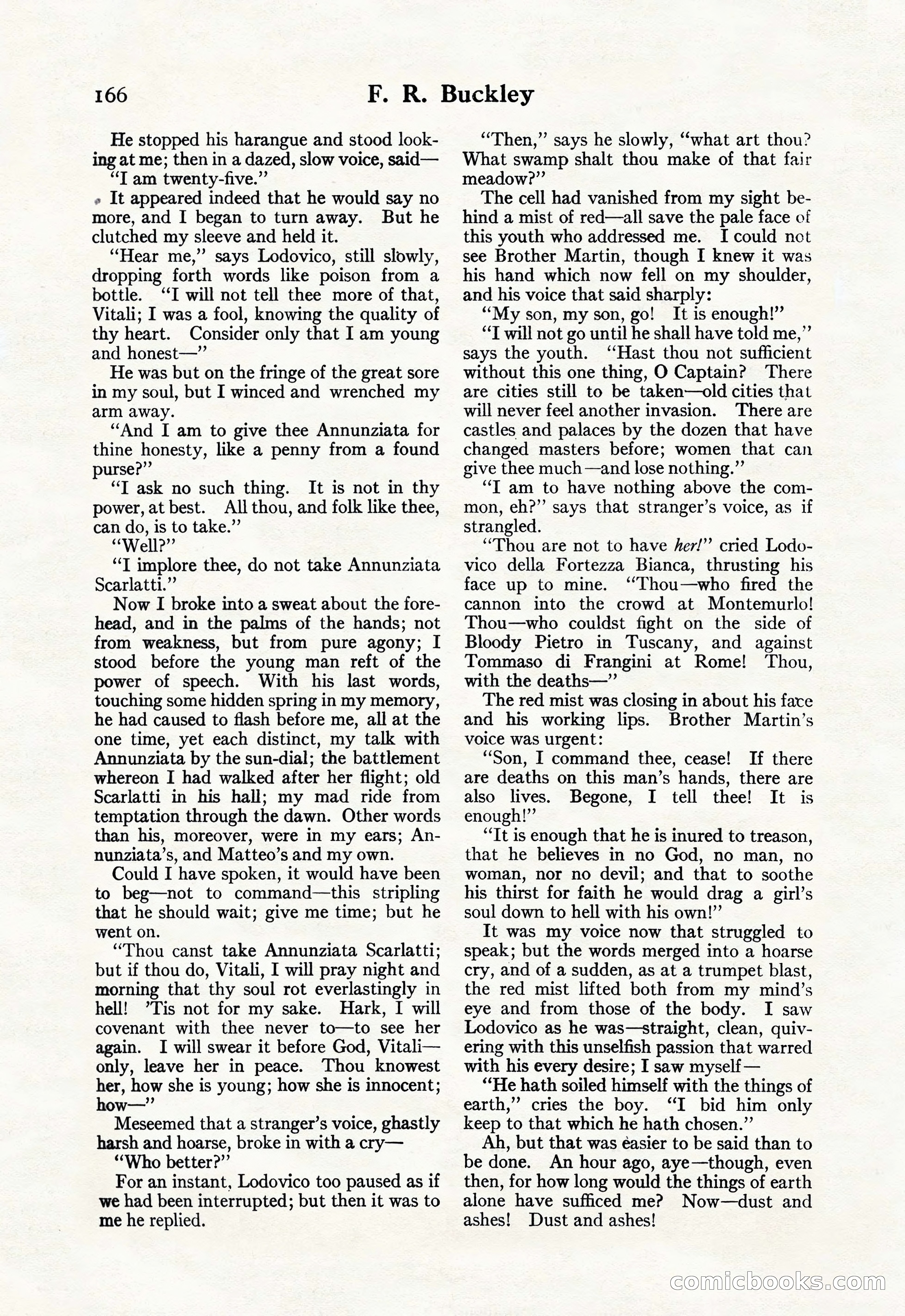
A restored page from Pulp Fiction, 1926. Page through the whole issue in the reader above.
📄 Transcribed text from this page (OCR, searchable)
Machine-transcribed from the original scan — historical spelling and the odd misread are preserved.
166 He stopped his harangue and stood look- ing at me; then in a dazed, slow voice, said— “T am twenty-five.”’ » It appeared indeed that he would say no more, and I began to turn away. But he clutched my sleeve and held it. “Hear me,” says Lodovico, still slowly, dropping forth words like poison from a bottle. ‘I will not tell thee more of that, Vitali; I was a fool, knowing the quality of thy heart. Consider only that I am young and honest—’” He was but on the fringe of the great sore in my soul, but I winced and wrenched my arm away. “And I am to give thee Annunziata for thine honesty, like a penny from a found purse?” “T ask no such thing. It is not in thy power, at best. All thou, and folk like thee, can do, is to take.” “Well?’’ “T implore thee, do not take Annunziata Scarlatti.” Now I broke into a sweat about the fore- head, and in the palms of the hands; not from weakness, but from pure agony; I stood before the young man reft of the power of speech. With his last words, touching some hidden spring in my memory, he had caused to flash before me, all at the one time, yet each distinct, my talk with Annunziata by the sun-dial; the battlement whereon I had walked after her flight; old Scarlatti in his hall; my mad ride from temptation through the dawn. Other words than his, moreover, were in my ears; An- nunziata’s, and Matteo’s and my own. Could I have spoken, it would have been to beg—not to command—this stripling that he should wait; give me time; but he went on. “Thou canst take Annunziata Scarlatti; but if thou do, Vitali, I will pray night and morning that thy soul rot everlastingly in hell! ’Tis not for my sake. Hark, I will covenant with thee never to—to see her again. I will swear it before God, Vitali— only, leave her in peace. Thou knowest her, how she is young; how she is innocent; how—” Meseemed that a stranger’s voice, ghastly harsh and hoarse, broke in with a cry— ‘‘Who better?”’ For an instant, Lodovico too paused as if we had been interrupted; but then it was to me he replied. F. R. Buckley “Then,” says he slowly, “what art thou? What swamp shalt thou make of that fair meadow?” The cell had vanished from my sight be- hind a mist of red—all save the pale face of this youth who addressed me. I could nct see Brother Martin, though I knew it was his hand which now fell on my shoulder, and his voice that said sharply: “My son, my son, go! It is enough “T will not go until he shall have told me,”’ says the youth. “Hast thou not sufficient without this one thing, O Captain? There are cities still to be taken—old cities that will never feel another invasion. There are castles and palaces by the dozen that have changed masters before; women that can give thee much —and lose nothing.” “T am to have nothing above the com- mon, eh?” says that stranger’s voice, as if strangled. “Thou are not to have her!” cried Lodo- vico della Fortezza Bianca, thrusting his face up to mine. “Thou—who fired the cannon into the crowd at Montemurlo! Thou—who couldst fight on the side of Bloody Pietro in Tuscany, and against Tommaso di Frangini at Rome! Thou, with the deaths—”’ The red mist was closing in about his face and his working lips. Brother Martin’s voice was urgent: ‘Son, I command thee, cease! If there are deaths on this man’s hands, there are also lives. Begone, I tell thee! It is enough!” ‘Tt is enough that he is inured to treason, that he believes in no God, no man, no woman, nor no devil; and that to soothe his thirst for faith he would drag a girl’s soul down to hell with his own!” It was my voice now that struggled to speak; but the words merged into a hoarse cry, and of a sudden, as at a trumpet blast, the red mist lifted both from my mind’s eye and from those of the body. I saw Lodovico as he was—straight, clean, quiv- ering with this unselfish passion that warred with his every desire; I saw myself — “He hath soiled himself with the things of earth,” cries the boy. “I bid him only keep to that which he hath chosen.”’ Ah, but that was éasier to be said than to be done. An hour ago, aye—though, even then, for how long would the things of earth alone have sufficed me? Now—dust and ashes! Dust and ashes! |? comicbook CO