
Pulp Fiction, 1926 · page 169 of 212
Adventure Magazine Cover — page 169: what you’re looking at
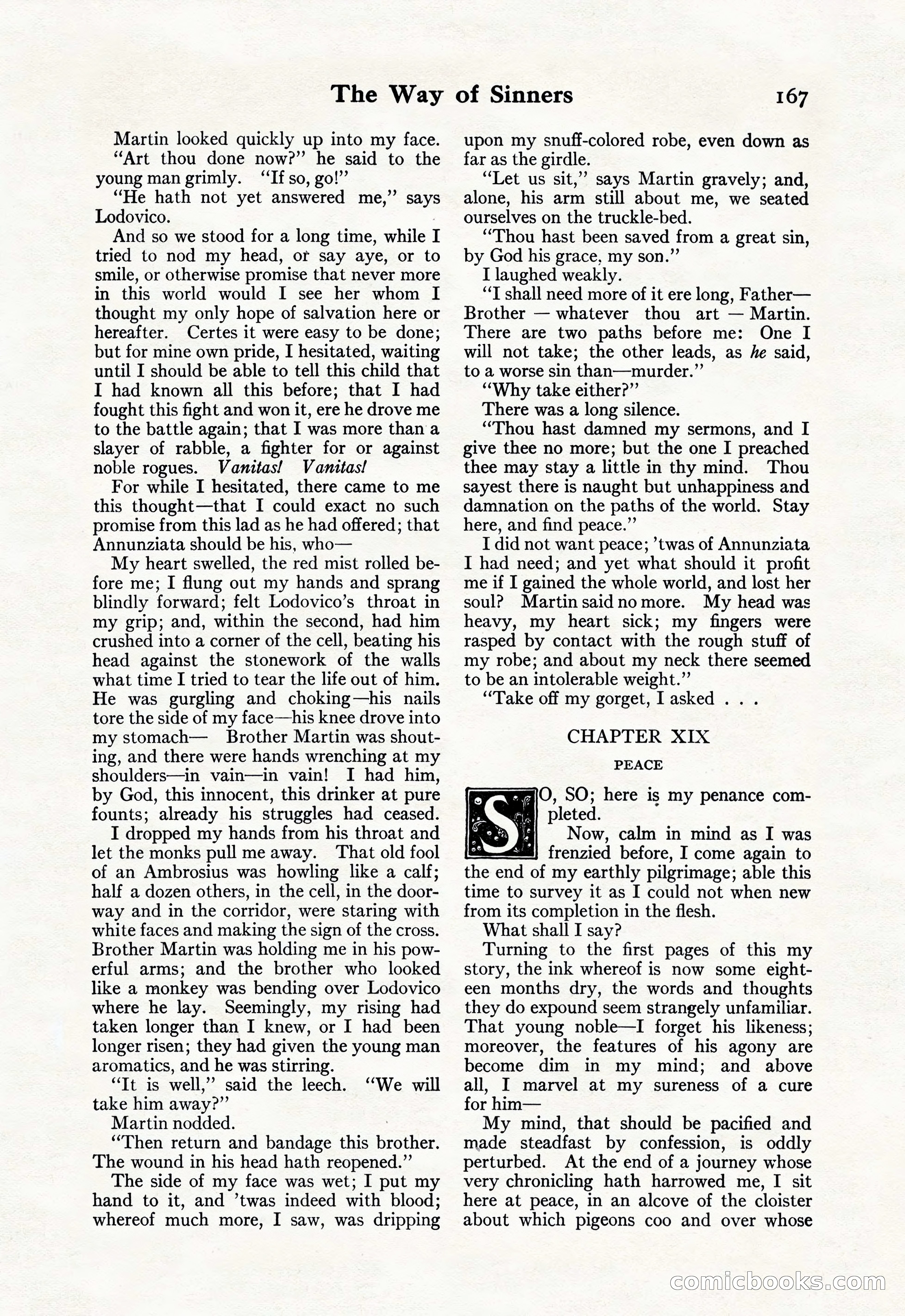
A restored page from Pulp Fiction, 1926. Page through the whole issue in the reader above.
📄 Transcribed text from this page (OCR, searchable)
Machine-transcribed from the original scan — historical spelling and the odd misread are preserved.
The Way of Sinners Martin looked quickly up into my face. “Art thou done now?” he said to the young man grimly. “If so, go!” “He hath not yet answered me,” Lodovico. And so we stood for a long time, while I tried to nod my head, or say aye, or to smile, or otherwise promise that never more in this world would I see her whom I thought my only hope of salvation here or hereafter. Certes it were easy to be done; but for mine own pride, I hesitated, waiting until I should be able to tell this child that I had known all this before; that I had fought this fight and won it, ere he drove me to the battle again; that I was more than a slayer of rabble, a fighter for or against noble rogues. Vamnitas! Vanitas! For while I hesitated, there came to me this thought—that I could exact no such promise from this lad as he had offered; that Annunziata should be his, who— My heart swelled, the red mist rolled be- fore me; I flung out my hands and sprang blindly forward; felt Lodovico’s throat in my grip; and, within the second, had him crushed into a corner of the cell, beating his head against the stonework of the walls what time I tried to tear the life out of him. He was gurgling and choking—his nails tore the side of my face—his knee drove into my stomach— Brother Martin was shout- ing, and there were hands wrenching at my shoulders—in vain—in vain! I had him, by God, this innocent, this drinker at pure founts; already his struggles had ceased. I dropped my hands from his throat and let the monks pull me away. That old fool of an Ambrosius was howling like a calf; half a dozen others, in the cell, in the door- way and in the corridor, were staring with white faces and making the sign of the cross. Brother Martin was holding me in his pow- erful arms; and the brother who looked like a monkey was bending over Lodovico where he lay. Seemingly, my rising had taken longer than I knew, or I had been longer risen; they had given the young man aromatics, and he was stirring. “Tt is well,” said the leech. take him away?” Martin nodded. . “Then return and bandage this brother. The wound in his head hath reopened.”’ The side of my face was wet; I put my hand to it, and ’twas indeed with blood; whereof much more, I saw, was dripping Says “We will 167 upon my snuff-colored robe, even down as far as the girdle. “Let us sit,” says Martin gravely; and, alone, his arm still about me, we seated ourselves on the truckle-bed. ‘Thou hast been saved from a great sin, by God his grace, my son.” I laughed weakly. “T shall need more of it ere long, Father— Brother — whatever thou art — Martin. There are two paths before me: One I will not take; the other leads, as he said, to a worse sin than—murder.”’ “Why take either?”’ There was a long silence. “Thou hast damned my sermons, and I give thee no more; but the one I preached thee may stay a little in thy mind. Thou sayest there is naught but unhappiness and damnation on the paths of the world. Stay here, and find peace.”’ I did not want peace; ’twas of Annunziata I had need; and yet what should it profit me if I gained the whole world, and lost her soul? Martinsaidnomore. My head was heavy, my heart sick; my fingers were rasped by contact with the rough stuff of my robe; and about my neck there seemed to be an intolerable weight.” “‘Take off my gorget, [asked ... CHAPTER XIX PEACE 4 O, SO; here is my penance com- pleted. Now, calm in mind as I was $ mi} frenzied before, I come again to the end of my earthly pilgrimage; able this time to survey it as I could not when new from its completion in the flesh. What shall I say? Turning to the first pages of this my story, the ink whereof is now some eight- een months dry, the words and thoughts they do expound seem strangely unfamiliar. That young noble—I forget his likeness; moreover, the features of his agony are become dim in my mind; and above all, I marvel at my sureness of a cure for him— My mind, that should be pacified and made steadfast by confession, is oddly perturbed. At the end of a journey whose very chronicling hath harrowed me, I sit here at peace, in an alcove of the cloister about which pigeons coo and over whose comiclbooks CO