
Pulp Fiction, 1926 · page 167 of 212
Adventure Magazine Cover — page 167: what you’re looking at
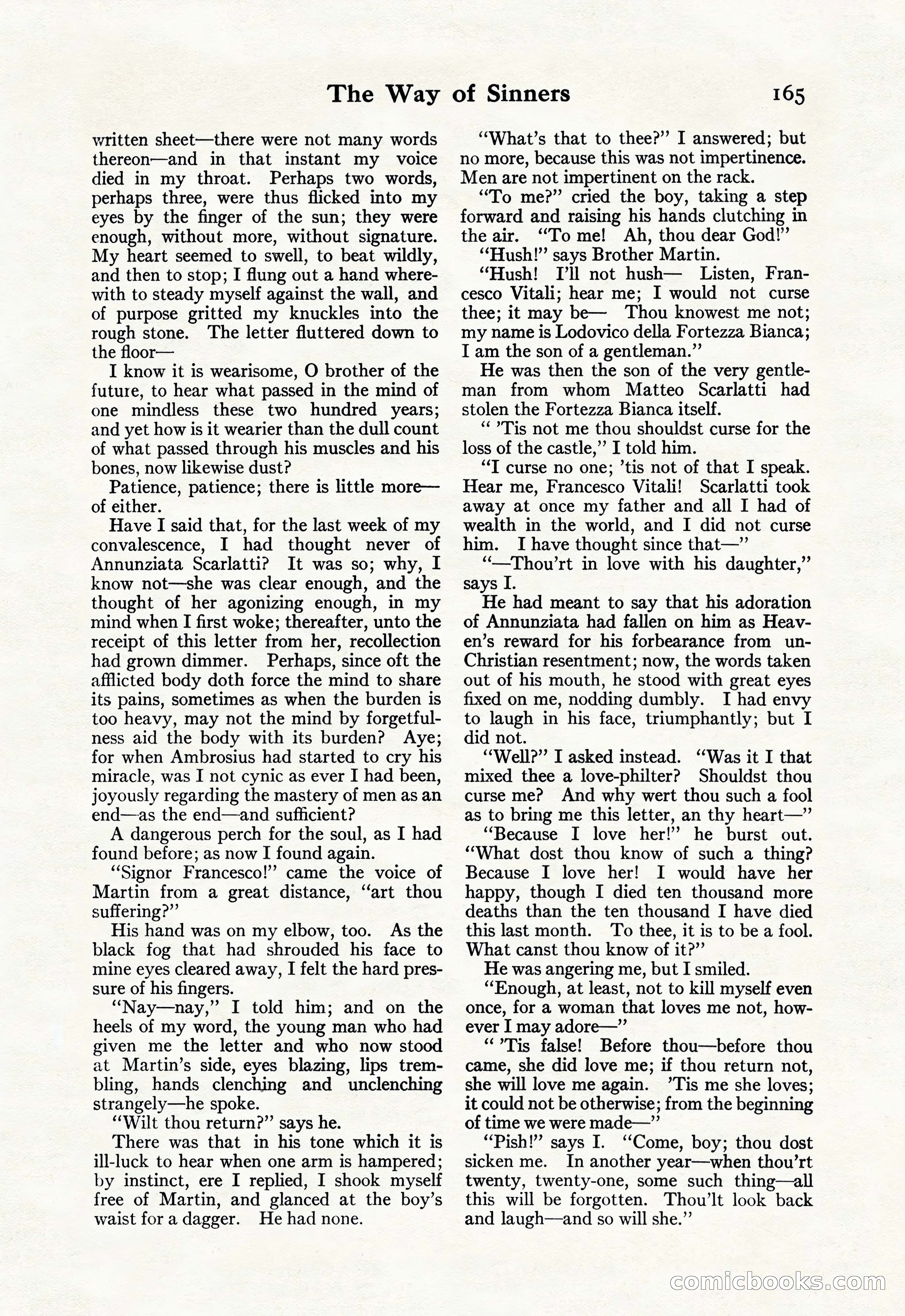
A restored page from Pulp Fiction, 1926. Page through the whole issue in the reader above.
📄 Transcribed text from this page (OCR, searchable)
Machine-transcribed from the original scan — historical spelling and the odd misread are preserved.
The Way written sheet—there were not many words thereon—and in that instant my voice died in my throat. Perhaps two words, perhaps three, were thus flicked into my eyes by the finger of the sun; they were enough, without more, without signature. My heart seemed to swell, to beat wildly, and then to stop; I flung out a hand where- with to steady myself against the wall, and of purpose gritted my knuckles into the rough stone. The letter fluttered down to the floor— I know it is wearisome, O brother of the future, to hear what passed in the mind of one mindless these two hundred years; and yet how is it wearier than the dull count of what passed through his muscles and his bones, now likewise dust? Patience, patience; there is little more— of either. Have I said that, for the last week of my convalescence, I had thought never of Annunziata Scarlatti? It was so; why, I know not—she was clear enough, and the thought of her agonizing enough, in my mind when I first woke; thereafter, unto the receipt of this letter from her, recollection had grown dimmer. Perhaps, since oft the afflicted body doth force the mind to share its pains, sometimes as when the burden is too heavy, may not the mind by forgetful- ness aid the body with its burden? Aye; for when Ambrosius had started to cry his miracle, was I not cynic as ever I had been, joyously regarding the mastery of men as an end—as the end—and sufficient? A dangerous perch for the soul, as I had found before; as now I found again. “Signor Francesco!” came the voice of Martin from a great distance, ‘“‘art thou suffering?” His hand was on my elbow, too. As the black fog that had shrouded his face to mine eyes cleared away, I felt the hard pres- sure of his fingers. “‘Nay—nay,” I told him; and on the heels of my word, the young man who had given me the letter and who now stood at Martin’s side, eyes blazing, lips trem- bling, hands clenching and _ unclenching strangely—he spoke. “Wilt thou return?” says he. There was that in his tone which it is ill-luck to hear when one arm is hampered; by instinct, ere I replied, I shook myself free of Martin, and glanced at the boy’s waist fora dagger. He had none. of Sinners 165 ‘“‘What’s that to thee?” I answered; but no more, because this was not impertinence. Men are not impertinent on the rack. “To me?” cried the boy, taking a step forward and raising his hands clutching in the air. “To me! Ah, thou dear God!’ ‘“‘Hush!”’ says Brother Martin. “Hush! Tl not hush— Listen, Fran- cesco Vitali; hear me; I would not curse thee; it may be— Thou knowest me not; my name is Lodovico della Fortezza Bianca; I am the son of a gentleman.” He was then the son of the very gentle- man from whom Matteo Scarlatti had stolen the Fortezza Bianca itself. ‘“‘*Tis not me thou shouldst curse for the loss of the castle,’ I told him. “T curse no one; ’tis not of that I speak. Hear me, Francesco Vitali! Scarlatti took away at once my father and all I had of wealth in the world, and I did not curse him. I have thought since that—”’ ‘“—Thou’rt in love with his daughter,” says I. He had meant to say that his adoration of Annunziata had fallen on him as Heav- en’s reward for his forbearance from un- Christian resentment; now, the words taken out of his mouth, he stood with great eyes fixed on me, nodding dumbly. I had envy to laugh in his face, triumphantly; but I did not. “Well?” I asked instead. ‘“‘Was it I that mixed thee a love-philter? Shouldst thou curse me? And why wert thou such a fool as to bring me this letter, an thy heart—”’ ““Because I love her!’ he burst out. “What dost thou know of such a thing? Because I love her! I would have her happy, though I died ten thousand more deaths than the ten thousand I have died this last month. To thee, it is to be a fool. What canst thou know of it?” He was angering me, but I smiled. “Enough, at least, not to kill myself even once, for a woman that loves me not, how- ever I may adore—” “°Tis false! Before thou—before thou came, she did love me; if thou return not, she will love me again. ’Tis me she loves; it could not be otherwise; from the beginning of time we were made—”’ “Pish!” says I. “Come, boy; thou dost sicken me. In another year—when thou’rt twenty, twenty-one, some such thing—all this will be forgotten. Thou’lt look back and laugh—and so will she.” comicloolk CO